

A Guide For When (And When Not) To Air Down Your Tires
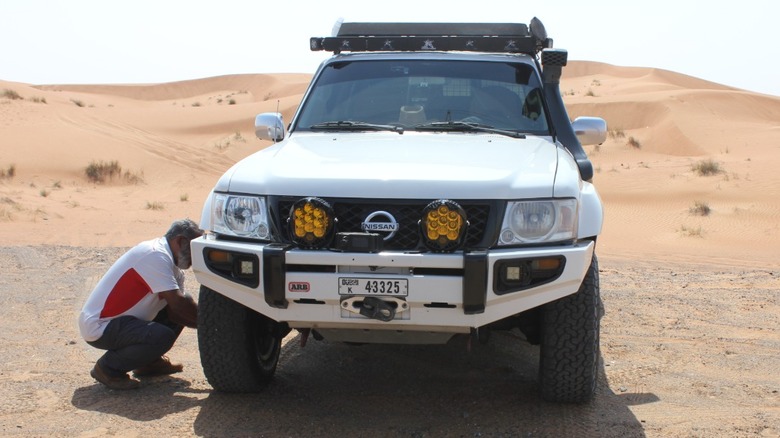
Off-roading can be a lot of fun, until you get stuck. That's not hard to do when you've hit a sandy or muddy trail. If you're an experienced off-roader, you likely know that taking some air out of your tires can go a long way towards preventing you from getting stuck in that kind of terrain. If you weren't aware of it, you may find that you won't be reaching for those recovery boards as much once you start airing down. Of course, we're talking about sandy beaches or muddy trails, not maintained gravel roads that are common in country neighborhoods.
Drag racers often air down, as well. This helps them with traction, which is important when you're jumping out of the gate. Of course, there are special tires for drag racing, and these are built with low air pressure in mind. Running long distances without being properly inflated can ruin a regular tire and pose a serious safety risk.
That's just one of the reasons why you wouldn't want to drive on the street with tires that have been aired down. That would be dangerous for multiple reasons. So check on the door jamb or your owner's manual for the recommended PSI, and keep your tires inflated to that number. However, you should not inflate the tire to the maximum PSI number printed on the side of the tire.
When to air down your tires
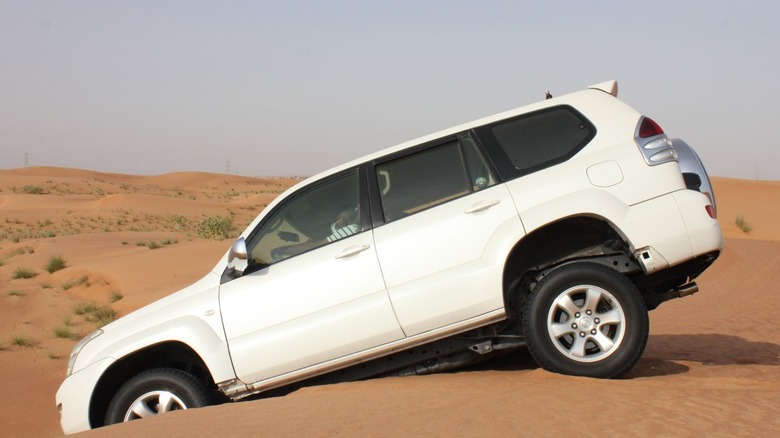
There are times when a tire with less air provides more traction. This is especially true on off-road sandy trails. Imagine you're at the beach and you want to press your fingers down into sand. It's not too hard, right? You point your fingers down and push. You might be able to press the entire length of your fingers down in one swoop. Now, imagine flattening your hand and trying to press it down into the sand, open palm first. Not so easy, is it? The same principle applies with your tires on unmaintained sandy or muddy roads — the wider the contact surface, the less likely the tire will be to dig a rut into the dirt. Still, you don't want to go lower than 12 PSI for a sandy trail, 18 PSI for mud, 20 PSI for snow, and 25 PSI for an unmaintained gravel road.
Like we said, drag racing is another scenario where some will lower the pressure in their tires for better traction. How much pressure to let out depends, among other factors, on whether you're running on drag slicks or radials. Slicks are built with soft sidewalls and are designed to run on 4 to 12 PSI. You would normally use low pressure on the rears and high pressure on the front wheels. Drag radials have stiff sidewalls, and should be deflated cautiously.
When not to air down your tires
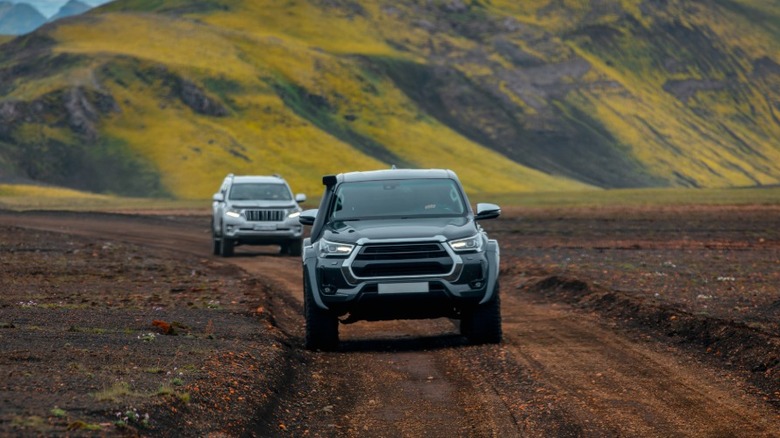
When should you not air down your tires? Basically, whenever you're on a paved road or street. Underinflated tires can come off the rim, mess up the car's handling, cause a blowout, or otherwise pose a hazard. So if you took some air out to go off-roading, remember to re-inflate your tires after coming off the trail. That's why you shouldn't take any air out of your tires unless you're packing a portable air compressor in your car. Besides, what if you take too much air out of one of your tires? You'll need to re-inflate it somehow.
Also, you don't need to air down your tires if you're just going a few miles on a dirt road, especially if it's well-packed or well-maintained. Folks who live in the country travel gravel roads all the time without airing down their tires or giving any more thought to tire pressure than people who live in the city.
If you do have to air down your tires often, consider getting some beadlock tires. The difference between beadlock tires and regular tires is that beadlocks are designed to lock one or both of the tire beads to the rim. Regular tires don't do this and rely on air pressure to hold the tire on the rim.