

The Clever Engineering Of Shipping The Chevy Vega By Train
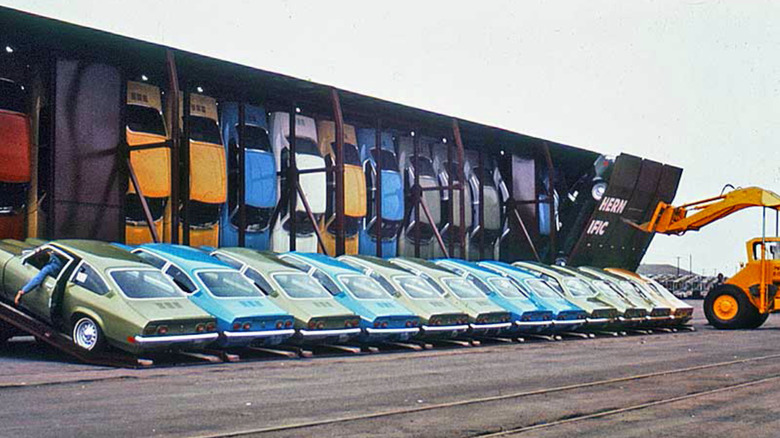
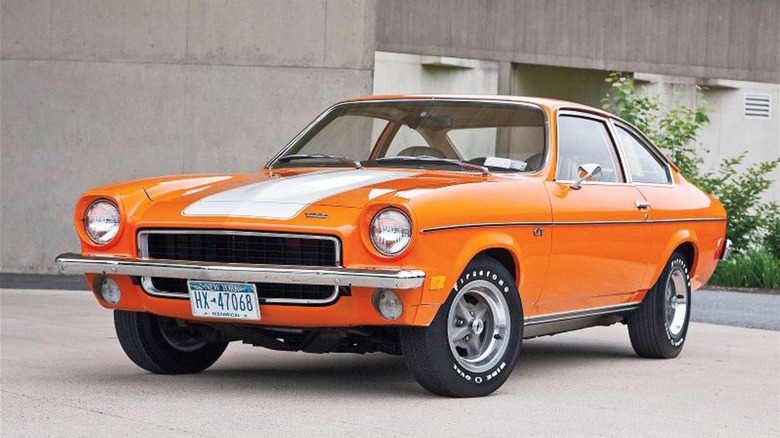
On paper, the Chevrolet Vega — unrelated to the $185,000 1958 Facel Vega Excellence — sure seemed like it was going to reinvent both General Motors and the American auto industry as a whole when it debuted in 1971. After all, nearly everything about the car, from its engineering to its assembly plant, was put under a microscope and finely tuned with a single aim in mind: creating the top compact in the world, besting not only small-car rivals from Volkswagen and Toyota, but also Ford's fresh compact of the era, the Pinto. Needless to say, none of that happened. Instead, the Vega — despite being named MotorTrend's 1971 Car of the Year — was rushed into production and quickly earned a reputation as one of the worst cars to ever come out of Detroit. But Chevy sure found a cool way of shipping these machines, and, more importantly, it was cheaper than traditional methods.
You see, the Vega wasn't just supposed to be good; it was supposed to be inexpensive, too. In fact, Chevy planned on keeping the Vega's costs down to $1 per pound, and the division got fairly close. The '71 Vega sedan had a base curb weight of 2,249 pounds and an MSRP of $2,250.
Yet it could cost approximately $300 per car to ship the Vegas to Chevy's distant U.S. customers – even with the ability to fit 18 compact Vegas in a railcar typically able to handle only 15 bigger automobiles. Enter the Vert-A-Pac system, which could almost double the number of Vegas that would fit in a railcar, to up to 30 units, by placing them nose down. The innovation cut shipping costs by roughly 40% per Vega.
Reaching the Vega's vertical limit
Honestly, looking back from 55 years into the future, it's hard to see exactly how GM saved money here. The automaker first had to partner with the Southern Pacific railroad to develop the railcars, which featured individual vertical, bottom-hinged doors/ramps for each car being loaded. Each individual railcar could fit two rows of 15 vertically oriented Vegas, with the cars being loaded from both sides of the tracks. Those doors also gave the Vert-A-Pac another key benefit over the horizontally loaded railcars. As remains the case today for some cars and trucks, vehicles would be transported open to the elements and readily available to thieves and vandals. When you closed the ramps/doors on the Vert-A-Pac railcars, however, they turned into protective walls.
Nor could Chevrolet simply tip the Vegas over onto their front ends without some modifications. Otherwise, their various fluids would be at risk of simply pouring out as soon as the vehicles were tipped over. For instance, when the Vega was turned nose down, a traditional battery could leak acid, which meant engineers had to relocate the filler caps. There was also the chance that oil could get into one of the cylinders, and this required the installation of a special baffle. It was the same story with the tanks for the windshield-washer fluid, so those had to be repositioned as well, and even the carburetor came in for some mods. Remember, 1994 was the last year carbureted engines sold new in America.
When the Vega met its end, though, so did the Vert-A-Pac system — which had been designed specifically for the Vega and its corporate cousin. That would be the Pontiac Astre, a car that may be best known to Jalopniks for having the funniest equipment-package name ever.