

This Is The Essential Tool Every Hybrid And EV Auto Mechanic Needs

No, it's not the 10mm socket, nor the simple gadget that can keep you from losing one. Both could no doubt come in handy for just about any wrenching task, but the uniquely electric nature of electrified cars — from hybrids to full EVs — naturally requires some special tools, too, including the multimeter. As the name suggests, it's a meter that can take multiple different measurements from an electrical circuit. In fact, it was invented by British engineer Donald Macadie in 1920 because he was fed up with having to carry individual meters for individual tests.
Also a handy tool when working on gas- or diesel-only vehicles — which do have plenty of electric features of their own — a multimeter is generally used to analyze a circuit's voltage, current, and resistance. The tool itself looks roughly like an OBD2 scanner, as it features a handheld device with readouts and controls plus connectors to the vehicle. But while you plug an OBD scanner into a special port to access a vehicle's ECU, a multimeter has two leads (one positive and one negative) that you connect to points of the electrical circuit.
As a very basic example, think of a typical, non-hybrid car battery. Checking the voltage is as simple as touching the multimeter's connectors to the appropriate battery terminals — negative to negative and positive to positive. The multimeter can then measure and display the circuit's voltage, letting you know if the battery is still good to go. Be aware, however, that the higher voltages found in EV/hybrid batteries mean you'll need a multimeter specifically engineered for those applications.
Why are multimeters so important when working on hybrids and EVs?
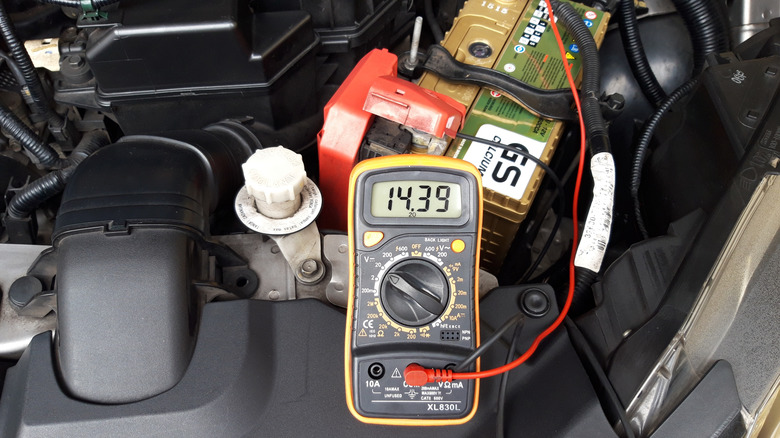
Having a multimeter around when working on EVs and hybrids can be a matter of life and death. Anything up to about 50 volts is usually thought of as safe, but as the voltage rises, so do your risks. Some safety mavens consider the cutoff mark for "high voltage" to be as low as 100 volts – a 120-volt circuit, typical in households, is enough to cause serious burns. But hybrid battery systems can produce up to 650 volts. As for EVs, many are moving from 400-volt architectures — already dangerous enough — to 800-volt setups like the one found in Volvo's first 800-volt EV, the ES90 sedan.
One of the first steps in conventional wrenching on an electrified vehicle is making sure that the high-voltage system is disabled. This is something that is easily verified with a multimeter. Note that you shouldn't use just any multimeter with high-voltage vehicles. You should have one that can handle at least 1,000 volts and falls under CAT III or CAT IV guidelines. (The CAT business refers to a set of international rules for electrical testing equipment aimed at measuring how well they hold up to sudden electrical surges before failing.) Don't forget the right leads, either, as these should meet the 1,000-volt and CAT III/IV standards, and also have at least one insulated attachment clip.
If the right kind of multimeter is tool No. 1 for EVs and hybrids, properly insulated gloves, again with the ability to withstand 1,000 volts, have to be rated as 1-A. You don't want to fuss with all that voltage without them. Plus, it's always a good idea to wear leather glove protectors over the gloves for an extra layer of safety.
Other common multimeter uses with electrified vehicles
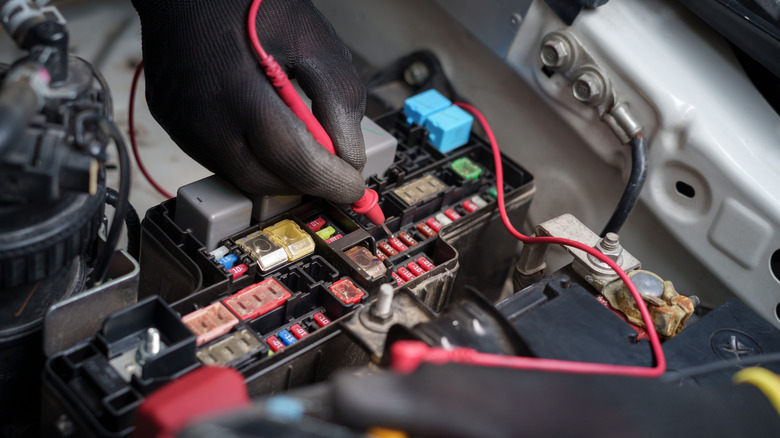
Now, there are times when EV mechanics do have to work directly on the high-voltage components, and this is another job for the multimeter. Remember, though, this article is merely meant to indicate what multimeters are capable of — it's not about offering directions on how to conduct the tests. Safely dealing with high-voltage vehicle systems requires extensive training, which is at least partly why there are not enough EV mechanics.
Anyway, HV battery packs are carefully insulated to help prevent electricity from "leaking" out of the circuit and shocking someone, but that insulation can be damaged and degrade over time. And to check this, mechanics can perform an isolation-resistance test with a a multimeter, essentially measuring how the system's voltage is affected by a known level of resistance. Multimeters are also often used to test high-voltage fuses — which operate pretty much like their low-voltage counterparts — as well as the DC-DC converter. EVs and hybrids usually have both a low-voltage 12-volt battery for typical car accessories and a high-voltage battery pack for motivation. Both run on direct current, but the huge difference in their voltage requires the converter for them to play well together. Testing the performance of the converter, unsurprisingly, is a further use for the ol' multimeter.
The bottom line is that a multimeter is a simple tool that can change your life. Not using one when you work on an EV or hybrid — or other high-voltage application — can be extremely dangerous.