

These Were The First Cars Ever Made By The World's Best-Known Automakers
When you're rolling down the road, radio blasting, the wind whipping through your open windows on a fine day, do you ever stop to think about how absolutely amazing it is that you can just stroll into a dealership and buy a car? It's crazy! Then you just drop into the driver's seat, turn a key, shift into gear, and step on the gas, and this multi-ton machine moves effortlessly at double- or triple-digit speeds.
Rationally, it seems like this just shouldn't be possible. So many resources and so much labor go into turning iron ore and other raw materials into cars. The reason we're lucky enough to be able to enjoy the open road is down to enterprising engineers, entrepreneurs, and tinkerers who built cars out of whatever materials they had on hand, turned those carmaking skills into fledgling businesses, and built those businesses into industrial giants. We owe these pioneers a debt of gratitude.
You're bound to notice something, so let's clear this up right away. We're skipping two of the world's biggest: GM and Stellantis. Both companies have such convoluted histories of mergers and acquisitions that make it hard to definitively say which was their first car. So, we'll take the easy way out and skip them altogether. Thankfully, there's still plenty left to explore — here are the first production models from some of the world's oldest automakers.
Ford
A poll would probably find that many people, if not most of them, think the Model T was Henry Ford's first production car. After all, with more than 15 million sold, the Model T is the stuff of legends — including an urban myth that bugs in the seats of Model Ts led to the first car recall in history – yet few pause to ask why it was called the Model T in the first place.
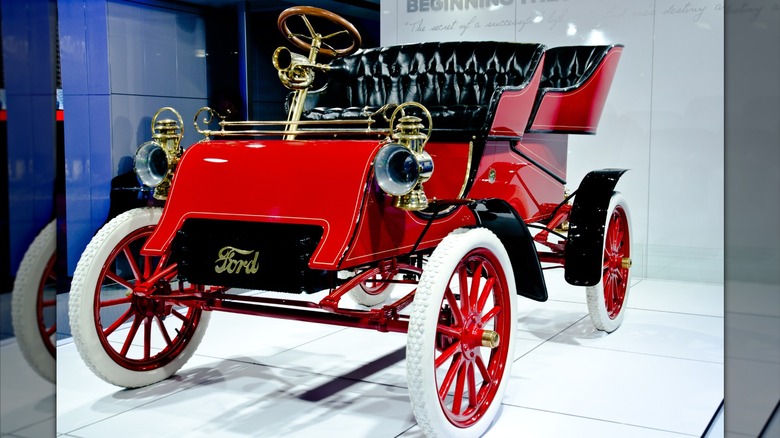
The answer is simple: it was preceded by Model A through Model S. Therefore, as you might expect, Ford's first production car was, in fact, the 1903 Model A. This designation can get a bit confusing because Ford resurrected the Model A name in 1927. But the earlier Model A was the fledgling Ford Motor Company's first-ever vehicle, with the first unit ordered on July 15, 1903 to a dentist named Ernst Pfenning.
The two-cylinder, eight horsepower Model A could seat two passengers on its bench seat, with an optional rear seat called a tonneau available — an option Dr. Pfenning chose. Ford built more than 670 examples of the car before discontinuing it a year later.
Toyota
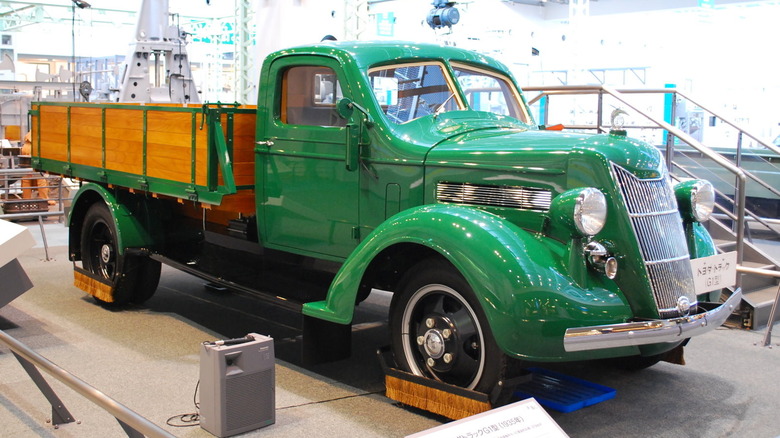
This one is a bit of a trick question, since many sources say that Toyota's first automobile was the Toyoda Model AA sedan. That was its first production car, but given the popularity of contemporary Toyota trucks, it's fitting that the company's first production vehicle was actually the G1 truck. The company's shareholders had voted to enter the automotive business in 1933, and since the Japanese government was trying to spark the growth of a domestic auto industry, the timing was right.
So how did the G1 beat the Model AA to production? To speed up the process, Toyoda purchased a 1934 Ford truck and used it as a reference for chassis design. The company also borrowed liberally from Chevrolet, developing a 1933 Chevy engine into the G1's "A engine." Other spare parts from Ford and Chevy were used to beat the company's self-imposed six-month deadline for building the G1 prototype.
The shortcuts worked, with the prototype completed in August of 1935 and ready for its public presentation in November. The truck was available for sale as a chassis or as a completed vehicle, although the company was now faced with selling it with no existing dealer network. It was quite a humble beginning for the company now known as Toyota, which shipped a record-breaking 11.2 million cars in 2023.
Honda
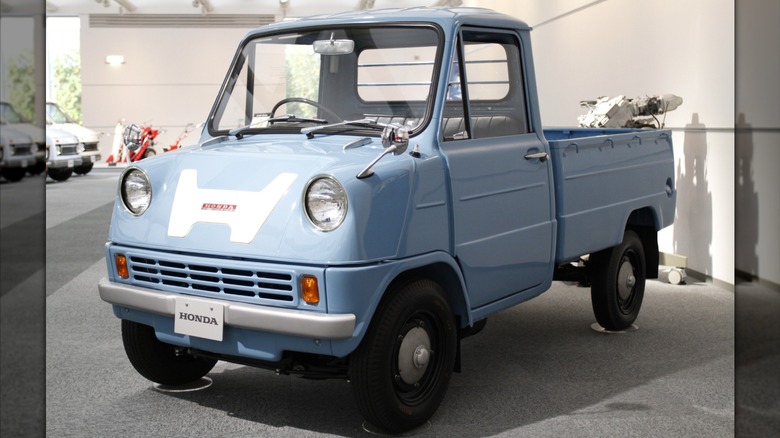
The adorable 1963 Honda S500 roadster gets all the glory as Honda's first production car, but just like Toyota, its first actual four-wheeled production vehicle was a truck. The T360 mini truck went on sale in August 1963, beating the S500 to market by a scant two months. Soichiro Honda's company, known until then for motorcycles, put the world on notice that it intended to stake its claim in the auto market, too.
The T360 benefited from the development Honda was undertaking for the S360 sports car prototype that became the S500. Specifically, it gained the car's wild and free-revving DOHC four-banger, a 360-cc unit that cranked out 30 hp at a screaming 8,600 rpm. The motor's output of nearly 100 hp per liter was practically unheard of at the time. Honda's expertise in motorcycle engines came in handy in wringing out every bit of power from this tiny motor.
The T360 was a rear-wheel drive truck, and get this: it was mid-engined. You won't find many work trucks with that arrangement. Heck, you won't find many trucks like that, period. The T360's wild drivetrain was good for a 60 mph top speed. There was a slightly longer version called the T500 with an additional 8 hp. There was even a snow-cat version!
Tesla
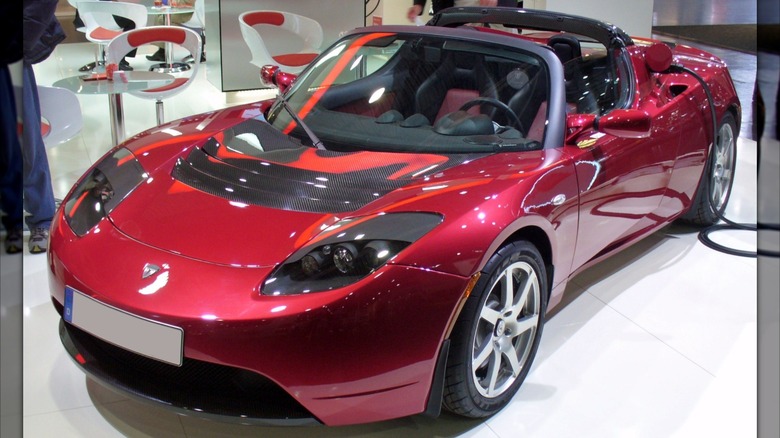
Tesla's first car was the 2008 Tesla Roadster, the only car in space. Before the Tesla Roadster got briefly added to the asteroid roster by mistake, it began life as a boutique model that offered few hints that Tesla would soon grow into one of the world's largest manufacturers of electric vehicles (EVs). Built on a Lotus chassis, the Roadster's total production run was only about 2,400 units. Still, it served as the foundation for Tesla's future success.
With EVs having gone more or less mainstream, it's amusing to see how early reviews treated the Roadster as an exotic and almost alien technology. A Car and Driver review from March 2008 called the Roadster "proof that an electric car can work, even if it's not quite practical." Fair enough. It was a two-seat sports car, after all. As the magazine's reviewer pointed out, previous EVs from companies like GM had been nothing to write home about.
The Tesla Roadster, by comparison, was an eye-opener. Its zero-to-60 time of 4.4 seconds and its 13.3-second quarter-mile time were serious performance numbers. The car lacked the electric whine of previous EVs, too. The car's battery pack drove a 248-hp electric motor with whisper-quiet grace. An official range isn't mentioned in C&D's review — perhaps the Roadster was so much fun to drive that they forgot to ask.
Ferrari
Enzo Ferrari's first company, Scuderia Ferrari S.A., maintained and ran race cars for Alfa Romeo for about a decade beginning in 1929. When Alfa switched to managing its racing division in-house, Ferrari was in a bit of a bind, since he had agreed not to use his own name on any cars for four years. He began building a couple of cars under the name of his manufacturing firm, Auto Avio Costruzioni, but the outbreak of war delayed the day he could build a car wearing a Ferrari badge.
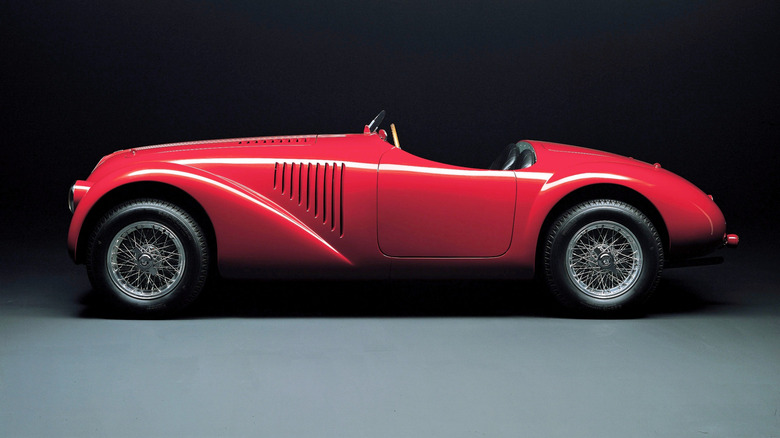
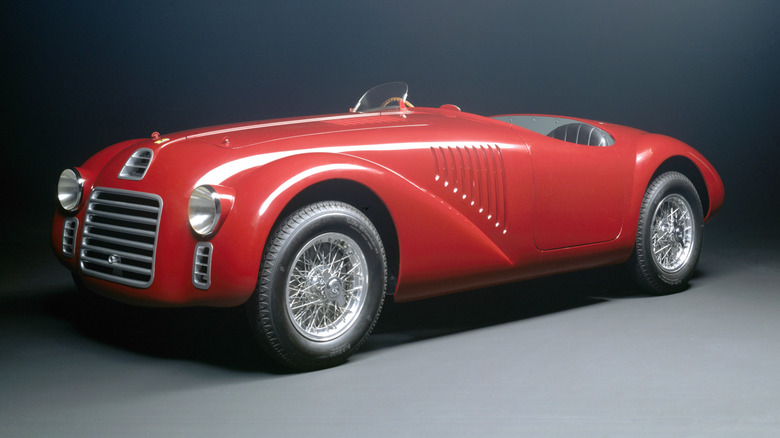
Finally, in 1947, that day came. The first Ferrari-branded car was the 125 S, and for such a historically important model, it's remarkable that only two were built. For any other carmaker, that would amount to a pair of prototypes. However, these Ferraris were built to race, not to show. Within two weeks of their public debut, a 125 S won the prestigious Grand Prix of Rome. A legend had been born.
Enzo Ferrari had engaged one of his former Alfa colleagues, Gioacchino Colombo, to design the car's engine. The Colombo V12 was one of the smallest-displacement V12 engines ever made, but it was a potent one. With a total displacement of just a hair under 1.5 liters, it generated 118 hp at 6,800 rpm. The car's top speed was 210 km/h, or about 130.5 mph.
Lamborghini
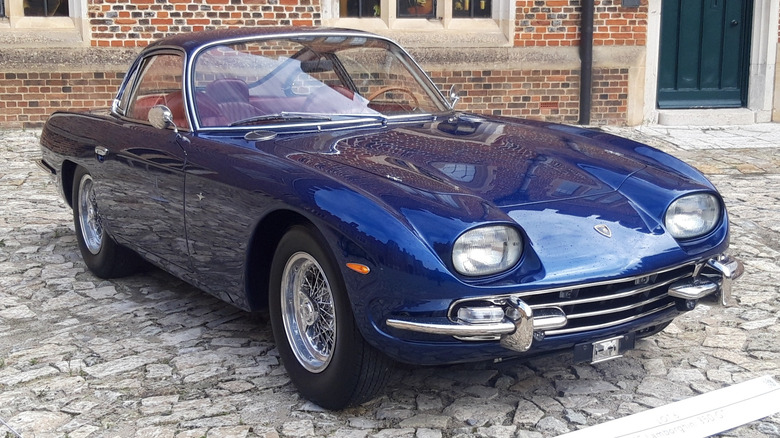
The legend says Ferruccio Lamborghini decided to build his own car after being personally insulted by Enzo Ferrari. As the story goes, Mr. Lamborghini, who owned a tractor manufacturing business, complained about the faulty clutch in his Ferrari directly to Mr. Ferrari. The latter gentleman essentially told the former to stick to driving tractors. So Ferruccio Lamborghini decided to build his own sports car. The result was the 350 GT.
Whether the story is true, false, or exaggerated, it makes for a great backstory to the rivalry between Italy's two most famous supercar manufacturers. It kicked off with the 350 GT, a swoopy grand tourer that featured advanced technology for its time, including a fully independent suspension with coil-over shocks, anti-roll bars in the front and rear, and disc brakes. Still, its most impressive feature was its all-aluminum 3.5-liter V12, which produced 280 hp and accelerated the car from 0 to 60 in 6.8 seconds.
Lamborghini built just 150 examples of the 350 GT, which was nevertheless an impressive feat for a first-time car manufacturer. The 350 GTV prototype debuted at the 1963 Turin Auto Show and the 350 GT went into production the following year. The production car's futuristic bodywork was refined by Carrozzeria Touring in Milan. Although Lamborghini has had several corporate owners in its history, it remains one of the most unique carmakers on the planet.
Mercedes-Benz
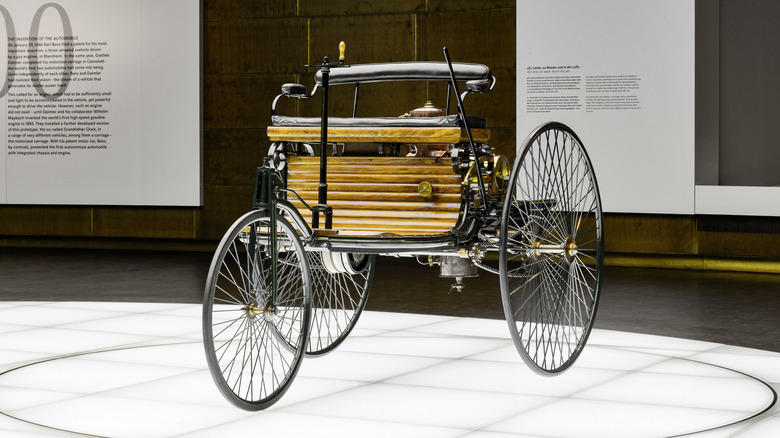
Carl Benz famously built the vehicle widely regarded as the world's first car: the three-wheeled 1886 Benz Patent-Motorwagen. He built it for Benz & Cie., the company that would later merge with Gottlieb Daimler's DMG to form Daimler-Benz AG, the company now known as Mercedes-Benz AG. Some readers might object that the Patent-Motorwagen shouldn't count as Mercedes' first model since the company didn't technically exist yet. However, the Benz in today's Mercedes-Benz indicates a direct, unbroken line of corporate succession from Benz & Cie. to the present day.
Between that and the fact that Mr. Benz literally held the patent for the gasoline-powered automobile, we're giving his proto-car the nod as the company's first vehicle. Production-wise, it was a low-volume vehicle, to say the least — only 25 would be built between 1886 and 1893. Yet it helped to prove the viability of the automobile as a form of transport, especially after Benz's wife Bertha took her husband's car to make an unannounced 120-mile round trip to visit her mother. Bertha's suggestions after the trip, such as a third forward gear, helped Mr. Benz refine later models of the car.
In its original form, the Benz Patent-Motorwagen featured a one-cylinder, four-stroke engine that generated 0.75 hp. Starting the engine was a complicated and adventuresome process, requiring white gas, water, and oil to be added before every trip. Oil and unburned fuel spatter all over the machinery, and as you might expect, a one-cylinder car with a tiller for steering can be a tough ride. One can only imagine what people along Bertha Benz's route must have thought of this smoky, clattering machine.
Volkswagen
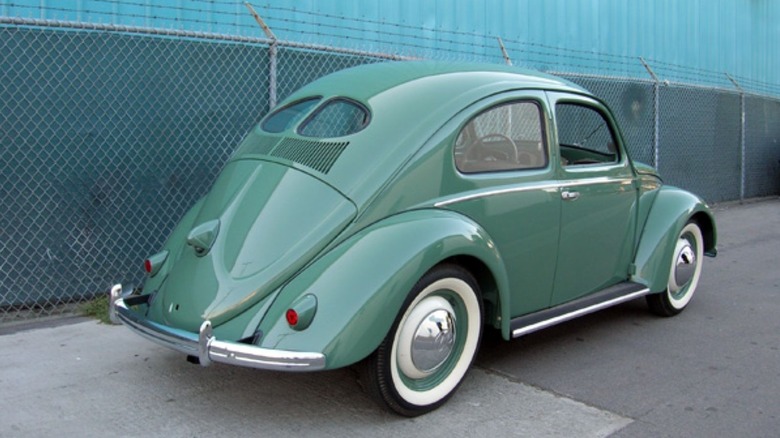
Well, this origin story is, ah, somewhat delicate, and VW can be a bit coy about the origins of the People's Car. However, the plain truth is that the Volkswagen Type 1 Beetle's origin is inextricably bound with a dark chapter of Germany's past, but the company's first car nevertheless stands on its own as a remarkable engineering achievement and an amazingly long-lived model.
Also, to be fair to Volkswagen, Hitler had a noticeable preference for Mercedes cars, a fact that Mercedes-Benz even admits to on its website. So, how closely was VW tied to National Socialism? Well, according to Hemmings, Hitler "directed automotive engineer Ferdinand Porsche to begin development on a 'Volkswagen,' or 'people's car.'" Whoops, now we've just implicated Porsche, too. The goal was to build an affordable, simple family car. By 1936, prototypes were undergoing extensive testing. However, before full production began, the war broke out.
After the war, the Type 1 was originally built to service the transportation needs of the occupying British Army. However, it slowly caught on across Europe and later in the United States. Its rear-mounted, air-cooled engine was a novelty, but its simplicity made maintenance easy. The Type 1 Beetle would remain in production for decades, with the last examples built in Mexico until 2003. Volkswagen sold 21 million of the little Bugs worldwide during this remarkable run.
Nissan
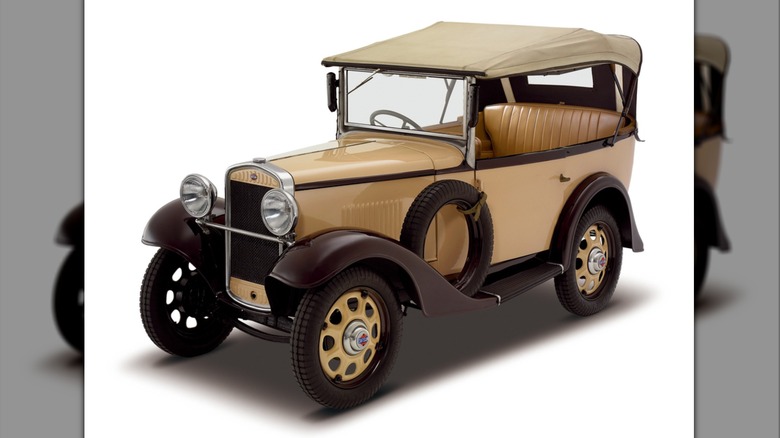
As is often the case in car company origins, things get murky with Nissan. A company called the DAT Car dated back to 1914, later becoming known as Datsun. The Nissan Motor Company was established in 1933 and took over Datsun production, so the 1933 Datsun 12 Phaeton is the car that Nissan itself identifies as its first model. The Datsun name stuck around to designate Nissan's compact cars. By the early 1980s, Nissan began to phase out the Datsun brand, although it relaunched that nameplate for almost a decade in some smaller markets beginning in 2013.
Anyway, back to that 1933 Datsun 12 Phaeton. It was a handsome little four-seater convertible with a soft top. Under its hood sat a water-cooled, 0.75-liter, four-cylinder side-valve engine that made all of about 12 hp, good for a top speed of 35 mph. An example of this car sits on display in the Nissan Heritage Collection in Kanagawa, Japan, which hosts models from 1933 onward, further confirming the 1933 Datsun Type 12 as being present at the dawn of Nissan.
Hyundai
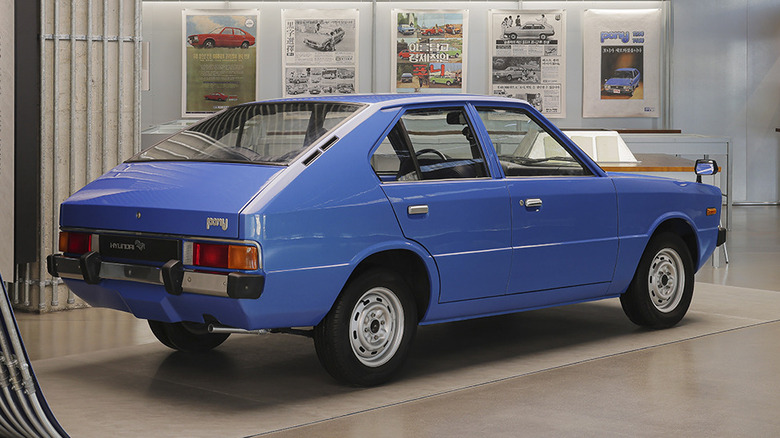
In the 1960s, Hyundai was well-established as a "chaebol," a term for a giant family-owned industrial corporation in South Korea. The firm specialized in construction, so the company decided to leverage that expertise to get into the automobile manufacturing business by assembling Ford Cortinas from complete knockdown kits. However, Hyundai's ambition was to produce vehicles under its own name. To that end, Hyundai hired a Brit named George Turnbull, a former executive at British Leyland, to advise them on how to launch their own car brand.
The result was the Hyundai Pony, a car that drew heavily on the Morris Marina, two examples of which Turnbull brought to Korea. While the car that Turnbull and Hyundai designed would owe a lot to the Marina and also use engines from Mitsubishi, it was still Hyundai's work that pulled it all together with Turnbull's guidance. To really put a stamp on it, Hyundai hired the famed Giorgetto Giugiaro to design the Pony's conservative but handsome body.
That body was available in sedan, hatchback, and utility coupe styles. Power from the four-cylinder engine was modest, as a typical example of a Canadian-market Pony produced 70 hp from a 1.4-liter motor with the power directed to the rear wheels through a four-speed manual shifter or a three-speed automatic transmission. The zero to 60 time was a tick over 15 seconds. Sales commenced in 1975, and despite the car's modest performance and lack of innovative features, it sold well, including in export markets like Canada. Emissions regulations kept it out of the U.S., however.
Rolls-Royce
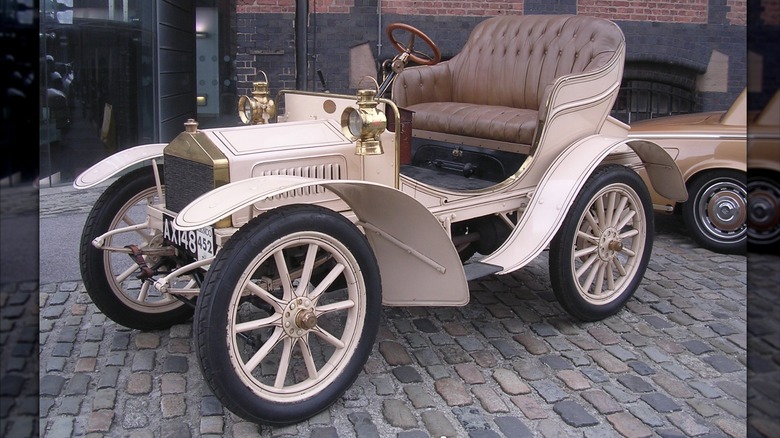
For a company with epic and lovely model names like Silver Dawn, the first Rolls-Royce in 1904 had a very prosaic name: the 10 H.P., which sounds like a network designation for a printer today. The car started out life as the Royce 10 H.P., built by an electrical engineer from Manchester named Henry Royce, who was looking to diversify his manufacturing company beyond electrical items. He used a French car called the 10 H.P. Decauville as his starting point, building a lighter and better car, completing it in April of 1904.
Barely a month later, Royce met a car importer from London named Charles Stewart Rolls, who had heard about Royce's car from a mutual acquaintance. Rolls traveled to Manchester to check out the 10 H.P., and was so impressed that he promised to sell as many as Royce could build. The new partnership was named Rolls-Royce, and today the company's website dubs the 10 H.P. "the inaugural model for the newly established marque."
Just as Royce had conscientiously improved every aspect of the Decauville to make the 10 H.P., redesigning everything from the bearings to the engine, he continued to tweak the car's design right up to when it went on sale later that year. This attention to detail became a hallmark of the brand, from hand-built sheet metal to carefully crafted wood and leather throughout the cabin. Rolls-Royce cars may be as close to hand-built automotive perfection as it's possible to achieve on this planet. Of course, perfection has a price, as seen with the 2023 reveal of the Rolls-Royce Droptail.
BMW
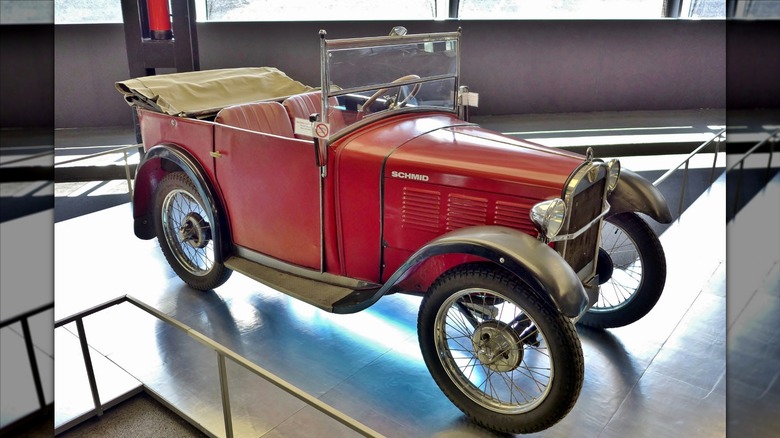
BMW originally built airplane engines, but after the First World War Germany was restricted in aircraft production under the Treaty of Versailles. This set BMW off in search of new lines of business, including motorcycles and, eventually, cars. In pursuit of the latter goal, BMW purchased Dixi, a small, struggling carmaker that had recently begun producing a license-built copy of the Austin Seven.
The Seven was an insanely popular car in England. BMW continued Dixi's production beginning in 1928, calling its newly acquired model the Dixi 3/15 PS DA 1, a mouthful of a name that represented the car's specs and tax class. Per BMW, the three in the title indicated the taxable horsepower rating, while 15 was the actual horsepower available. The DA 1, meanwhile, stood for Deutsche Ausführung 1, or German Version 1.
BMW upgraded the model to the BMW 3/15 PS DA 2 in 1929, which would remain in production until 1932 when it was replaced by the BMW 3/20. Improvements made to the DA 2 included the addition of a four-wheel braking system, a handful of cabin upgrades, and the very first appearance of the famous BMW blue-and-white roundel badge.