

The 90-Degree Torque Problem: How Engineering Bent Power Around Corners
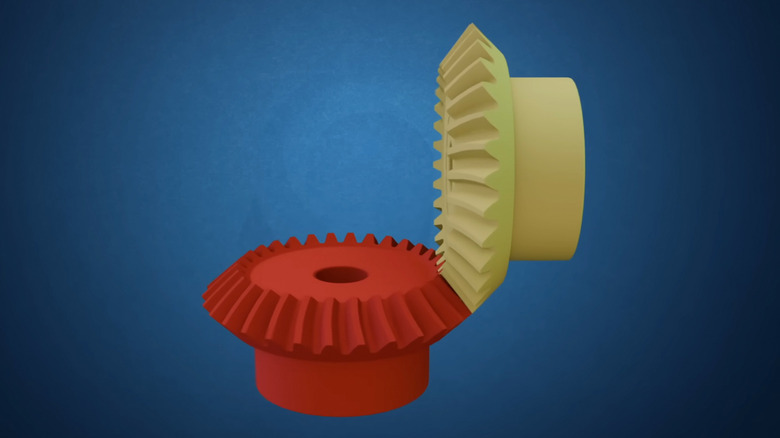
Every time you drive your car, you could be using one of the most impactful mechanical inventions in history. It's something that took centuries to get right, and you almost certainly never give it a second thought: 90-degree torque. Sending rotational power around corners was something that engineers figured out early in the first century, and the same basic idea has been in continuous use to this day.
When you press the throttle pedal of your car, your engine generates rotational power. From there, that power is sent through a transmission and a driveshaft (or vice versa, depending on the drivetrain layout). But that all happens in a straight line. The wheels are perpendicular to that line, so to get that rotational power to the wheels, it has to turn 90 degrees. That's where the differential comes in, as it effectively turns that torque around corners to send it to the wheels. And while that seems simple now, it's taken centuries to get to this point.
Turning torque around corners dates back to ancient Rome
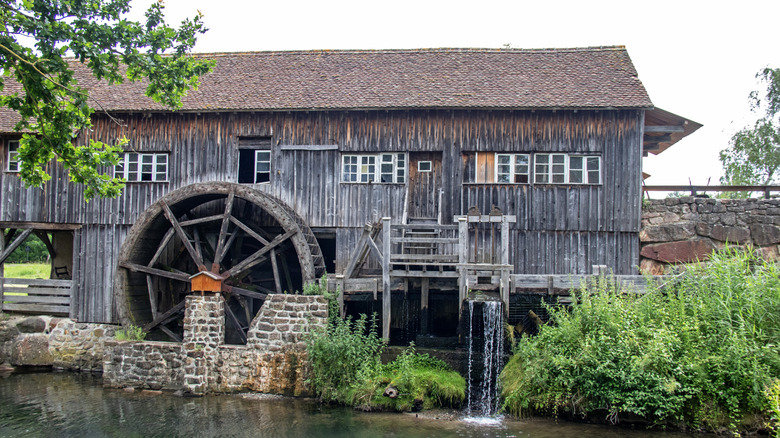
The usage of right-angle gear drives to take rotational power from one axis and reroute it to another was developed by Roman engineer and architect Vitruvius sometime during the first century B.C. Vitruvius realized that he could harness the continuous power of a water wheel and redirect its horizontal axis to a vertical one to turn a grain wheel. To do so, he employed a vertical face wheel with cylindrical teeth and a cylindrical lantern pinion. As the water wheel turned, it would rotate the vertical face wheel via an axle. And as the face wheel turned, its horizontal teeth would mesh with the lantern pinion's vertical teeth, which would rotate its vertical shaft.
That seemingly simple invention officially kicked off a new mechanical age. From there, engineers could power almost any sort of machine with subsequent gearing. Using running water as a primary source of power, engineers would use the same Vitruvian mechanism to power everything from grain mills to oscillating saws.
Over the centuries, engineers would improve upon Vitruvius' design by creating different gear and teeth designs. While early gears were made of wood, cast iron quickly became the common material of gear drives. However, cast iron gears could crack from constant use due to the crude manufacturing processes of the time, especially after more powerful steam engines came along. So there were even cast iron wheels with mortices filled by wooden teeth. Once helical gears came along, full cast iron gears became commonplace along with other types of metal, as the helical style prevented damage and reduced noise, vibration, and harshness versus straight-cut gears.
How Virtruvius' invention is used to do smokey burnouts today

Whenever you see someone in a rear-wheel drive performance car doing smokey burnouts, you can thank Vitrivius for such awesomeness. Modern differentials are just gear drives that take the rotational power of the engine and bend it 90-degrees, but they're able to do so in two directions. They also do it far more effectively, though, as they can even control the amount of power that goes to each wheel with limited-slip differentials.
There are several kinds of limited-slip differentials, with the two most common today being mechanical or electronic. However, all of them are designed to prevent one wheel from spinning freely, ensuring that both wheels get power. Electronic differentials are sophisticated enough to send specific amounts of power to either wheel, depending on the vehicle's given traction needs.
Additionally, there are Torsen differentials, locking differentials, transaxles, and all manner of gear drives that send power in different directions. All of them owe themselves to Vitruvius, who was the first to truly bend torque around a corner. Without that invention from 2,000 years ago, we might not have the fantastic burnouts and tire-shredding launches that we have today.