

2026 Hyundai Kona Limited Has Bougie Features For Budget Buyers, But Doesn't Offer Driving Fun
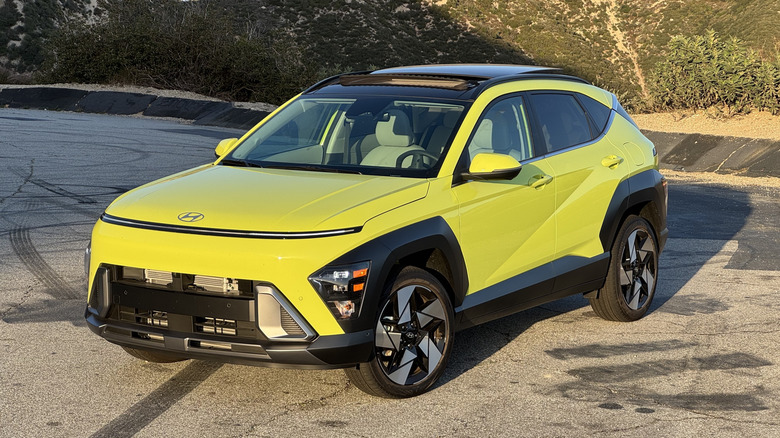
Finding the perfect car that checks all your boxes is a challenging pursuit, but finding the perfect car that checks all your boxes and is in your price range can be much harder. In a time when the rich are reaching new levels of wealth that have never been seen before — and they're sharing their lavish lifestyles on social media — the vast majority of us who live paycheck to paycheck are left to watch all the fun from the other side of the screen. If you have champagne taste on a beer budget, then I think I have the right car for you, so long as you prioritize luxurious features over driving enjoyment: the 2026 Hyundai Kona Limited.
Full disclosure: Hyundai lent me a 2026 Kona Limited for a week so I could live with it and write this review. Prior to receiving the press car, I prayed it wouldn't be highlighter yellow. My prayers were ignored.
First, some numbers
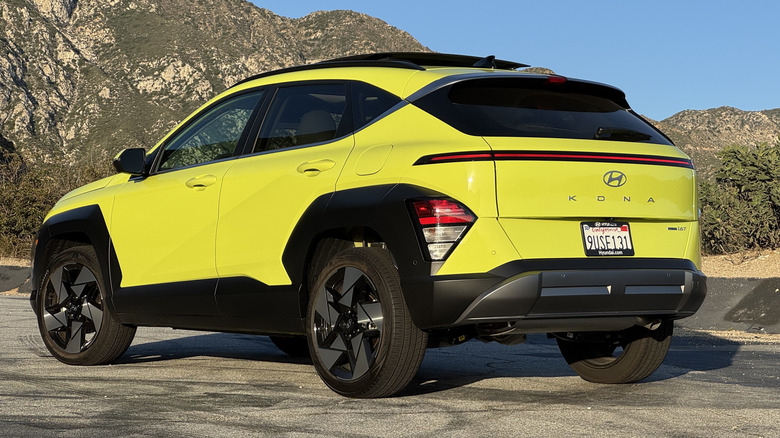
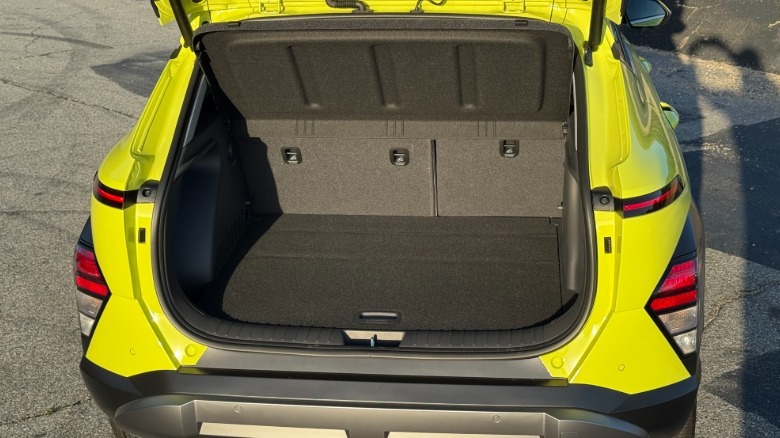
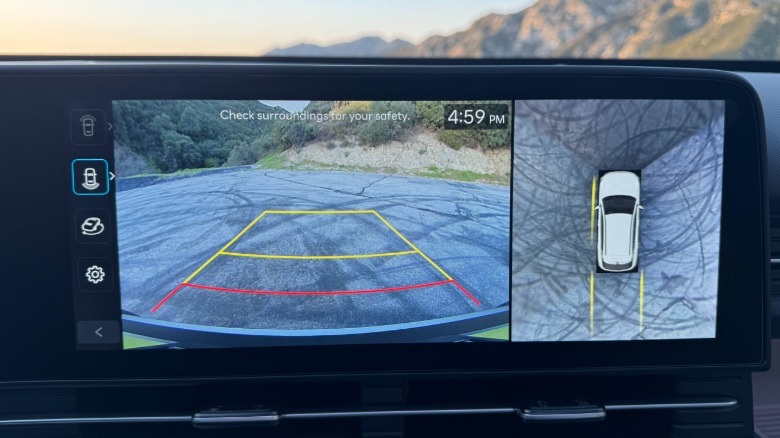
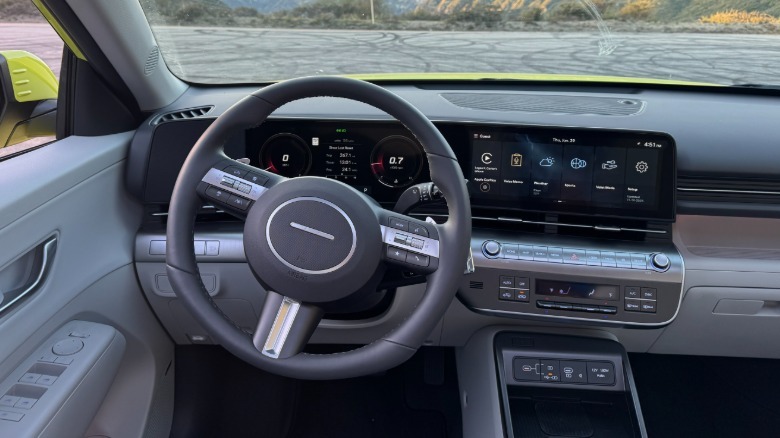
The Kona is one of two subcompact crossovers from Hyundai, landing one rung above the cheapest new car on sale today, the foot-shorter Hyundai Venue. Pricing for the 2026 Kona starts at $27,100 including destination, but my test car was a top trim Limited AWD model that requires you to part with at least $36,385. While that isn't especially cheap on the surface, it's what's inside that counts, and the Kona Limited comes loaded with luxurious features like ventilated front seats, an impressive eight-speaker Bose stereo, a surround-view monitor, a hands-free tailgate, remote parking, a 12.3-inch digital driver's display, and full-speed adaptive cruise control. Some of those are features you won't find available on many cars without spending thousands more.
Opting for the SEL Premium or Limited trim brings more power in the form of Hyundai's turbocharged 1.6-liter inline-4 engine that sends 190 horsepower and 195 pound-feet of torque through a proper 8-speed automatic transmission to the front wheels, or all four if so optioned. The standard engine on Kona SE and SEL Sport trims is a naturally aspirated 2.0-liter four-cylinder that sends 147 hp and 132 lb-ft of torque through a CVT, with AWD also an option.
 Logan K. Carter/ Jalopnik
If fuel efficiency is your priority, you'll want to stick with the front-wheel-drive base model that returns 28 mpg city, 35 mpg highway, and 31 mpg combined. Opting for all-wheel drive drops those numbers significantly to 26 mpg city, 29 mpg highway, and 27 mpg combined. Upgrading to the turbo doesn't hurt fuel economy too much, with front-wheel-drive Kona turbos returning 26 mpg city, 31 mpg highway, and 28 combined, and all-wheel-drive turbos getting 25 mpg city, 28 mpg highway, and 26 mpg combined.
The features are exciting
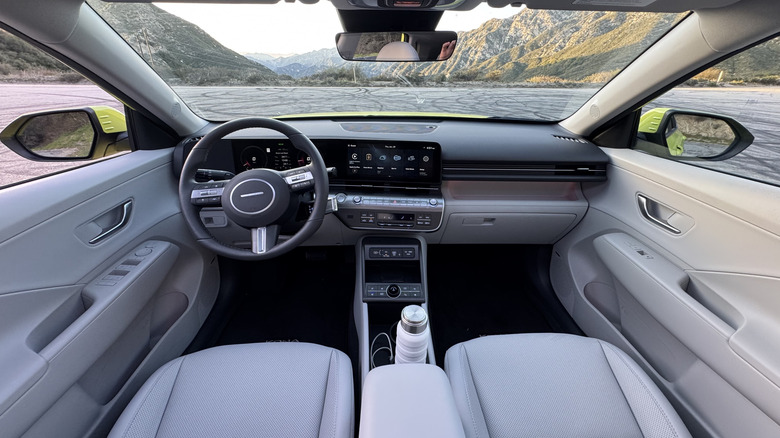
Over the course of my week living with the Kona, I grew to love the Highway Drive Assist, ventilated seats, physical climate control buttons, elevated driving position and Bose stereo. Hyundai's adaptive cruise control did a respectable job handling LA's toughest traffic jams and distracted drivers without much unexpected intervention on my part as the driver, but I found the system to sit too close to the right lane line, particularly when passing semi-trucks. There were a few pucker moments, but you should have your hands on the wheel anyway so it's easy to correct that tendency in tight situations.
If I'm honest, I'm a sucker for ventilated seats whether they're in a Kona or a Mercedes-Benz S-Class, but the fact that you can get this luxurious feature in a Kona is great news for compact crossover buyers. I think every car should offer them. The Kona's standard 12.3-inch touchscreen infotainment system works well when you need to use it, but thankfully the vast majority of daily interactions are achieved using its generous array of physical controls. All HVAC duties are performed with physical controls, as well as drive mode selection, camera activation, and most radio controls. There are also plenty of buttons and switches on the steering wheel that don't require the driver to look away from the road to make adjustments. This might seem like a "no duh," but when some cars require you to use the screen to perform a task as simple as adjusting your air vents or volume, it earns the Kona brownie points.
 Logan K. Carter/ Jalopnik
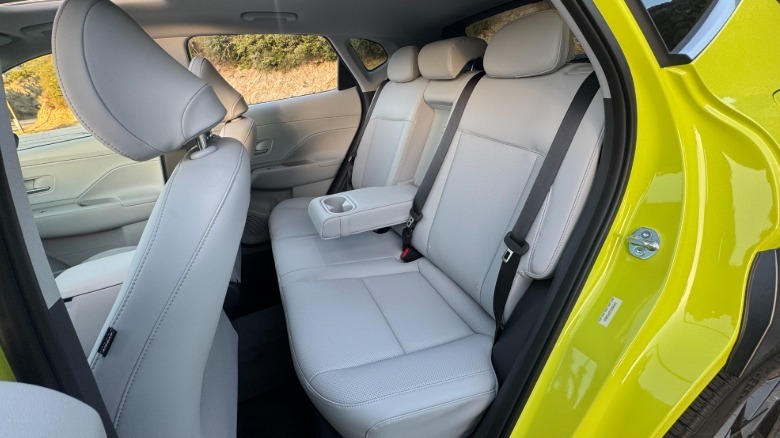
I was surprised by how high the seating position is in the Kona; you feel like you're eye-level with folks in much larger vehicles, which many buyers demand. I could care less about an elevated driving position, but it does help with seeing over and around traffic and parked vehicles. The front seats are spacious, with enough travel to suit my 6-foot-8 frame comfortably. If you're carrying tall folk in the back seat, they'll thank you profusely if you scoot the front seats forward a smidge to give them some wiggle room. They'll be kept comfortable with second-row air vents, too, which come standard in all trims above the base SE.
 Logan K. Carter/ Jalopnik
The front cabin is also rife with small item storage, from cavernous cupholders that spring into action when you need them and fold away when you don't, to a removable bin under the center arm rest that hides even more storage beneath it. Yes, most surfaces are hard injection-molded plastics, but they still look good in my test car's pleasing light gray interior color, and important bits like the arm rests are nicely padded. The interior looks modern and chic, and the vast array of convenience features spoil, but the swaths of hard plastic surfaces don't feel particularly premium.
The driving experience is not
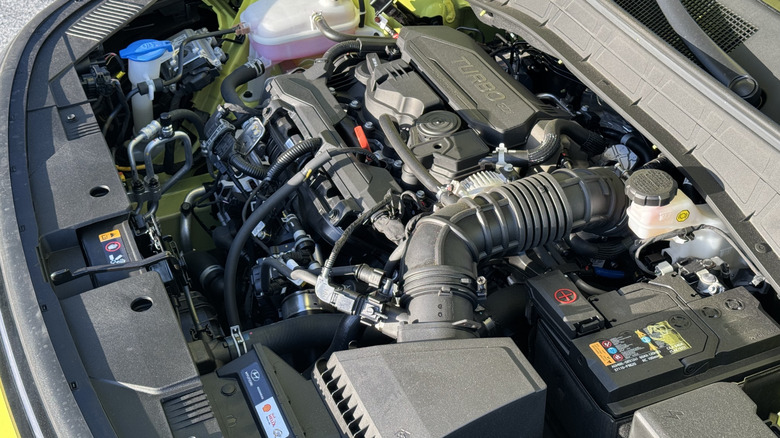
Seeing as how my press car was fitted with a turbocharged engine, I hoped the Kona would feel fun and playful, but it didn't. I found the engine response to be inconsistent; sometimes when I stomped on the throttle the car would react accordingly and get going quickly, and other times it would merely meander. Even when using the steering wheel-mounted paddle shifters to hold gears, I couldn't count on consistent power delivery on twisty roads. The issue wasn't too apparent in day-to-day driving, but there's some noticeable turbo lag when trying to quickly pull away from a stop.
The Kona's ride is very squishy, bordering on wallowy — on the undulating freeways and speed bump-filled roads around LA, the front end would porpoise after hitting a bump. This quality caused me to slow down on rougher, twisting roads, which was a disappointment. But the suspension's floppy demeanor returned a pleasantly comfy ride quality around town, and the cabin is quiet on the highway, so if you don't care about handling, the Kona will be a great choice.
 Logan K. Carter/ Jalopnik
Its steering is weirdly light, particularly at low speeds, so I found myself accidentally whipping the Kona around parking lots and 90-degree turns more aggressively than intended. Those quick directional maneuvers didn't play well with the overly squishy springs, so the car wallowed around a lot, even when straightening the wheel. Of course, there's no semblance of road feel that comes through the wheel, either, which didn't help things.
The Kona is a comfortable cruiser with great features
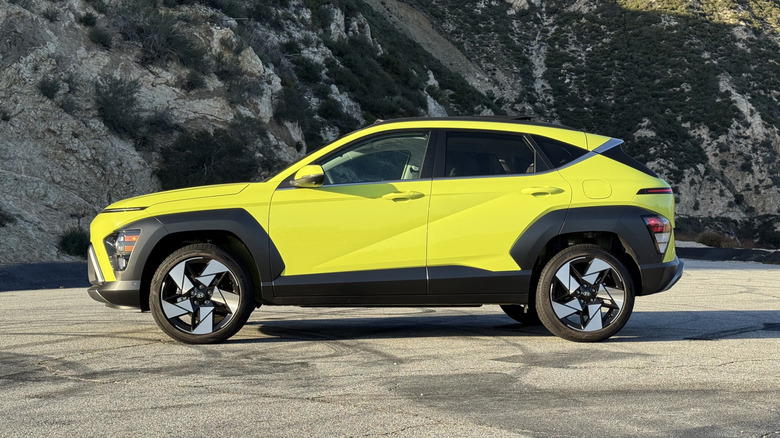
I've avoided discussing the most polarizing aspect of the Kona, particularly when it comes to my Neoteric Yellow press car: its appearance. The Kona's styling is certainly bold, with sharp creases and angles balanced with rounded curves, but there is no excuse for this highlighter paint color. Styling is subjective though, so you may love the Kona's statement-making looks and color options. [Editor's note: I absolutely love this color but respect Logan's opinion. -Daniel Golson]
My complaints about the Kona should not deter most buyers, so long as you don't care about how fast you can weave down a winding road. In daily driving scenarios, the Kona fares just fine, and if you value comfort and isolation from the road, it should be toward the top of your shopping list. Hyundai is known for packing a lot of features and style into an affordable package, and the 2026 Kona is no different. If you want a compact crossover that's full of bougie features at a bargain price, the Kona's got you covered.