

Why Did Jaguar Switch From A V12 To A Twin-Turbo V6 In The XJ220?
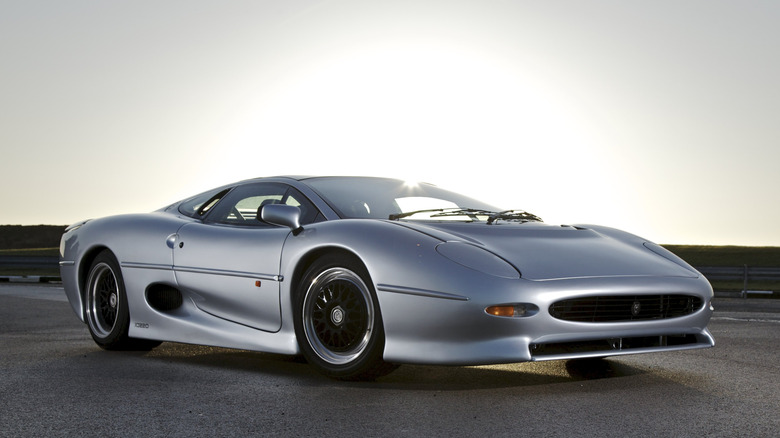
With each decade of the 20th century, supercars kept on getting better and better. Mercedes-Benz's 300SL sparked the segment in the '50s, Lamborghini's Miura and Countach took the '60s and '70s by storm, then greats such as the Ferraria F40 and Porsche 959 battled it out throughout the late '80s and early '90s. At this point, Jaguar had built a formidable reputation as a storied race, luxury, and sports car manufacturer, and it decided to join the party with a flagship supercar dubbed the XJ220.
The promised recipe was an enticing one. A powerful V12 engine, all-wheel drive — much like the technological masterpiece that was the Porsche 959 – and a world-beating top speed of 220 mph. If it had managed to deliver upon these promises, it would undoubtedly share the limelight with icons such as the Ferrari F40 and McLaren F1. But the delivered units fell somewhat short. Instead, the XJ220 was sold with a twin-turbocharged 3.5-liter V6 in the V12's place. It drove the rear wheels only, and the top speed sat at 217 mph. It was still fast enough to claim the title of the world's fastest production car, sure, but it wasn't fast enough to deliver upon its promised speed.
As such, many orders were cancelled, and the XJ220 was immediately considered as something of a failure. No wonder Jaguar has never revisited the supercar scene since, although the brand did get close once with the C-X75. The V12's demise was due to a number of factors, and as is the case with many downsized power plants these days, emissions were largely to blame. Weight, size, and financial implications also had their say, but the reasons behind the changes didn't change how the XJ220 was a severe disappointment to many.
Here's what went wrong
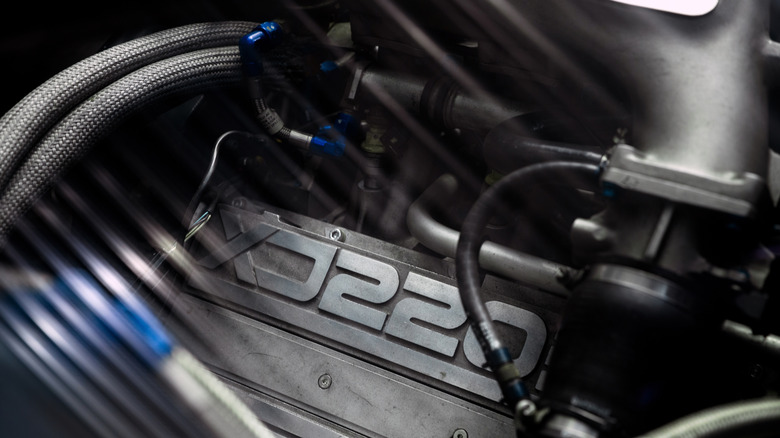
Initial plans for the XJ220 had always centered around a powerful V12 engine providing the grunt — not surprising, given the success Jaguar had enjoyed with V12-powered racers in the Group C endurance racing division. The plans were given the go-ahead for a one-off show car to be created, and after a few years, one such car was ready. Packing a 500 horsepower 6.2-liter V12 engine and a capable all-wheel drive system, the XJ220 debuted in '88 in Birmingham. Naturally, the sleek Jag received a warm welcome from the public, and so Jaguar instructed the help of Tom Walkinshaw Racing to inspect the show car and see how viable the design was for a full production run. That's where things take a turn for the worst.
The supercar was too heavy for the pressures that would be placed on the tires at speed, and it would never meet the ever-tighter emissions regulations. Fortunately for Jaguar, an answer wasn't too far away — it could simply use the twin-turbocharged V6 from the Metro 6R4 rally car. That gave the car 542 horsepower, leading to a 217 mph top speed and a 0-60 mph time of under four seconds. As great as it was, it wasn't what the people were promised.
Not only was the V12 dropped, but now only the rear wheels would be driven, and other features were stripped. Scissor doors, adaptive suspension, and four-wheel steering was originally planned, but production models would only ever be equipped with regular units. The changes left buyers sufficiently unenthused, and as a result, Jaguar only produced 281 out of a planned 350 units — and many units sat unsold for years.
30 years on, enthusiasts are beginning to forgive the XJ220
In 1992, the first XJ220 was sold at the extortionate price of £470,000. Adjusted for inflation, and then converted into dollars, that's over $1,000,000. Yikes. Just a decade later, as-new examples with barely more than delivery miles were selling for around £100,000. Evidently, the initial disappointment in the supercar languished for quite some time.
Fast-forward to today, and the tide is starting to turn. Granted, if you'd purchased one new, then there's still a fair bit of depreciation to counter before you'd get your $1 million back. But Classic.com now reports that the average price achieved is at least north of $500,000, with top examples fetching close to $700,000.
If it had been packaged with the V12 and everything else that came with it, then perhaps we'd be looking at an altogether far more valuable car. The comparable Bugatti EB110 is now worth $2 million, and as for the McLaren F1, you could have an XJ220 for every day of the week and a gaggle of EB110s for the price of one of those. Still, at least the XJ220 is finally being seen as the jaw-dropping supercar that it has secretly always been. It's just taken three decades for that initial disappointment to wear off.