

What Are The Biggest Differences Between Jet Drive And Sterndrive Boat Engines?
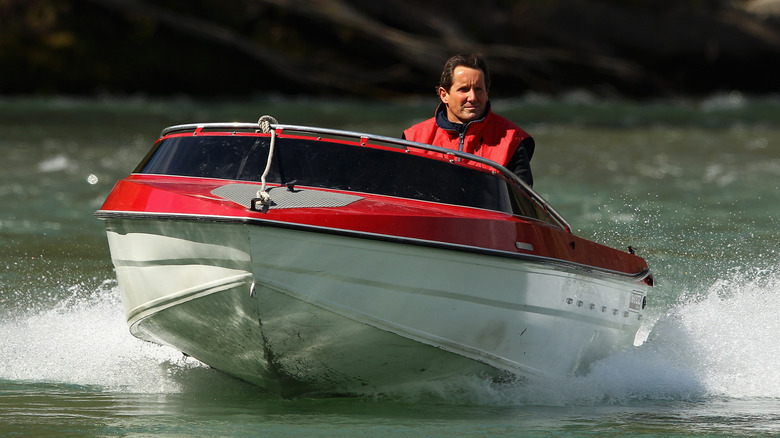
The world of boats can be confusing, especially for those who spend most their time fawning over automobiles. In rare cases like this jet-powered sport boat from the 1990s that looks like a Porsche on purpose, the two collide. But outrageous custom builds aside, what sorts of boats are ideal for a fun day out on the lake with a small group of people?
One option is the runabout, which doesn't exceed 30 feet in length and often has only a main deck. Among runabouts, two popular options are jet drive and sterndrive models, terms that describe the type of propulsion each uses.
A jet drive uses that same method of generating thrust as something like a Jet Ski. Essentially, water is pulled in by a robust pump, then shot out, thrusting the boat forward. A sterndrive, on the other hand, is a bit of a hybrid between inboard and outboard configurations. The engine is installed inside the vessel, but other components like the gearbox and propeller are fitted externally.
Both propulsion methods offer benefits and drawbacks, with each performing especially well in certain scenarios. For instance, a jet drive boat could get you places a sterndrive couldn't, especially if you choose something smaller like the weird Sea-Doo Switch, which combines jet drive with a pontoon. But for pulling water-skiers and wakeboarders, you'd be much better off with a sterndrive.
Jet drive and sterndrive: what each does well
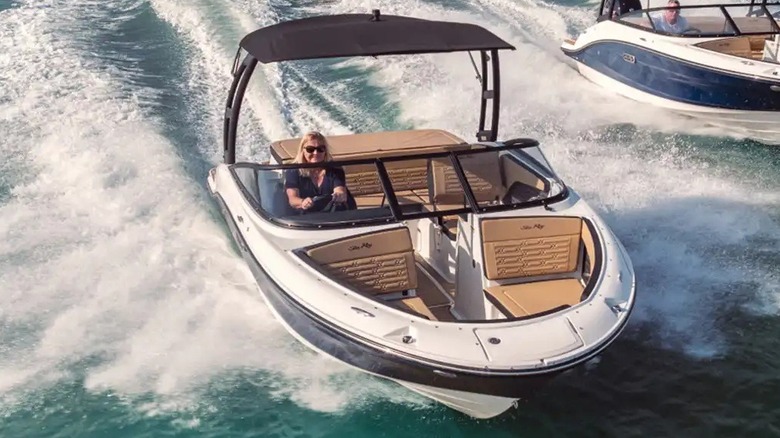
The design of a jet drive, which doesn't use an external propellor, gives it some key advantages in maneuverability and safety. Jet drives provide thrilling acceleration and can turn on a dime. And shallow water and areas with submerged obstacles don't affect them, as they have minimal draft. There's less equipment jutting out underneath the boat, too, and no propeller to damage — and the absence of a spinning external propeller also helps keep people in the water near the vessel safe. According to California State Parks Boating and Waterways, the average boat propeller rotating at 3,200 rpm can hit a swimmer 160 times in a single second.
Sterndrive boats also have plenty of positives to offer you on the water. They excel at towing because a rudder lets them maintain a steady heading even while pulling an innertube or other recreational towable. When slowing, such as approaching a dock, a sterndrive boat is considered highly maneuverable, whereas the same scenario in a jet boat may require greater finesse. In addition, a sterndrive allows you to use trimming, which is essentially lowering or raising the engine. This lets you control the boat's angle, allowing for adjustments that handle rougher water better, and provide a smoother ride when cruising at speed.
Cost and maintenance
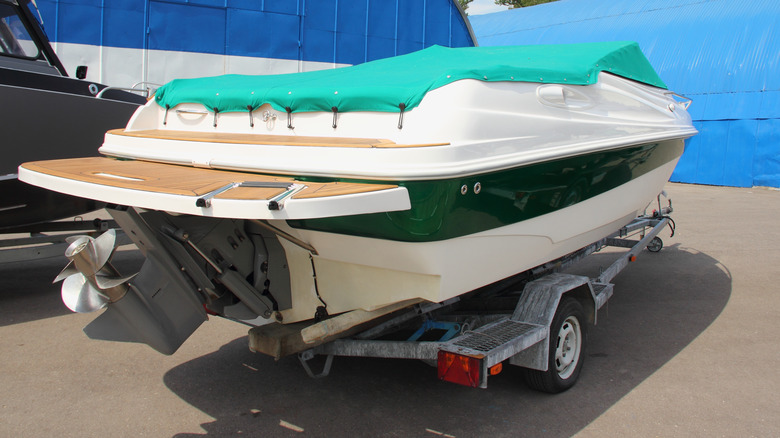
Jet drive vessels can to be more affordable than sterndrive, but it depends on the model and features. For example, the Yamaha SX190 jet drive boat and Sea Ray SPX 190 sterndrive are comparable but have far different prices.
Yamaha's SX190 is 19 feet 5 inches long and can hold up to eight people. The Sea Ray SPX 190 is just a bit longer at 19 feet 7 inches and can hold a maximum of 10. However, the Yamaha starts at $41,999, whereas a base Sea Ray has a higher entry point at $56,115. Although this sum pales in comparison to some options flirting with half a million dollars, like this 630-horsepower supercharged V8 wakeboarding boat with an inboard engine from MasterCraft.
In terms of maintenance, often more moving parts equals greater complexity and cost. A sterndrive setup is more costly to keep up than a simpler jet drive engine. With some components located externally, there is also a greater risk of harm to a sterndrive, which could encounter the bottom or other obstruction. However, jet drive systems are highly sensitive to clogging, as the mechanism that sucks in water can bring debris with it.