

Private Company Wants To Bag House-Sized Asteroid For Resources
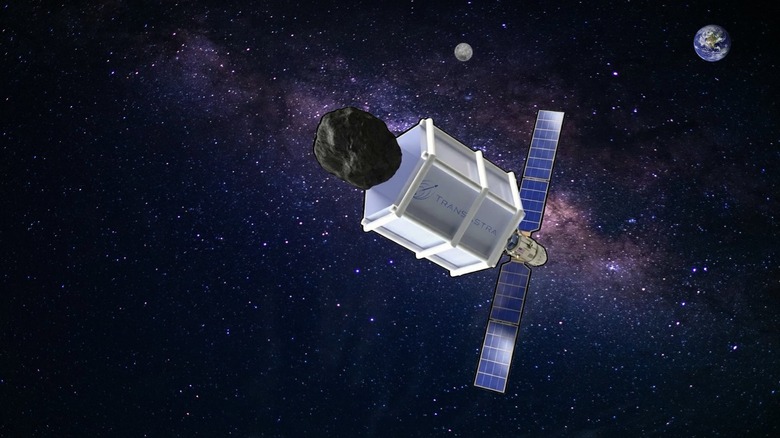
From "The Expanse" to "For All Mankind," asteroid mining is often portrayed in science fiction as a pillar of the future space economy or the next gold rush. With these fictional influences in mind, it's not difficult to imagine that investors are enticed by the prospect of trillions of dollars in minerals being up for grabs out in the solar system. The company TransAstra announced on Wednesday that an unnamed investor had agreed to fund the prerequisite study for an asteroid-capture mission. The aptly-named New Moon mission could be conducted as early as 2028.
New Moon would see the private company capture a 100-ton, house-sized asteroid with a massive capture bag and relocate it to a more accessible location near Earth. TransAstra CEO Joel Sercel told Ars Technica that there are up to 250 potential target asteroids with a maximum diameter of 65 feet that could be captured, redirected, and sent to a processing facility. The processing facilities could become self-sustaining with solar panels crafted from the ore and rocket propellant refined from the mined water. Sercel said:
"We envision it becoming a base for robotic research and development on materials processing and manufacturing. Long term, instead of building space hardware on the ground and launching propellant up from the Earth, we could harvest it from raw materials in space."
TransAstra is going to need a bigger bag
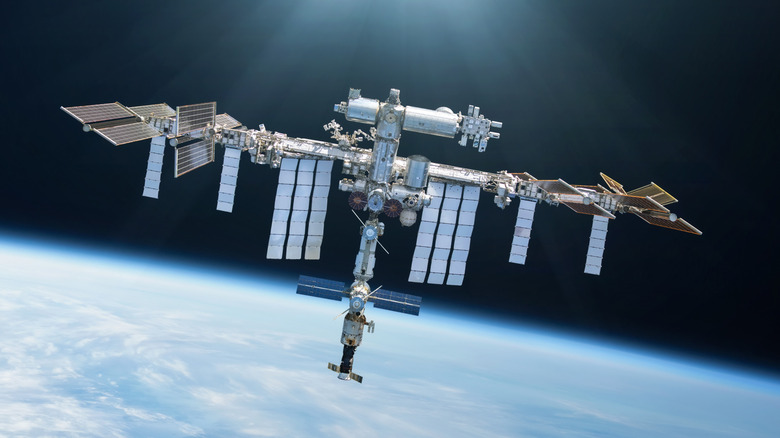
Sercel's grand ambition is to have a monumental mining facility positioned over 900,000 miles away from Earth. Then, theoretically, the mining could be done in space and the materials used to build off-earth. Before TransAstra starts harvesting asteroids by the hundreds, it needs to prove its technology for catching space rocks. The company tested a 3.2-foot-wide capture bag on the International Space Station last year. SpaceNews reported that NASA awarded TransAstra with a $2.5 million contract to scale up the bag to a 32-foot diameter.
The capture bag also has another purpose: clearing space debris. It might not be as flashy or lucrative as snatching pricy rocks for electronics, but debris could be so overwhelming that it obstructs humanity's access to space. The danger became very real last year when China's Shenzhou-20 spacecraft was damaged by debris to the point where it was unsafe for its crew to return inside the capsule from the Tiangong space station.