

Rolls-Royce Walks Back All-Electric Plan Because Some Customers Want A Worse Car
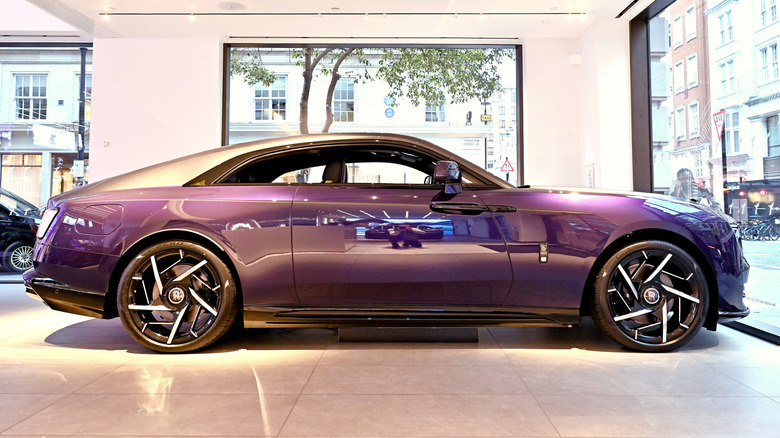
When the all-electric Rolls-Royce Spectre launched in 2022 the company was committed to ending its reliance on gasoline engines by the end of the decade. That decision made all the sense in the world, because the company's ethos is inextricably intertwined with quietness, refinement, and effortless power, which are exactly the things that electric propulsion brings to the table. Rolls-Royce CEO Chris Brownridge told The Guardian the V12 internal combustion engine is sticking around past the company's initial 2030 retirement target. "We can respond to our client demand," Brownridge added. "We build what is ordered."
Rolls is the poster child for why it makes sense to switch to electric, as the downsides of EV ownership flat out don't matter to the average Rolls buyer. The extra weight of batteries is practically a rounding error when you're talking about 5,700 pound luxury machines. Charging times are practically irrelevant when you have a hired driver and hundreds of miles of range. If you're going more than the estimated 329 miles of range in Rolls' Spectre EV, you're taking the private jet, natch. A lot of Rolls-Royce driving (or being driven) is done in the large city centers of Europe, most of which charge a significant congestion fee for gasoline powered vehicles as well.
The pros of EV adoption among Rolls-Royce owners dramatically outweigh the cons. I simply can't fathom why anyone with Rolls money would waste their time with the less efficient, slower, louder, and more bothersome twin-turbo V12 engine models. It isn't as though this V12 is a new engine, either. The 6.75-liter Rolls-Royce version of BMW's N74 engine was introduced in 2009, and its architecture dates back to the M70 V12 introduced in 1987. Since the N74 was removed from the lineup of BMW 7-series engines, it has been a Rolls-Royce exclusive engine since 2022, potentially having an effect on the economics of continuing its production.
Electric isn't dead
All of this, of course is in response to the watering down of Euro 7 emissions standards and the walking back of the EU's planned 2035 ban on internal combustion engines. Rolls was initially looking to get out ahead of these regulations and get its customers all-electric a few years early, that way if it spilled over a couple years, it would still be well within legality. Now that these rules have been relaxed, Rolls is content to keep chugging along on the old internal combustion train as if nothing happened.
"The legislation has changed," Brownridge said. "That prediction was based on a different set of circumstances. We recognize some clients would rather have a V12 engine. The V12 is part of our history."
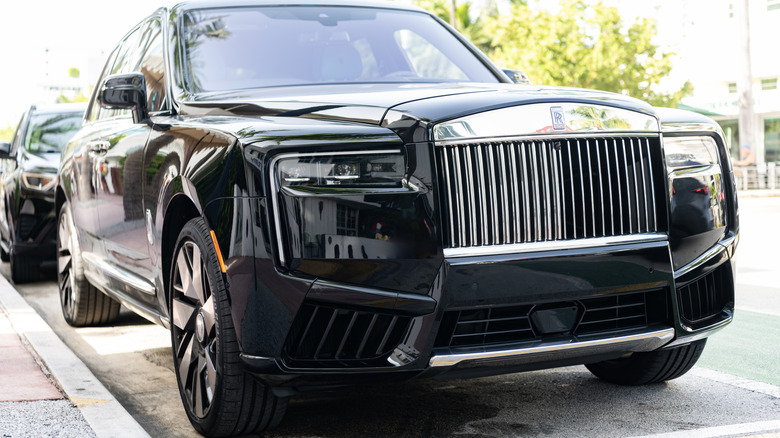
To Rolls' credit, the company isn't giving up on electric propulsion altogether. The Spectre will continue to sell, and the expected next-generation Cullinan will offer an all-electric option as well. Being that the Cullinan is far and away the most popular Rolls-Royce model in history, making it electric will significantly increase the number of electric Rolls-Royce cars on the road. It seems silly go "all-in" on a direction for the company only to reverse direction so willingly after the slightest hint of pushback. For how much longer will a V12-powered SUV achieving no better than 12 miles per gallon be considered classy and elegant instead of crass and wasteful?
If this were a sports car or grand tourer, I could understand wanting a wailing V12 under the hood, but taking the Rolls is supposed to be an otherworldly disconnected experience of refinement, and electric propulsion simply does that job infinitely better than a gasoline V12 ever will. Rolls has been endeavoring for decades to make its V12 as quiet and smooth as possible, but it still gets its butt kicked in NVH tests by the electric motor. You would be a fool to order a gas-powered Rolls, and that's completely ignoring the woke lib talking points like exhaust emissions, congestion charges, and the rapidly rising cost of fuel.