

The OG Four-Door Porsche Sports Sedan Wasn't Even Built By Porsche
The Porsche Panamera debuted more than 16 years ago, marking the brand's first foray into the production sports sedan segment. Offering between 400 and 500 horsepower between its naturally aspirated and turbocharged 4.8-liter V8 engine options, it showed that this legendary brand was capable of stretching out its signature 911 aesthetic, throwing in four doors, and offering fun driving dynamics in something that could comfortably fit four adults.
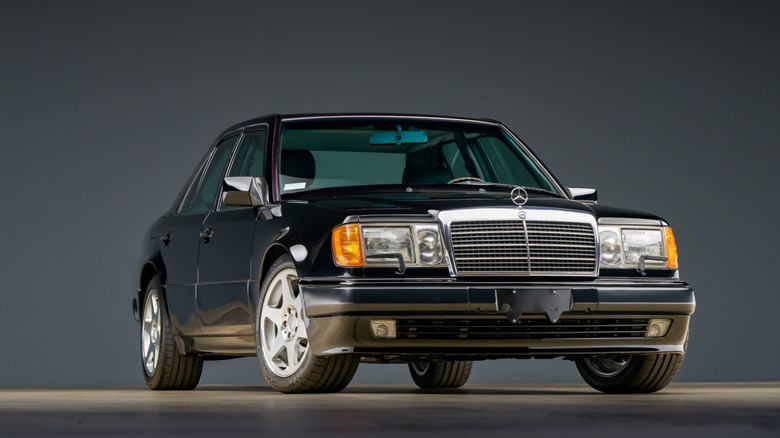
This wasn't the brand's first go at sedans. The 1990 Mercedes 500E may have been badged by its Stuttgart neighbor, but Porsche had a major hand in its development and construction. Then, there was the 1994 Audi RS2 Avant — okay, this technically was a five-door hatch, but so too is the Panamera — with Porsche DNA throughout its construction. Porsche even contemplated a four-door 928 that made it as far as the concept stage.
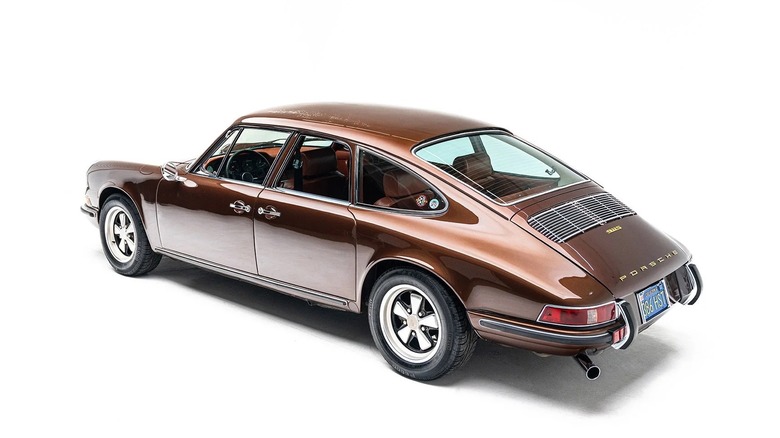
But there's a one-of-one Porsche that clearly predates all of the above. Back in 1967, the Panamera recipe was already in place, with the 911 shape stretched out to accommodate four doors. Admittedly, this OG four-door Porsche sports sedan wasn't technically even built by Porsche, but its history is far more fascinating as a result.
And then there were four
The 1960s were a thick chapter of American history. One year before recording artist Tiny Tim released his debut album God Bless Tiny Tim in 1968, a Texas-based Porsche dealer by the name of William Dick concocted one heck of an idea.
He wanted the two-door-favoring firm that he so proudly marketed to build him a four-door 911 S. Not just as a gift to his wife at Christmas, but as a proof-of-concept showing the versatility of a four-door performance sports sedan. In conventional form, the 2.0-liter flat-six in the S produced 180 horsepower, a five-speed manual gearbox was standard, and thanks in-part to lightweight magnesium wheels, it tipped the scales at just 2,271 pounds. At the hands of Car And Driver's testers, a 0-60 mph run was possible in just 6.9 seconds, with the quarter mile mark arriving in 15.6 at 90 mph.
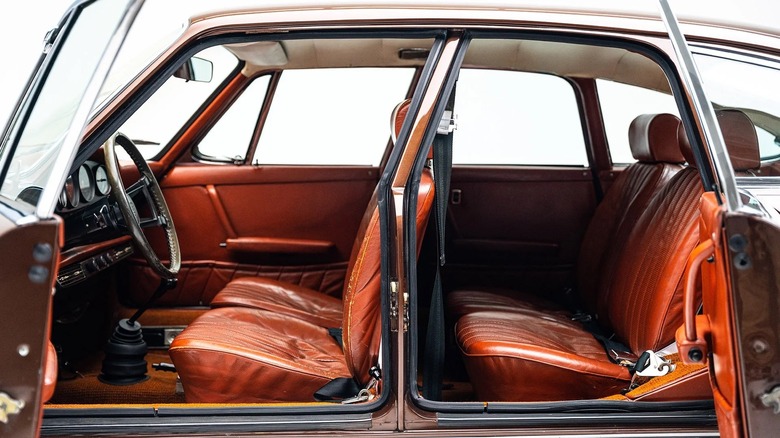
Porsche refused to elongate the 911, though, so he instead enlisted the help of California-based fabricators Troutman and Barnes. They cut a 911 S in half, welded in sheet metal to stretch it out, then integrated factory 911 doors behind the existing pair. The rears were "suicide-style", so they hinged at the back, and revealed a spacious rear cabin. Or at least, more spacious than a standard 911. As explained by The Petersen Automotive Museum, the interior leather was dye-matched to a pair of shoes owned by Dick, at the hand of the factory, and then crafted by well-known upholsterer Tony Nancy.
It's definitely odd-looking, especially considering the slender 911 body shape was now more egg-like. But still quite cool, and considering a 911's entire engine sits behind the rear wheels, it seems like it was a generally straightforward project besides the massive amount of body and interior work.
Porsche's hand in sedans ever since
Since 1967, Porsche has either had a hand in other automakers' sedans, come up with its own stretched-out 911 concepts, or finally put them into regular production. There was 1989's 989 concept, which looks like the precursor to the 996-generation's overall styling and had a naturally aspirated 4.5-liter V8 under its hood making 350 horsepower. That was cancelled in 1992. And that followed the aforementioned 928 four-door concept, scrapped in the late '80s.
In the early '90s, the Mercedes-Benz 500E saw Porsche contribute a portion of the bodywork, engine tuning, and chassis tuning. Production on each unit took 18 days, transferring between one of Porsche's Zuffenhausen facilities and Mercedes' Sindelfingen plant, twice.
The Audi RS2 sported an Audi body and paint, and the lion's share of necessary components from its other models, but the rest was taken care of by Porsche. The iconic wheels, brakes, and engine cover all let discerning consumers know that this was one of the coolest automotive brand collaborations, ever.
Then, we can't forget about the humble Panamera. When it initially debuted, this author found its fish-resembling body to be rather ugly, but it has matured well. Especially the most recent 976 generation that debuted in 2023. And considering the 'Mera's been around since 2010 and is still going strong (plus, there's also the EV Taycan sedan), it was clearly a wise move by the German brand. Still, it's funny to think that the OG four-door Porsche sports sedan wasn't built by Porsche, but was the brainchild of a Texan with a bit of imagination.