

Class 6 Vs. Class 8 Semi Trucks: What Are The Differences Between Them?
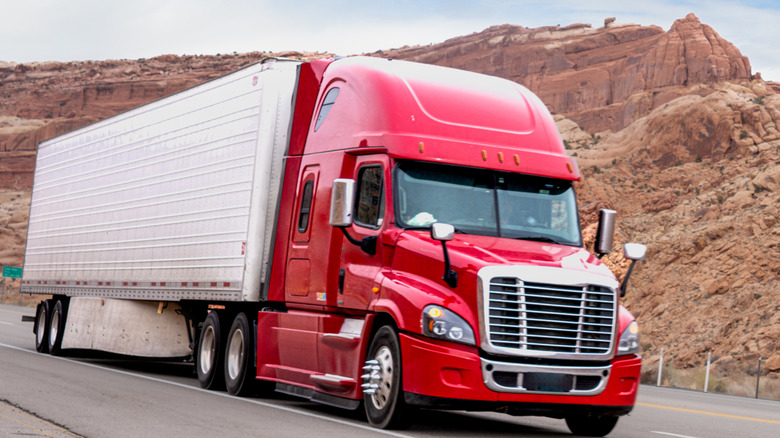
We're fascinated with anything with wheels, and it goes beyond your typical car, crossover, truck, or motorcycle. We care about them all, from the weirdest cars owned by celebrities to rare cars that only Jalopnik readers know about. However, we also have a thing for semis and big rigs, because what car-loving '80s or '90s kid didn't grow up pretending to be a truck driver, or at least mimicking pulling the cord for the train horn while pretending to be driving?
For truckers, operators, or fleet managers, though, it's not that simple. They know that commercial vehicles are sorted into classes based on their gross vehicle weight rating (GVWR) — the truck's maximum payload capacity, including fuel, passengers, cargo, and other accessories.
The U.S. Department of Transportation's Federal Highway Administration defines Class 6 trucks as medium-duty vehicles. Class 6 trucks include buses and delivery trucks with six tires or more and a GVWR of 19,501 to 26,000 pounds. If you happen to have a Class 6 truck in your stable, you'll usually need to obtain a commercial driver's license (CDL) from your state licensing bureau to drive it.
In fact, Classes 3 to 6 are all classified as medium-duty trucks. Class 3 are trucks with a GVWR of 10,001 to 14,000 pounds and six tires or more, while Classes 4 and 5 should have GVWRs of 14,0001 to 16,001 pounds and 16,001 to 19,500 pounds, respectively, as well as those same six tires. They're all single-unit vehicles with no more than three axles. And because they weigh more than 10,000 pounds, all of them should have a DOT number on both sides to conform with regulations.
Class 8 is for heavy-duty commercial trucks
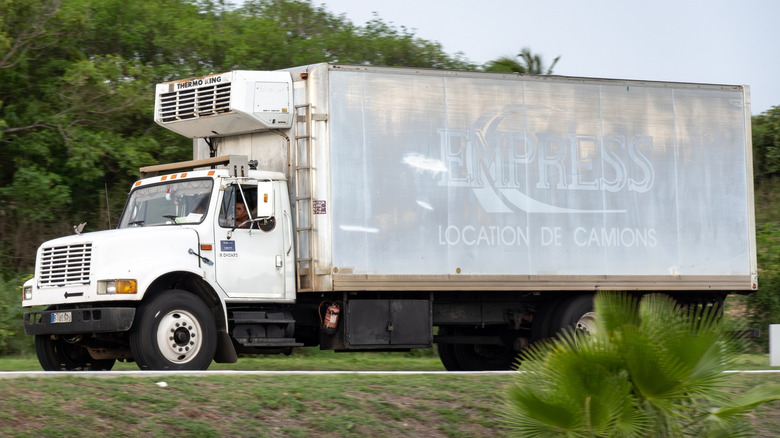
While classes 3 to 6 fall under the medium-duty category, classes 7 and 8 are classified as heavy-duty commercial vehicles with GVWRs of 26,001 pounds and over. Class 7 delivery trucks and tractor-trailers have a GVWR of 26,001 to 33,000 pounds and have six or more tires with four or more axles in a single unit. Meanwhile, Class 8 trucks have 10 or more tires and a GVWR of 33,001 pounds or more. Class 8 includes single-trailer trucks with two units and four or fewer axles. Other examples of Class 8 trucks include dump trucks, cement mixers, and large tour buses.
To sum it up, the primary difference between a Class 6 and a Class 8 truck is the gross vehicle weight rating. Class 6 trucks should weigh between 19,501 and 26,000 pounds, while Class 8 trucks have a GVWR of 33,001 pounds and over. The difference in GVWR also affects other variations, including the number of axles and tires.
What's the point behind all these truck classes and categories? They have to do with safety, driver licensing, permits, maintenance requirements, weigh station standards, and whether you need to comply with hours-of-service (HOS) laws. All drivers of trucks that weigh more than 10,000 pounds must adhere to and follow the HOS limits prescribed by the U.S. DOT's Federal Motor Carrier Safety Administration (FMCSA). They include a 14-hour driving window limit, an 11-hour driving limit, and 60-hour/7-day and 70-hour/8-day duty limits.