

How Catastrophically Bad Is Rod Knock For Your Engine?

Your engine can make a lot of weird noises, depending on what has gone or is about to go fully kaput. If it's a rhythmic pinging sound that progressively increases as you step on the throttle, otherwise called rod knock, chances are your engine is running on borrowed time. Ignore it for long enough, and yes, it can lead to the engine completely seizing, and you, stranded on the side of the road. And it's not a matter of "if" but "when".
But how can you tell if it's rod knock or something else, like a the sound of a failing water pump bearing or a tappety valve? Since they all sound very similar, your best bet is to enlist the help of someone with a trained eye — or ear, in this case. Even the detonation from your engine running lean or a defective knock sensor can often lead to sounds that are similar to rod knocks.
If you happen to be mechanically inclined, you probably know that diagnosing the origin of the sound is a good way to kick things off. If the ticking sound is toward the bottom of the engine and gets noisier as you press the throttle pedal, it's likely rod knock. On the other hand, if it's closer to the top of the engine and progresses relatively slowly, as demonstrated in this YouTube video, it's probably something related to the valvetrain.
Inspecting the engine oil for excessive metal shavings is another way of confirming your suspicions of a rod knock, provided it falls in line with the rest of the symptoms, like low oil levels and reduced oil pressure. For all this to make sense, though, it's important to understand the role of rod bearings and how they work inside an engine.
Understanding the root cause and how to fix it
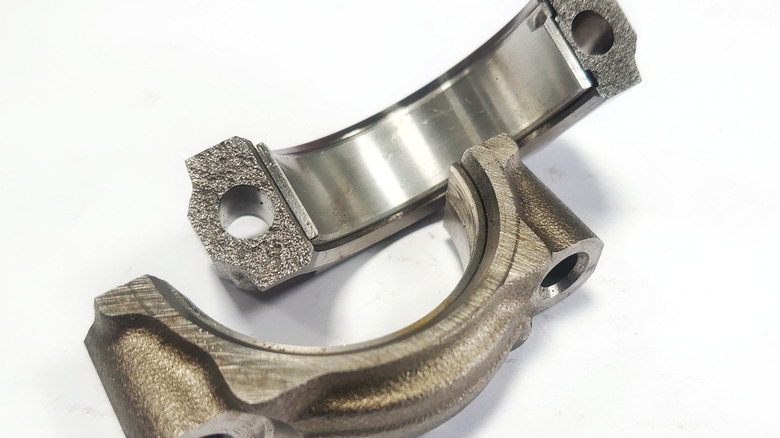
There's a bearing (typically of a softer multi-metal variety) sandwiched between the crankshaft and connecting rod, with a thin layer of oil acting as a barrier. This oil separates the bearing's surface from that of the crank journal, so when the engine is low on oil, the barrier weakens, resulting in direct metal-to-metal contact. Ergo more friction and, consequently, increased wear. Because engines often run on tight tolerances, this oil-starved, friction-induced gap is enough for the connecting rod to rattle around, causing the metal-on-metal sound that you hear as rod knock. This is different from engine knocking, and can also be a result of poorly designed rod bearings (as was the case with certain BMW M cars) or ones that are damaged or completely worn out.
Depending on the engine's "condition," you can perhaps continue driving the car, but it's generally not recommended. As you can probably tell, it's not one of those that's going to magically go away. It has to be fixed at some point. The longer it takes, the worse your repair bill is going to be.
Fixing rod knocks is relatively straightforward — you replace the bearings, which, in all fairness, is easier said than done. This sort of work, which typically involves taking apart the engine, is among the automotive maintenance jobs best left to the professionals. Assessing the extent of damage inside your engine will determine whether it's worth repairing or simply getting a replacement engine, because the increased friction may have damaged the crank's surface (which you can fix to a certain extent), among other things. But generally speaking, these engine-out jobs tend to be pretty expensive.