

The Owen Magnetic Walked So The Chevy Volt Could Run (Well, Until GM GM'd)
The Chevy Volt might seem like a cheap, funny-looking econobox to some, but it was so ahead of its time that automakers are just now catching up. While electric vehicles with gas engine generators or range extenders aren't special now, they were basically unheard of back in 2011, when GM first launched the Volt. And since the Volt was affordable, it brought long-distance electrification to the masses. The Nissan Leaf was cheaper but it only had 73 miles of range and that was it — time to charge. The Volt only had between 25 and 50 miles of pure electric range, but the gas-powered range extender increased that to 380 miles, at the equivalent of 93 mpg.
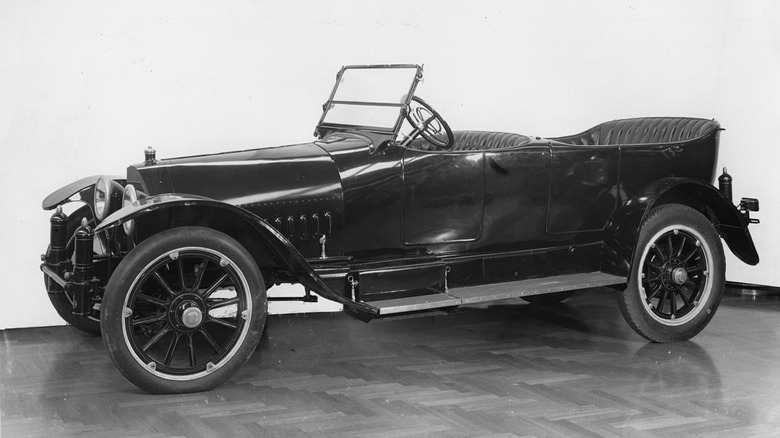
However, before GM could run with the Volt, something else had to walk first. And that something else was the Owen Magnetic, one of the weirdest things we've ever driven. The Owen Magnetic was truly a revolutionary machine, one that was almost a century ahead of its time. It was a hybrid whose engine never drove the wheels but only supplied power for an electric motor, and it debuted at the New York Auto Show in 1914.
Why the Owen Magnetic was ahead of its time
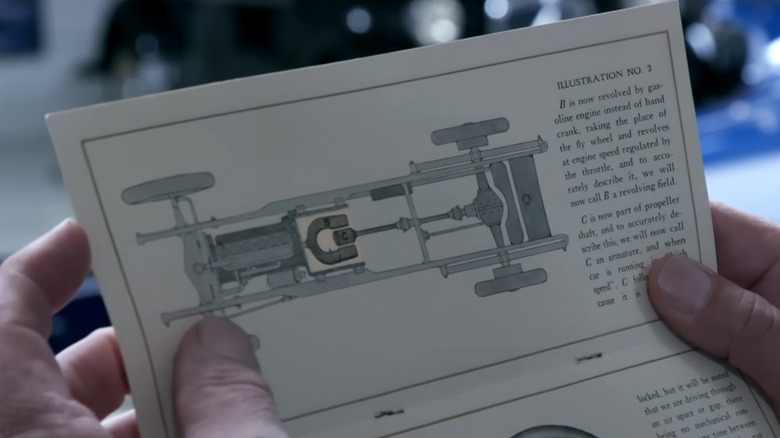
Electric cars aren't new. Inventors and engineers have been toying with electric propulsion since the 1830s. But using a gas engine to constantly power an electric motor, while simultaneously recharging its batteries, was a novel idea in the early 20th century. When engineer Justus B. Entz was first granted a patent for his "Dynamo-electric machine" (surely, you hear that in old-timey radio guy voice, right?), it was like nothing else before it.
Instead of having the engine drive the wheels, through a transmission, the Owen Magnetic's 374 cubic-inch six-cylinder powered a generator that was attached to the engine's crankshaft. That generator spun a big horseshoe-shaped magnet so hilariously old-fashioned and cartoonish that it looks like something Wile E. Coyote would use. The cartoonish magnet would spin around a steel armature, which would in turn cause it to spin from the magnetic imbalance. That spinning armature was connected to an electric motor and would create the current to drive the rear wheels.
There was no direct connection between the engine and wheels, nor was there a transmission. Instead, the driver controlled the "speeds" of the Owen with a rheostat lever mounted to the steering wheel. It was almost like a continuously variable transmission (CVT), just with the pros but without any of the cons, as it technically could have infinite "gear ratios." Thus it was nicknamed the "Car of a Thousand Speeds." It even had a 24-volt electrical system, which the engine would charge. You can see how it works and drives on Jay Leno's Garage YouTube channel, because of course Jay has one, and it's pretty fascinating.
The Chevy Volt didn't use a magnet but it had a similar idea
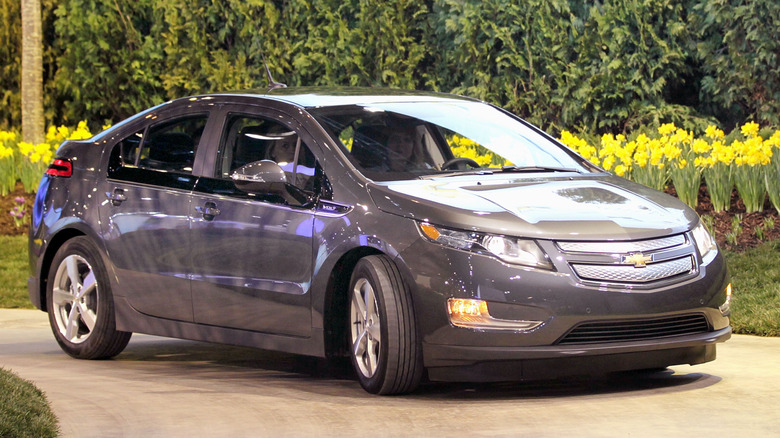
You can't say that the Chevy Volt is a modern-day Owen Magnetic, because they are mechanically very different. Not only does the Volt not have a giant spinning magnet in its belly, it can also drive without the engine running at all. As long as the 16 kWh battery pack has enough energy to drive the front-mounted electric motor, the engine stays off. And when the battery charge drops low enough, the engine will kick on and power a generator that will keep the electric motor spinning and charge the battery. So it works similarly to the Owen Magnetic, in that the engine powers a generator that runs an electric motor. However, the Volt doesn't need the engine to run.
The Volt also has another trick up its sleeve. Despite the electric motor handling propulsion, the engine can actually help out a bit. If the battery is completely flat and you're driving above 70 mph, a clutch connects the engine to the electric motor's planetary transmission to help drive the wheels. It's just a little boost for the motor, so the Volt is never fully driven by its engine, but it's something the Owen Magnetic couldn't do.
GM outdid itself with the second-generation Volt in 2016, adding more range, better performance, and a plug-in powertrain. So owners could actually plug it in at home to recharge the battery, using even less gasoline than before. The second-gen Volt helped to further democratize electrification as something affordable for families at a time when Tesla was far more expensive. Sadly, poor sales killed the Volt off in 2019, but the idea of series hybrids still lives on.