

The Saga Of This Cheap Bentley Flying Spur Shows Off Just How Tough Volkswagen's W12 Can Be
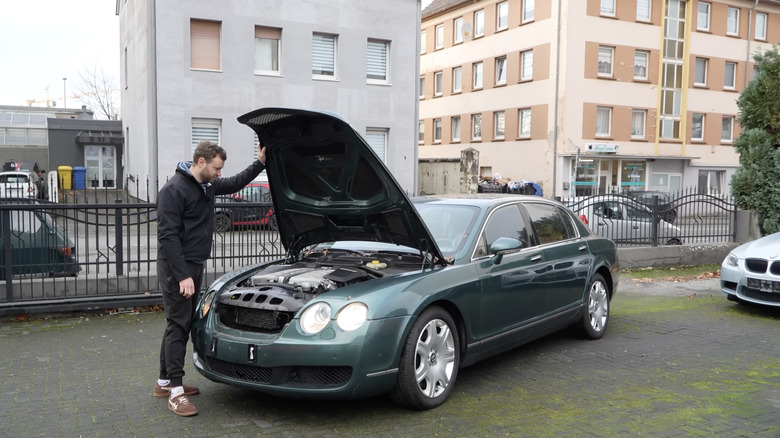
Buying the cheapest Bentley Flying Spur you can find sounds like a terrible idea. And, for the most part, it is. I strongly advise against it, no matter how good the deal seems on Copart. But it's certainly fun to watch other people do it, so we can live out our restoration dreams while assuming none of the financial, mental, and emotional risk.
YouTuber Sreten, host of the M539 Restorations YouTube Channel and glutton for mechanical pain, recently decided to buy the cheapest Bentley Flying Spur in Europe. Originally, his Bentley cost around $275,000, but he bought it for $12,500 — and it had over 160,000 miles on the odometer. And when he bought it, the Flying Spur was rough. Not only did it have several electrical issues, some rust, and a shocking paint job, but its interior was filled with mold due to the lakes in its footwells. However, the W12 seemed to run well, so it seemed like it could be a worthwhile project.
When Sreten got the cheap-o Bentley back to his shop, he fixed the sunroof drain leaks, spent days drying up the floor mat swimming pools, and even refurbished a leaky rear parking brake. It was looking like things were going smoothly, especially since the engine seemed solid. Then, once he finally got it out on the road and enjoyed the creamy smoothness of the fastest sedan in the world circa 2004, tragedy struck. It overheated.
Constant overheating can kill even the toughest engines but not the W12
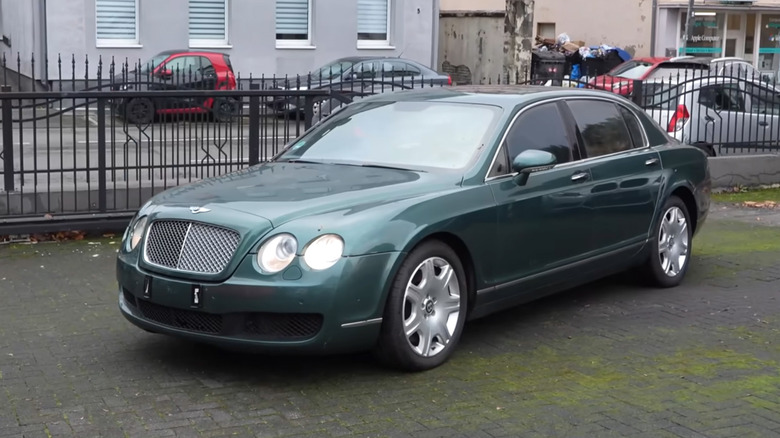
After much digging into the overheating issue, Sreten learned that it had been overheating constantly throughout the course of its long life. So much so that the original plastic coolant overflow tank had swollen. However, he couldn't find the reason why the temps kept rising, so he used a block tester to determine if combustion gasses were getting into the coolant. And, of course, the test said that they were, suggesting a blown head gasket or cracked cylinder head
Despite the test, Sreten wasn't convinced. The W12 had no other symptoms of a blown head gasket, so he did some more digging with a borescope to check the cylinders and pistons for any signs of a different problem. He found that the head gasket seemed fine, but the engine had been overheating so much that one of the cylinder head bolts stretched. So whenever the engine was under load, the increased pressure would lift the cylinder head slightly, allowing combustion gasses to enter the coolant.
Replacing just one cylinder head bolt is the wrong way to fix such an issue, which he admitted. But the old Bentley was so beat up that it wasn't worth removing the entire engine to do it properly. After replacing the bolt as carefully as possible, so as to not damage the head or gasket, it seemed to work — until it didn't. It was still overheating. More digging, along with some trial and error, had him replace sensors and radiator fans, and he even found that the engine lacked a thermostat completely. The W12 had overheated so often, without an obvious explanation, that a previous owner removed the thermostat entirely to see if just permanently running coolant through would fix it. The fact that it was still regularly overheating without a thermostat signaled bad news for the Flying Spur.
Somehow, the W12 lives
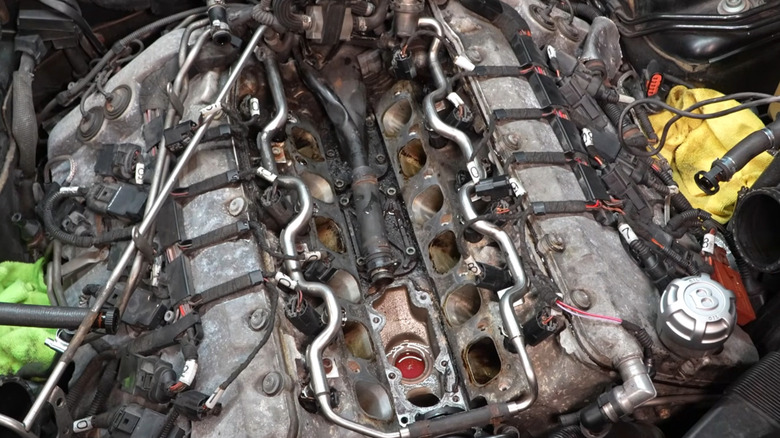
Sreten finally learned that the radiator had some blockage, so he bought a new radiator and, voila, that finally did the trick. With the new radiator, new cylinder head bolts, an actual thermostat, and new coolant tank, the mighty W12 lives and runs smoothly. Well, sort of. A bad turbo boost solenoid keeps the engine in limp mode, and requires the entire engine to come out to replace. But with the engine running without overheating, that's a job worth doing.
All in, Sreten has spent $16,431 and countless hours of work on this Bentley so far, and there's still more to come. But at least Sreten's Bentley proves that Volkswagen's W12 is incredibly robust. It withstood potentially years of overheating, enough to stretch head bolts and damage a coolant tank, and it's still not only alive but running as smoothly as it did two decades ago. It's understandable to fear working on such a complex engine, but the W12 is a lot tougher than you might think.