

The Giant Engines That Helped The B-29 Superfortress Rule The Skies
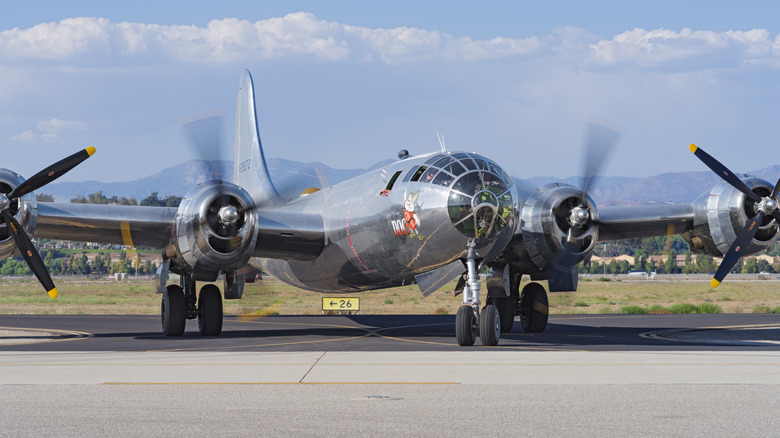
One of the U.S. military's most notable bombers, the B-29 Superfortress, was an indispensable aircraft from World War II through the Korean War. With a length greater than an NBA basketball court at 99 feet, and a wingspan of over 141-feet (more than three city buses parked end to end), the B-29's formidable size offered unprecedented capabilities for its time, though it would be surpassed in dimensions by later aircraft like Boeing's ever-youthful B-52 bomber.
The B-29 Superfortress also could fly weighing as much as 133,500 pounds by using four Wright R-3350-23 Duplex-Cyclone engines, each pushing out 2,200 to 3,500 horsepower. Each radial engine displaced 3,350 cubic inches, or almost 55 liters. Comprising 18 cylinders and twin turbo-supercharged, this engine used air-cooling to manage heat and is considered one of America's most potent engines of this type. Each ran a propeller measuring over 16 feet in diameter, spinning at a little over a third of the engine's rpm. For example, the B-29's engines would run at 2,800 rpm when working to get the plane airborne, and the massive propellers were spinning at around 980 rpm.
While powerful, each engine contributed to the aircraft's overall weight, tipping the scales at greater than 2,700 pounds each. The plane itself weighed nearly 35 tons empty, but unbelievable as it sounds, the B-29 didn't make our list of the biggest planes ever made, with some models surpassing 600 and even 700 tons.
The Wright R-3350 used forced induction and fuel injection
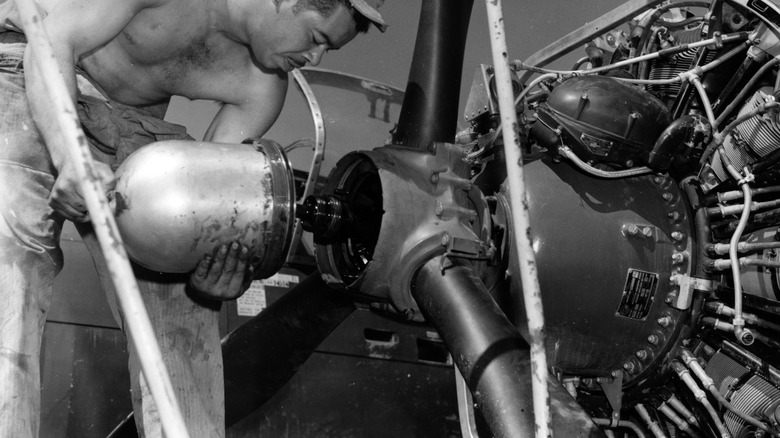
With an altitude maximum of around 33,600 feet, the B-29 could cruise in environments with greatly diminished oxygen. One reasons this was possible was the forced induction system built into each Wright R-3350 engine. With twin turbo-superchargers added to each of the four power plants, compressed air with greater amounts of oxygen was pushed into the engines, enabling more efficient combustion. This was especially critical at high altitudes where the engines may have struggled to produce as much power otherwise. But while designed for high-altitude daylight operations, the B-29 ended up being far more effective on low-level night raids.
The first iterations of the Wright R-3350 encountered some difficulties the engineers had to correct. They were equipped with carburetors that mechanically combined air and fuel in the proper proportions for combustion. However, the mixtures weren't quite coming out right, leading to engine fires and backfires. So a fuel-injection configuration was installed with an impeller replacing the carburetors. According to NASA, this change — along with more efficient airflow via baffles — offered a 38% improvement in performance during 1944 tests.
The purpose of the B-29 and how it contributed to American efforts across two wars
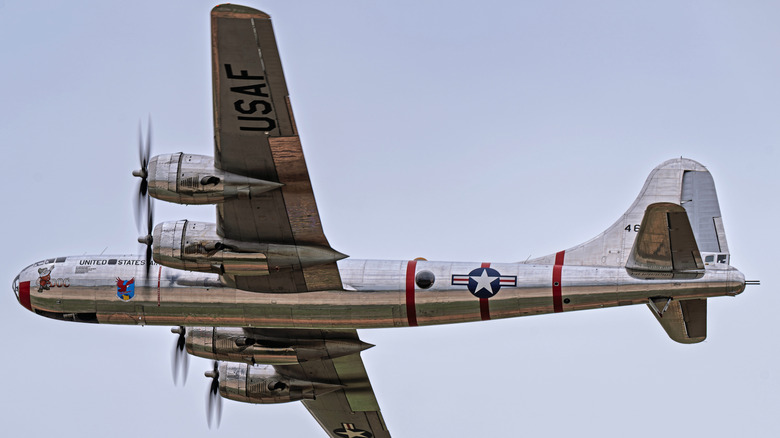
During World War II, the U.S. was engaged in multiple theaters of combat operations: Africa, Europe, and the Pacific. One issue with fighting Japan in the Pacific was the immense distances that had to be overcome, so American forces were looking for a high-tech bomber that could haul 10 tons of bombs and covering a radius of around 2,500 miles. After considerable prototyping, the B-29 was born, though it came at a considerable cost of $3 billion ($69.7 billion today).
This aircraft became a crucial tool in attacks against Japan, where its range made lengthy trips a nonissue. The B-29 ultimately delivered the atomic bombs to the cities of Hiroshima and Nagasaki. But not all of the standard ordnance dropped on the country detonated on impact. IA 500-pound World War II bomb unexpectedly exploded at an airport in Japan in 2024, more than 75 years after it fell.
Still in service as the Korean War kicked off, the B-29 effectively delivered around 167,000 tons of ordnance during its various operations. However, the large B-29 showed its weakness to newly developed enemy fighter jets designed to intercept the slow flying bomber. According to Nuclear Companion, 16 B-29s succumbed to MiG-15 jets in combat. As America's military aircraft steadily became jet-powered, the impressive, but dated, final B-29 model was phased out in 1960.