

The Rearview Mirror Wasn't Just Invented For Safety
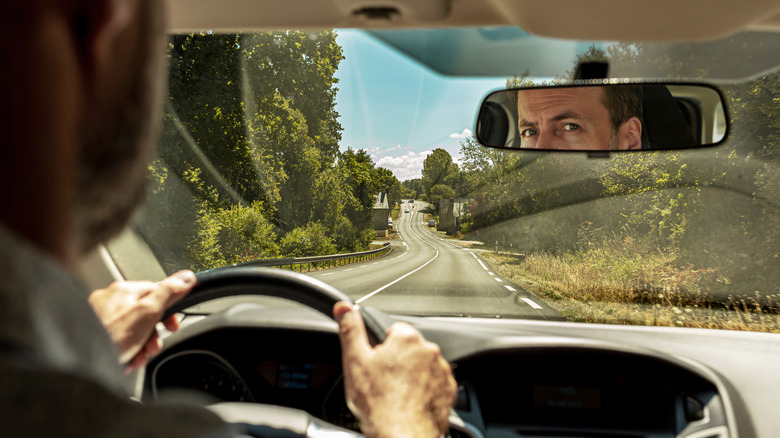
Mirrors in cars are easy enough to understand. Mirrors help drivers grasp a better perception of what's happening around and behind the vehicle, but it wasn't until 1966 that mirrors became standard fare in production cars. It's quite perplexing to think about driving on today's roads without mirrors, especially knowing that the history behind them has more to do with speed than safety.
In 1911, Ray Harroun installed a mirror in the cowl of his six-cylinder Marmon Wasp racing car, essentially birthing the first-ever rearview mirror on a vehicle. Back then, the rules said you needed a driver and a mechanic to go racing. When in motion, the mechanic is like a second set of eyes that informs the driver what's happening to the rear and sides of the vehicle.
However, Harroun was thinking about something else. You see, Harroun was an engineer at Nordyke & Marmon before stepping into the driver's seat, and he was probably aware that weight savings wins races. Besides, he was entirely confident in his Marmon Wasp's reliability, so he convinced race officials to forego a co-driver and use a rear-facing mirror to address safety concerns. Inspired by the rearview mirrors in the horse-drawn taxi cabs of Chicago, Harroun drove his car to victory in the inaugural Indianapolis 500, which also proved that his experiment with mirrors was a resounding success.
Then again, it had more to do with his lighter car than the mirror alone, since Harroun later said that the brickyard pavement of the Indianapolis raceway made his rearview mirror vibrate so rapidly that it was almost impossible to discern what was behind him during the race. The mirror didn't fall off as some Honda side mirrors did in 2023, but he did win, with or without mirrors.
From racing heroics to 'Cop Spotter'
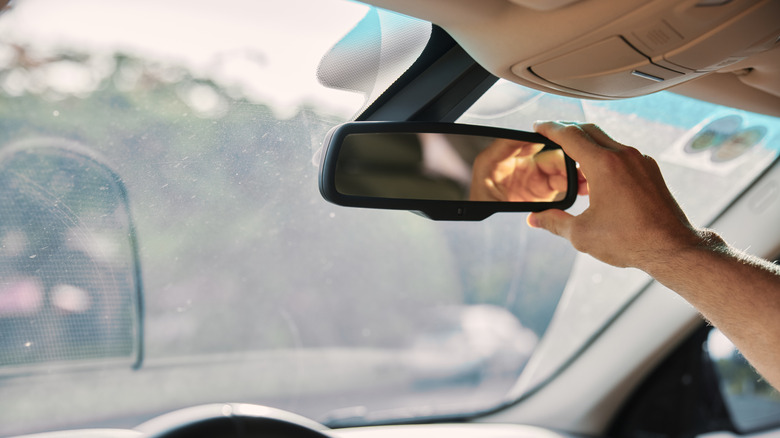
Although credit goes to Ray Harroun for first putting a rearview mirror in a moving car, it wasn't until 1921 that engineer and inventor Elmer Berger began selling mirror accessories for cars. Affectionally called the 'Cop Spotter,' Berger's rearview mirror was a 3 x 7 plate glass that attached to the top of the windshield. It was nowhere as fancy as the weirdest mirrors we've seen in cars, but it worked.
As per the name, Berger had law enforcement in mind when conceiving the Cop Spotter, but little did he know that his $4 accessory would lead automakers to make mirrors standard in production automobiles, albeit in a somewhat 'why didn't we think about that first?' moment. Yes, Berger was the first to commercially market rearview mirrors for cars, but Ray Harroum beat him to the punch in thinking about installing mirrors in a moving vehicle.
Berger filed patents for his Cop Spotter, and some sources say he was granted them. However, we couldn't verify this fact, although we do know he profited nicely from his endeavor. What we did find was that Chester Weed received a patent in 1914 for a 'mirror attachment for automobiles,' essentially beating Berger by seven years.
Dorothy Levitt birthed the idea of a mirror for cars
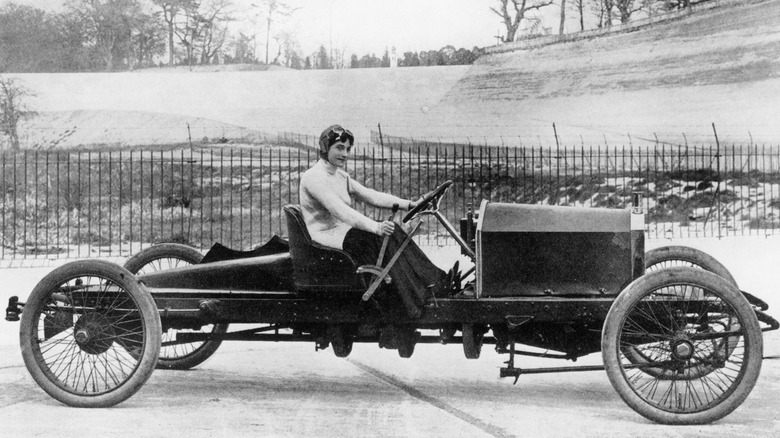
Ray Harroum, Elmer Berger, and other distinguished gentlemen can share the spotlight on the use of mirrors in cars. However, British driver, author, and prolific record holder Dorothy Levitt is widely credited for being the first to recommend using mirrors when driving, with other courses claiming her as the rightful inventor of the rearview mirror.
We assume this was before tailgating or following a car too closely became habitual among drivers, but Ms. Levitt didn't need patents to claim her place in automotive history. In her 1909 book titled "The Woman and the Car: A Chatty Little Handbook For All Women Who Motor or Who Want to Motor," Levitt mentioned a mirror with a handle to be useful for seeing what's behind you.
Dorothy Levitt was not just another talking head who knew how to drive. She was genuinely interested in the intricacies of the automobile, and her experience goes beyond driving and fixing cars. Levitt was the first British woman racing driver and was the world's first water speed record holder and the first woman to hold a land speed record. If that's not enough, she drove from Liverpool to London and back in an eight-horsepower De Dion-Bouton in 1905. She covered 411 miles in just two days. What's more impressive is she did it all alone and without a mechanic on tow.