

The 1957 Aurora Safety Car Looks Ready To Scoop Up Krill Into Its Gaping Maw
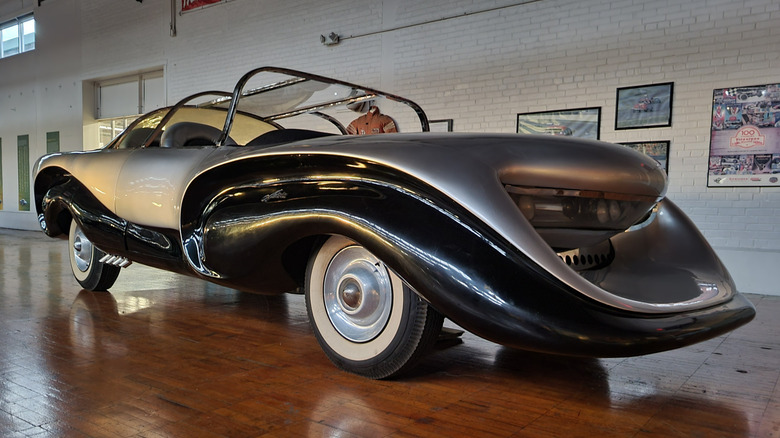
In 1938, when he was 19 years old, Alfred A. Juliano faced a crossroads in his life. On the one hand, he seems to have grown up as a gearhead with a talent for automotive design. In fact, after GM got a look at some of his drawings, he had a chance to start learning the craft under the General's high priest of styling, Harley Earl. Who knows, Juliano could have ended up having a hand in the creation of the Y-Job, which debuted that same year as the industry's first modern concept car. Yet he was already well on his way to becoming a Catholic priest.
In the end, God won out over the General and Juliano donned the white collar, albeit after studying aerodynamics at Yale. Still, if the one and only car he produced was any evidence, it was a good thing he answered the higher calling. Juliano's 1957 Aurora Safety Car may have incorporated some notable passenger-protection principles, but the car's exterior design, with a convoluted full-fiberglass body, looked like an abomination to many. The front of the car was particularly, uh, interesting, thanks to a huge mouth that looked ready to suck pedestrians off the road like a combination of a giant Hoover and a baleen whale.
And although that really was its basic purpose — to safely and softly gather folks up instead of flattening them, like today's tall hoods and big grilles — the Safety Car was a victim of Juliano's good intentions. He didn't think folks would buy a car just based on its safety performance, so he purposely jazzed up the body to get their attention. Which he did, but in the wrong way.
Safety features from the Safety Car
Nor was the front-end, helpfully stuffed with foam, the only styling cue inspired by a need for keeping people safe. The bulging frontal lobe of a windshield was engineered to prevent the driver and front passenger from hitting their heads on the glass during an impact — the fact that it caused people to stop and stare was an intended consequence, too. It was the same story with the car's overall shape as well: It both distinguished the Safety Car from the more typical fare of the time and helped improve structural rigidity. As for further, unseen impact protection, the Juliano had the Aurora's spare tire mounted in front of the bumper. The car's flush door handles were another nice touch, though we don't consider them as safety measures today.
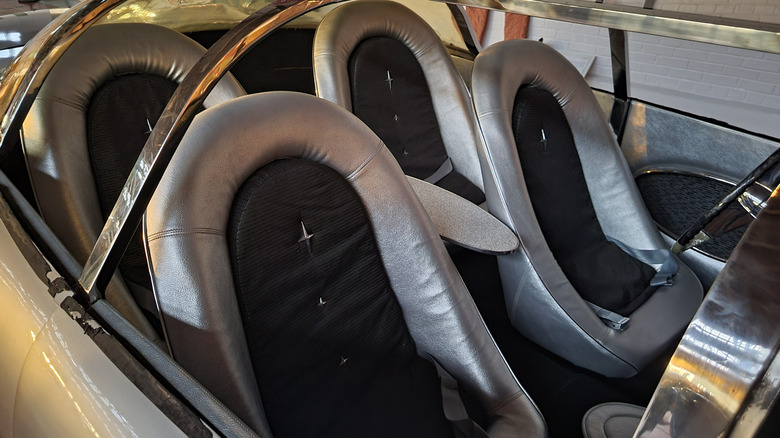
Notable interior features included seat belts, which had been first introduced as an option on Nash vehicles in 1948 and wouldn't become standard for the industry until Volvo debuted the three-point belt in 1959 – although the Swedish company's U.S. patent for them was only issued in 1962. A telescoping steering column, a padded dashboard, dual roll bars, and "puncture proof" tires were also all on board. So were swiveling bucket seats at all four seating positions. The concept was, if passengers realized they were about to be in an accident, they could change the seats' orientation to lessen potential consequences.
It wasn't a lack of interest in safety, or its outrageous looks, or its equally outrageous price — $15,000, or more than $176,767 today — that likely killed the Safety Car, however. It was that Juliano didn't put much effort into anything else.
What happened to the Aurora Safety Car?
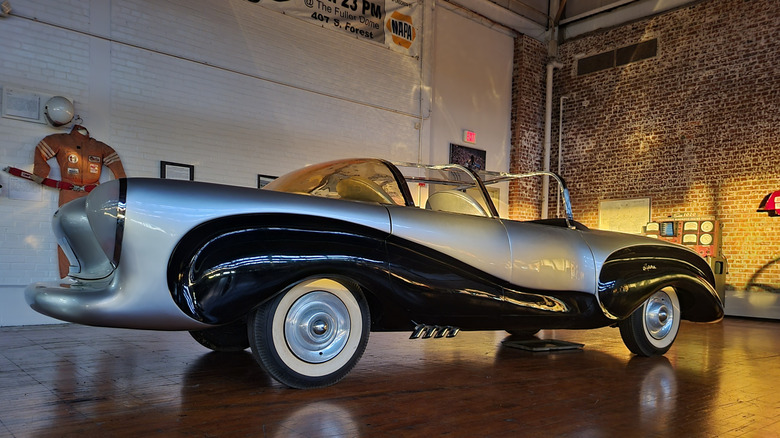
Juliano put the car together in a Connecticut horse stable in the mid-1950s, starting with the remains of a previously wrecked 1954 Buick Roadmaster. He hoped to premiere the Aurora at the 1956 Hartford Autorama, but when he couldn't make the deadline, he set his sights on a big-time debut in Manhattan the following fall. He barely made that one, arriving eight hours late, and that was an impressive feat in and of itself. By neglecting any routine maintenance, the car ended up breaking down 15 times on its journey from Connecticut to New York, mostly because of rust and water getting into its fuel line. Then, when Juliano did arrive, the remaining media on hand was more interested in the car's recent road trip than its safety technology.
It looks like the good father abandoned the Aurora in a Connecticut body shop soon after, then also left the priesthood when he was allegedly caught in some financial shenanigans with funds originally meant for the car. At least he wasn't caught allegedly rigging his church's Corvette raffle, unlike some priests.
That said, the story does have a positive ending. After having undergone an 11-year restoration at the hands of British vintage-car expert Andy Saunders, only to have it driven into a concrete traffic bollard a few years later, the Aurora Safety Car is now undergoing a comprehensive restoration at the legendary Lane Automotive Museum in Nashville — where it's expected to become the second example from a whole collection of American safety cars at Lane. The first? The fantastically named Sir Vival car built by Walter Jerome and based on a Hudson.