

Hydraulic Vs Rubber Engine Mounts: How Are They Different And Why It Matters
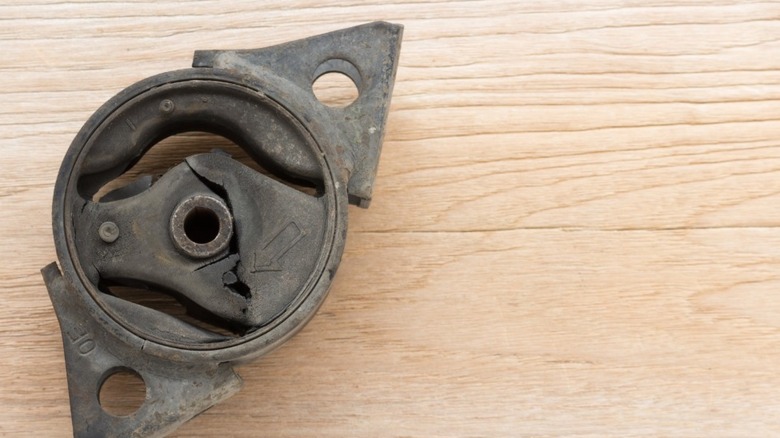
Most engine mounts are pretty simple, but they handle two very important jobs: They help keep the engine in place and bear its weight, and they cut down on the vibration and noise so that you can have a relatively comfortable and quiet ride. This is true whether the engine mounts are rubber or hydraulic.
What's the difference between these two mounts? The obvious difference is in their names. Rubber mounts consist of solid rubber, and hydraulic mounts contain hydraulic fluid or gel. But that means that they go about the job of controlling vibration much differently. Conventional rubber mounts absorb vibrations while providing enough flexibility for the engine to move a little. Hydraulic mounts adapt to a wider range of vibrations by adjusting the way fluid moves around inside of them. There are other differences. For one, hydraulic mounts are more expensive than rubber mounts. Additionally, rubber mounts are more durable than their hydraulic cousins.
Why does it matter? Well, it matters if comfort is a high priority, like it typically is when building a luxury vehicle. Because hydraulic mounts can adapt to a wider range of vibrations, they provide a significantly more comfortable ride. Of course, there are other elements that make a ride comfortable, like the features found in this list of the most comfortable cars on the market. On the other hand, when durability is especially important, like in certain racing applications, then solid rubber mounts are the preferred choice.
How rubber engine mounts work
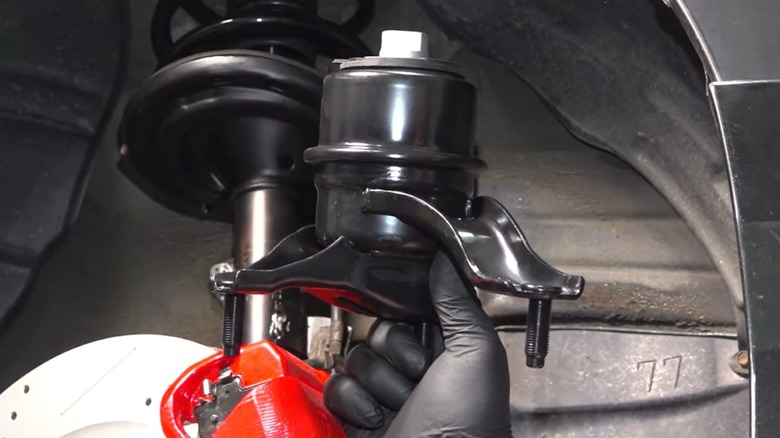
Your car's engine shakes a lot when it is running. It can also move a lot depending on how rough the road is or how many bumps and potholes you hit. You don't feel it so much, thanks to your engine mounts. A rubber engine mount is pretty simple in design — it's basically a rubber spring sandwiched between two metal plates. One metal plate is bolted to the engine, the other is bolted to your car's frame. The rubber absorbs the shaking and vibration. Without the rubber spring, if your engine were bolted directly to the frame, the whole car would shake with the engine, or the engine may detach from the frame. If you're interested, here are some other causes of engine vibration.
The function of an engine mount is twofold. One of the things a mount does is to act as a spring, meaning it supports the weight of the engine, while allowing it to move by contracting and expanding. Rubber is good for that, and this is important, as the engine needs the ability to move without also moving the frame, but it should not move or vibrate too much. So, the second thing an engine mount does is dampen vibration by turning that energy into heat. This is all determined by how stiff or soft the rubber is. Stiffer rubber provides more control, while softer rubber allows for more comfort.
The pros and cons of rubber engine mounts
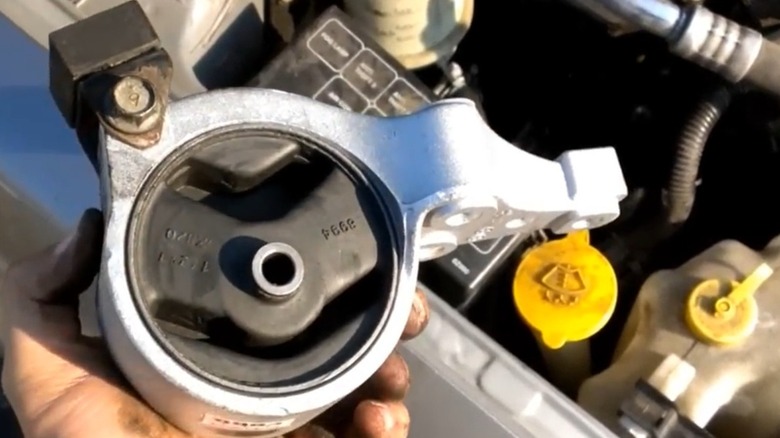
To understand the limitations of rubber engine mounts, you have to understand the difference between amplitude and frequency when it comes to engine vibration. Amplitude is basically how hard the engine is shaking, while frequency is how fast it is shaking. Low‑frequency, high‑amplitude situations like shifting or takeoff require the mounts to be stiff enough to dampen the shake. High-frequency, low-amplitude situations need the mounts to be softer so that the vibrations aren't felt inside the car. The problem with conventional rubber mounts is that they can't adapt their stiffness to different situations. They have to be manufactured for a certain range of amplitudes and frequencies. They are often too stiff to provide as comfortable ride at low speeds as hydraulic mounts.
That's not to say rubber mounts don't have their advantages. They are significantly more affordable than hydraulic mounts, for one. And since they are just rubber and metal, there is nothing to leak out, unlike with hydraulic mounts. There's not as much that can go wrong with them, in general, since the design of a rubber mount isn't all that complex. Because of that, rubber mounts are more durable than hydraulic ones. They aren't indestructible, of course. They eventually wear out, as they will harden over time. Oil that has leaked onto them and extreme heat can cause them to crack and deteriorate. But overall, they should last longer than hydraulic engine mounts.
How hydraulic engine mounts work
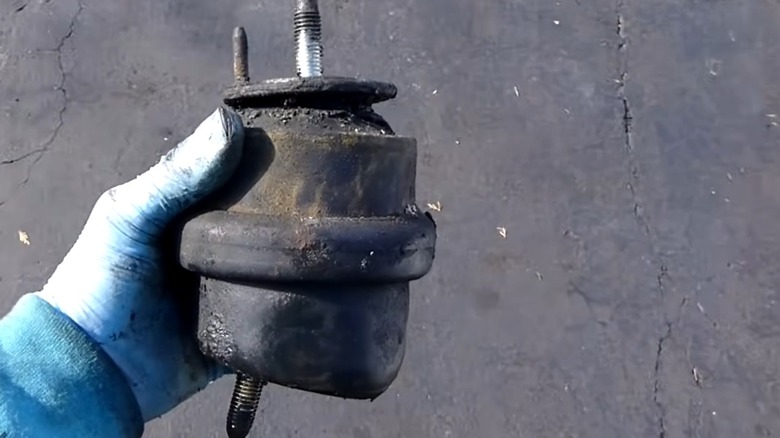
Hydraulic engine mounts are, in fact, rubber mounts. The difference is that they have rubber toward the outside, and hydraulic fluid on the inside. The hydraulic fluid sloshes back and forth between two chambers, an upper and lower chamber. There are typically two holes between the chambers, one big hole, and a smaller one, called an inertia track. There's also a thin plate called a decoupler that floats between the chambers. When the fluid flows easily between the two chambers, the mount is softer or more flexible. When the fluid doesn't flow quite as freely, it's stiffer.
One way to understand how hydraulic engine mounts work is to think about a full squeeze-bottle of ketchup. You can either flip open the cap and squirt the ketchup through the small hole or screw the cap off entirely and dump the ketchup out that way. You have to squeeze harder when you're squirting the ketchup through the small hole because there's more pressure, so the bottle feels stiffer. But if you take off the cap, the ketchup flows quite easily and the bottle feels softer or more flexible.
Hydraulic mounts work similarly. Fluid flows quite freely through the big hole between the chambers during smaller, faster (lower-amplitude, higher-frequency) vibrations, so the mount has the softness it needs. But larger, slower (higher-amplitude, lower-frequency) vibrations push the decoupler against the big hole, covering it and forcing the fluid through the smaller hole, making the mount stiffer, or less flexible.
The pros and cons of hydraulic engine mounts
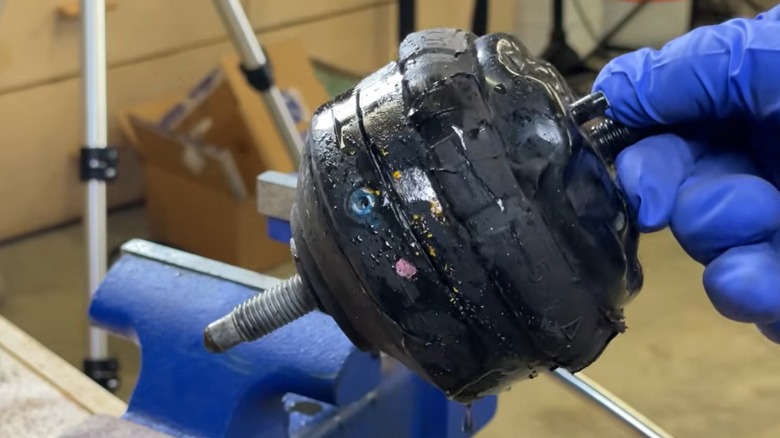
The main advantage of hydraulic engine mounts over conventional rubber mounts is their adaptability. Since their stiffness adjusts depending on the type of vibration, hydraulic mounts provide for a much more comfortable ride within a wider range of engine motion. What's more, a hydraulic engine mount can be tuned for different conditions. Conventional rubber engine mounts don't have that kind of adaptability.
However, hydraulic engine mounts can be hundreds of dollars more expensive than conventional rubber mounts. This is no doubt why they end up in luxury vehicles, and it may be why many automakers use a mixed set of engine mounts, consisting of both hydraulic and conventional rubber versions.
Another downside of hydraulic engine mounts is their complexity, which means more can go wrong with a hydraulic mount than a conventional rubber one. That's especially true of the possibility of springing a leak. Once a hydraulic mount has leaked out its fluid, it will wear out much more quickly. Hydraulic engine mounts can also collapse over time. That can impact the height of the engine and cause damage to other components. Hydraulic mounts are overall less durable than conventional rubber engine mounts. Their complexity also makes them harder to install than conventional rubber mounts.
Can you replace worn hydraulic engine mounts with rubber ones?
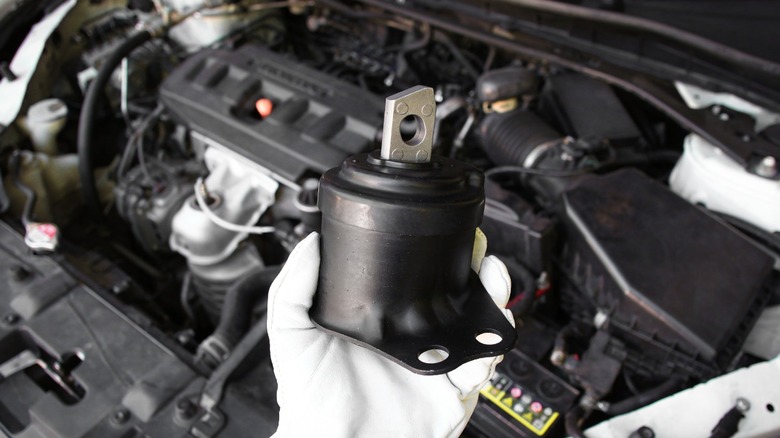
Is it okay to save a few bucks by replacing worn hydraulic mounts with rubber ones? While we always recommend checking with the manufacturer, product descriptions for some aftermarket rubber mounts say they can replace hydraulic mounts. This can make financial sense if your car is older and you don't intend on keeping it much longer. It also makes sense in certain racing applications. However, you will likely notice an increase in vibration and engine noise. You'll also want to be careful not to replace your mounts with solid rubber mounts that are too stiff. It's been found that increasing stiffness by 50% can have a serious impact on the life of the gearbox bearings. And if you have those fancy active mounts or any other kind of mount that plugs into your car's computer, trying to replace them with anything else will likely cause the check engine light to come on, since the computer won't be able to tune the system.
Should you upgrade to hydraulic mounts if your factory mounts were solid rubber? It's not worth it, in our opinion, especially if you haven't noticed excessive vibrations or road noise. Rubber mounts will get the job done, unless they're defective, of course. In 1971, GM motor mounts became part of one of the largest recalls in history. But in most cases, either type of mount will support your engine and dampen vibrations.