

The Term 'Supercar' Existed Long Before The Miura
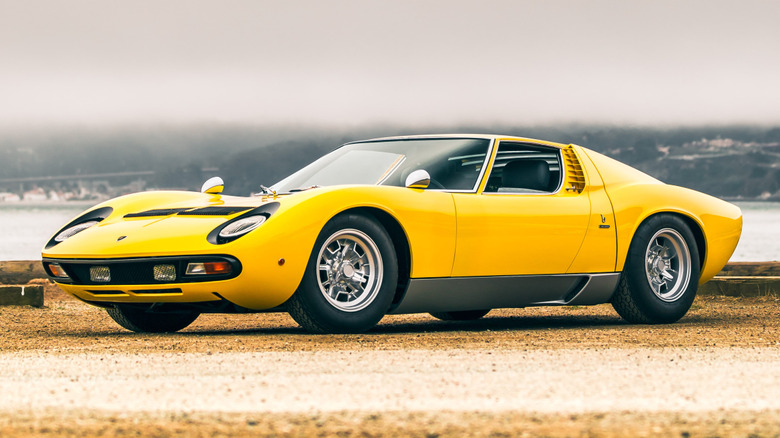
Hate to break it to you, but if you thought the Lamborghini Miura and its 345-horsepower V12 introduced the term "supercar" into the automotive dictionary, you're sorely mistaken. It seems hilarious by today's standards, but the first recorded account of the term "supercar" came in 1920, when a British newspaper used it to describe the might of the 6.7-liter Ensign 6, a high-performance motor car that had nearly 39 horsepower. Perhaps not as glamorous as we thought, but that's roughly twice the power of a 1915 Ford Model T.
Although "supercar" is used and abused in today's journalistic landscape, we can't help but wonder why the late L.J.K. Setright (from CAR Magazine) chose the '67 Miura as his preferred automobile to popularize the term. Was it just the looks, or did its engineering and sophistication play a part? There's no denying that the Miura brought along several chassis advancements, and it certainly was/is a looker. Performance was also a step above its rivals at the time. However, one might even argue that the 1954 Mercedes-Benz 300 SL Gullwing and 1962 Ferrari 250 GTO are equally deserving of the title.
This is perhaps a convenient segue into defining what a supercar is. We reckon a supercar is something that's fast, attractive, and not easily attainable. But then, does that make the 2026 Porsche 911 Turbo S or Ford Mustang GTD a supercar? Unfortunately, these days, the line between a sports car and supercar is as blurry as a fogged windshield, so we have to be a bit more nuanced than that.
Sports cars versus supercars
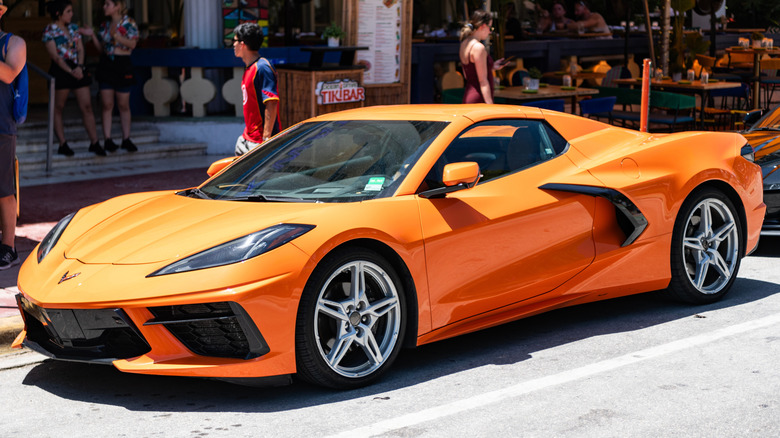
Although there's no written rule in place, for anything to qualify as a supercar, we reckon it has to be gorgeous and poster-worthy. But where do you draw the line on performance? The Turbo S and Ferrari 296 are fast cars, but so are BMW M4s and C8 Corvettes. Maybe it's 0-60 times? The Dodge Challenger SRT Demon 170 has roughly the same 0-60 time (on a non-prepped surface with stock tires) as a Lamborghini Huracan.
The Demon 170, despite its 1,025 horsepower, is not a supercar in our books, but the C8 ZR1X is. Although GM calls it a hypercar because it's a mid-engined hybrid and produces more than 1,200 horsepower, YouTubers like Doud DeMuro still call it a supercar. Interestingly, the Pagani Utopia, which is also mid-engined but is down roughly 400 horsepower against the ZR1X, is widely regarded as a hypercar despite its sub-1,000-horse output.
Clearly, we're at a point where horsepower and performance are not enough to distinguish sports cars from supercars and supercars from hypercars. So it all boils down to money, then? Yes, that and exclusivity. According to the Cambridge Dictionary, a supercar is defined as a very fast car that's unusual or rare, with others including price and engine location in the mix. A sports car, on the other hand, is often described based on seating capacity and handling abilities.
As you can probably tell, cars like the C8 Corvette and Porsche 911s (depending on their versions) clearly overlap simply based on definitions. In the end, although there is a performance delta, what we can confidently say is that a supercar is relatively rare and much more expensive than a sports car, with a similar distinction applied between supercars and hypercars.