

Air Travel Is Full Of Weird Things: Here Are 3 Of Our Favorites
For some, flying is a quiet escape and a means to detach from an ever more connected society. As explained by user batmans_a_scientist on Reddit's r/travel, "I'm 100% unreachable for work, friends, family, etc. I can just relax and read a book." For others it's a necessary evil, or worse, a frightening experience. According to The Hill, Americans afraid of flying number as much as 40% of the population. And according to a new report, you're not wrong, rough air while flying is getting worse.
It doesn't help that there are several oddities surrounding various aircraft, and plenty of unanswered questions rattling inside the brains of passengers 30,000 feet up in the sky. For instance, do those black lines stretching across the wings of a Boeing 737NG do anything, or are they just for show? Airline food is generally considered bad, but what's the reason behind it? And with ticket prices steadily rising, you might also have wondered: What would happen if you tried hiding in the plane's landing gear area instead of paying for airfare?
An acceptable area for wing frost under certain conditions
Ice buildup and aircraft wings can be a scary combination, so airlines must consistently apply de-icer to operate safely. At the cruising altitude of 30,000 to 40,000 feet, commercial airliners are operating in temperatures as low as minus 70 degrees Fahrenheit. This level of cold, mixed with any condensation, can cause ice to start forming on the wings. This is bad because ice alters the shape of the wing and it becomes heavier, which affects lift.
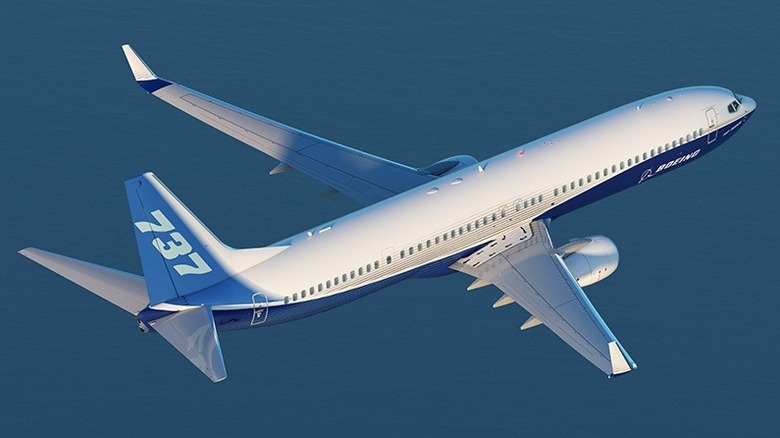
However, in the case of the Boeing 737NG, frost can form another way. This jet features thinner wings, which also house fuel. Because the fuel is nearer to the frigid exterior air, its temperature is influenced. When there's enough fuel that it's touching the top part of the wing, which is colder than other parts of the jet's exterior, a phenomenon called "cold soaked fuel frost" occurs.
Boeing studied this behavior with tests using wind tunnels, and found that this type of frost didn't negatively impact flight. So rather than needlessly de-ice aircraft experiencing cold soaked fuel frost, Boeing created these black lines on the wing as a guide. If frost appeared only within these lines, was deemed to be purely due to differences in temperature between the fuel and surrounding aircraft, and wasn't thicker than 3 millimeters, pilots could take off without de-icing.
It might be your taste buds, not the airline food
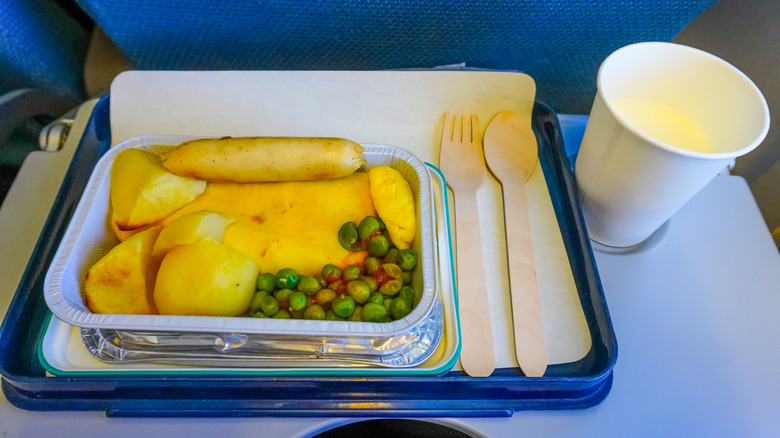
A common position among travelers is that the food served on flights is bad or at best, extremely flavorless. However, it may not be the fault of the airline, but rather the way your taste buds and nose react to high altitudes. The BBC reports that a pressurized cabin at 30,000 feet affects both your sense of smell and your ability to taste.
According to the BBC, at cruising altitude the level of humidity in the air of an aircraft's cabin can be under 12% — lower than what you'd usually find in a desert. Combine that with cabin pressure and the constant white-noise drone in the background, and according to Leona Qi, U.S. president of charter company VistaJet, as reported by Travel and Leisure, "the perception of salt reduces by 30%."
So recipes that typically please the palate on the ground don't automatically translate to an in-air meal, but must be altered with extra salt and spices. While the results may not always be gourmet, if you find yourself unhappy about your meal, don't be like the unruly passenger who diverted a nine-hour flight over airline food.
Why the landing gear is not a place you'd want to be when traveling
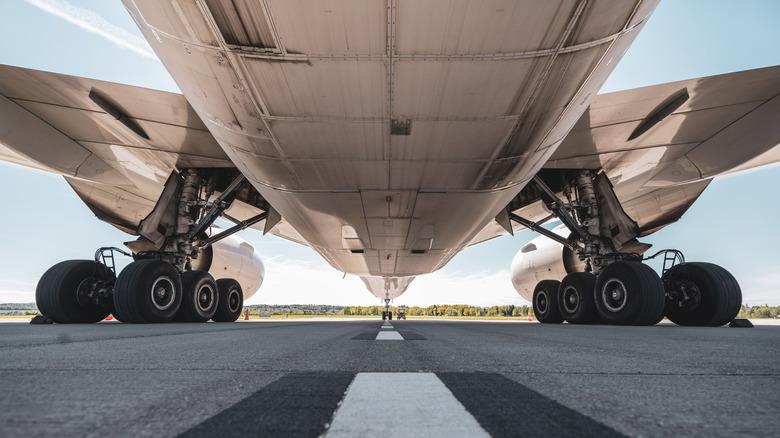
You've likely seen Hollywood productions showcasing characters climbing up near the landing gear, sneaking onto the plane just before takeoff. While at first it seems plausible, as there is some space within the wheel wells, it's not only a bad idea, but likely a fatal one. Unfortunately, it hasn't stopped many people from trying it anyway. Some lucky ones make it, like the stowaway who survived an 11-hour flight in frigid temperatures, but authorities were amazed he was alive. And for good reason: According to an FAA report, per CNN, of those who have chosen to stow away on an aircraft, more than 77% perished.
The reason it's so dangerous is three-fold: extremely low temperatures, low oxygen levels, and the potential to be crushed by the landing gear. The passengers in the cabin are experiencing pressure equivalent to around 8,000 feet, which helps maintain comfortable oxygen levels. They also have the benefit of an environmental control system that works to keep passengers warm, even with freezing outside temperatures at high altitude.
However, before the cold or thin air can take a toll on you, you'll have to escape the retracting landing gear wheels. According to CNN, these work at 3,000 pounds per square inch of hydraulic pressure. If you're not familiar with exactly how to orient your body within the wheel well, the aircraft will squeeze you to death.