

Displacement You Can't Refuse: The Godfather Big Block Somehow Reached 1,000+ Cubes
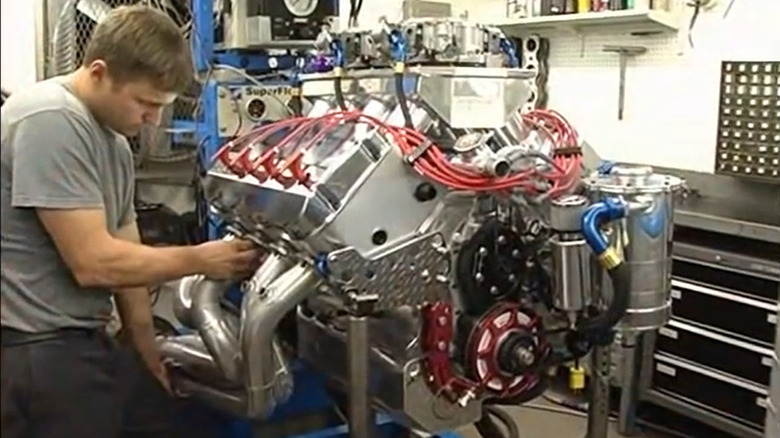
In the world of high-performance engines, there are big block motors, and then there are gargantuan power plants that make big blocks feel like a Kei car motor. For decades, the fight for cubic space supremacy was fought on inches, a turf war over a tenth-of-an-inch increase in bore and stroke. Then came Sonny Leonard, the king of large-displacement V8 racing engines. He set out to build an engine that would surpass all, one that would remain untouchable for decades to come.
We're talking about the SAR 1005, better known as the "Godfather." While Sonny could have gone with a name like Ford's Godzilla and Megazilla V8s, this one, too, gets the message accross.
Pop the hood on a standard dragster, and you expect to see a massive motor. Nothing prepares you for the size of the SAR 1005, though. This gargantuan V8 displaces 1,005 cubic inches or 16.4 liters. To put that number into perspective, that's over eight Honda Civics combined, or two Bugatti Chirons. This motor represented the absolute pinnacle of engine building, delivering close to 2,150 horsepower from a naturally aspirated engine. And the motor didn't have a consigliere in the form of turbochargers, supercharger, or even nitrous. Just pure displacement to deliver the goods. A true example of the adage, "There is no replacement for displacement."
Why, you ask? The Godfather was envisioned to dominate International Hot Rod Association (IHRA) Pro Stock racing, a place that thrives on cubic inches and where bigger has always been better. Even at this hallowed ground, crossing the 1,000-cubic-inch threshold had long been a mechanical fantasy. Holding back that dream were limitations like twisting engine blocks, flexing crankshafts, and the cylinder head's inability to feed a beast that large.
The road to 1,005 cubic inches
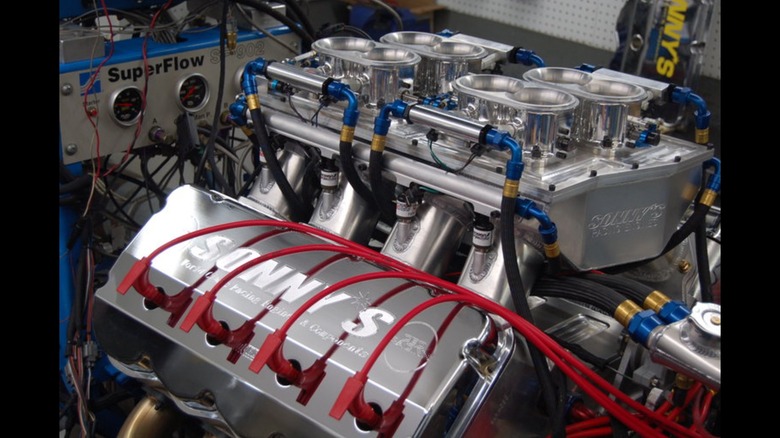
Mountain motors like the Godfather don't spring up overnight; they evolve through decades of engineering know-how and at the National Hot Rod Association (NHRA), home to the most powerful racing engines on the planet. Early Pro Stock engines had displacements limited to 500 cubic inches. Before the NHRA, though, under other sanctioning bodies like the IHRA and the Professional Drag Racers Association (PDRA), engine builders for Mountain Motor Pro Stock pushed the envelope to over 800 cubic inches. As billet blocks became common and crankshaft technology progressed, the 900-cubic-inch barrier was crossed as well.
However, the holy grail, the 1,000-cubic-inch threshold, remained unattainable. After all, it's twice the size of the biggest V8 engines ever put into production cars. At that engine size, you have to scale up everything exponentially. As bore size increases, so does the need for spacing; a longer stroke increases piston speed and crank stresses. The valve train also has to reliably operate larger valves at above 8,000 rpm.
The foundation for the dragster is a special billet aluminium engine block with an impressive 12.225-inch deck height. For reference, a big block Chevy has a maximum deck height of 9.8 inches. The extra height accommodates a rotating assembly that wouldn't look out of place in a diesel locomotive. The engine has a massive 5.22-inch bore and 5.875-inch stroke. The impossibly long 8-inch connecting rods sit on a special Bryant billet steel crankshaft that does a fine job of moving custom-machined pistons the size of snack plates, at racing speeds, without shaking the engine into pieces.
Maintaining reliable oil pressure is another engineering nightmare. The motor features a dry sump to ensure stable lubrication even during violent acceleration.
The Godfather is hemispherical engine royalty
To feed 16.4 liters of displacement, you need to look beyond off-the-shelf parts. To achieve this, Sonny specially developed hemispherical cylinder heads, masterpieces ported with computer numerical control. In an intensely competitve sport like Top Fuel racing, hemispherical heads can offer a 10% power advantage over a wedge combustion chamber. On the flow bench, they move more air than most turbocharged engines.
Then there are the titanium valves. The intake valves are nearly 3 inches in diameter, roughly the same as a soda can. For perspective, most performance engine valves are around 2.3 inches. The large size reflects the massive amount of air the engine needs to inhale. These cylinder heads are one of the more important reasons the engine is capable of pushing out 2,100 hp without the need for turbocharging or nitrous boost. Its atmospheric pressure is doing the heavy lifting and is worth its weight in gold for Pro Stock racing engine builders, where cubic feet per minute (cfm) is one of the most sought-after metrics. The Godfather has its volume ports flow measured at 740 cfm.
To ensure that the valve train doesn't flex under the pressure of the massive valve springs, the engine uses a thick camshaft. The engine features large bore spacing to ensure the block is strong enough to survive the violence of combustion the equivalent of mini-bombs happening thousands of times per minute.
The Godfatber's fueling madness
The 16.4-liter V8 has a voracious appetite for 112 octane that can't be satiated with the regular single four-barrel carburetor setup. To achieve 2,150 hp, the SAR 1005 uses a sophisticated four twin-barrel throttle bodies and a highly advanced electronic fuel injection system (with 16 injectors!), depending on the buyer's requirements. The intake manifold is a towering piece of custom-made aluminium designed to evenly distribute racing fuel over a cavernous plenum. With a compression ratio of 16.0:1, this is a high-pressure environment where a massive amount of fuel is atomized and shoved into eight gigantic combustion chambers with the intent of achieving the most efficient explosion possible.
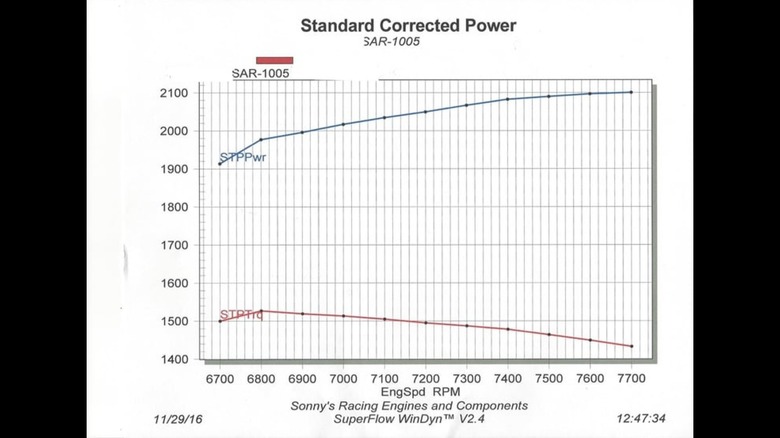
The result is over 1,500 pound-feet of torque. That's enough twisting force to warp a standard tube chassis. And the engine produces over 2 horsepower per cubic inch, something previously unheard of for an engine of this size. For context, 2 hp per cubic inch for a 350-cubic-inch V8 would translate to 700 horsepower.
On the dyno, the Godfather pulls with a relentless linear power curve that shames even the best turbocharged performance engines. While most naturally aspirated big block engines lose steam as engine revs reach the higher band, the SAR 1005 digs in even deeper, its massive displacement delivering a torque curve that's more of a vast flat plateau. On the drag strip, the instantaneous power hits like a freight train and keeps pulling hard until you lift off. The Godfather V8 has cemented Sonny Leonard's legacy as the man who took the idea of a big block engine to its absolute limit.
The Godfather's legacy of displacement
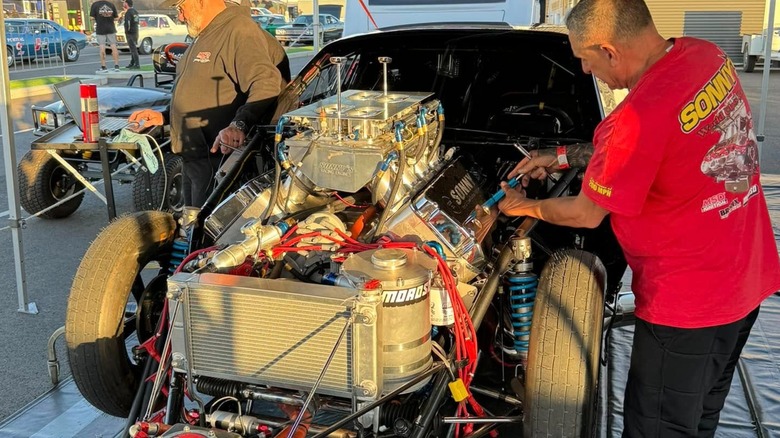
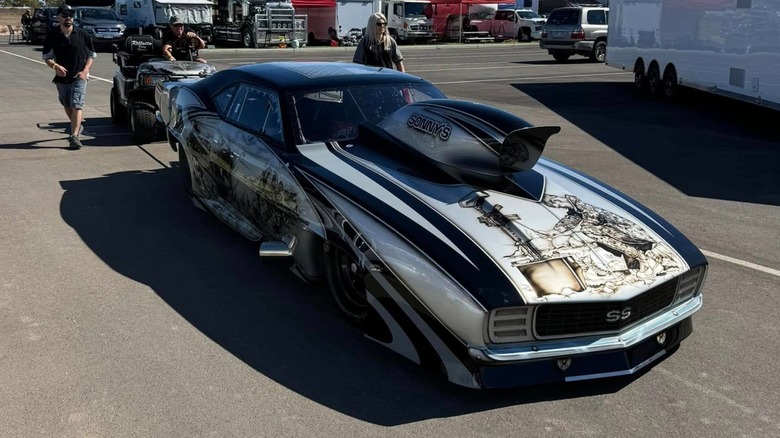
The SAR 1005 wasn't built as a museum showpiece; it was developed to settle scores on the drag strip. Even today, the world of the PDRA Extreme Pro Stock Class considers the Godfather V8 the gold standard. When you race against the fastest naturally aspirated engines in the world, you need an edge. Sonny's Racing provided that edge by simply outclassing everyone in displacement. When 800 cubic inches was once considered pushing it, racing in a 1005 was akin to bringing a bazooka to a gunfight. The influence of the 1005 even extended beyond professional racing to powerboat racing. Driving a car powered by the Godfather engine made you the apex predator.
Sonny Leonard died in 2021, but his legacy lives on in the Godfather. It broke the 1,000-cubic-inch psychological and engineering barrier while retaining its functionality and reliability. Even today, you can buy the SAR 1005 from Sonny's Racing Engines in Lynchburg, Virginia, for your Pro Stock Camaro or wild street legal (barely) project car, for a princely sum of $140,000.
It's worth the price for what it can achieve and what it represents. It's a mechanical masterpiece, an engine with the precision of a Swiss watch, scaled up to the size of a sledgehammer. It's the engine that turned the 1,000-cubic-inch fantasy into an attainable, terrifying reality.
Still not convinced? Click above to check out the profoundly soul-stirring scream of 16 liters of displacement at 8,000 rpm. If you ever got close enough to one, you didn't simply hear it, you felt it.