

Why Increasing An Engine's Compression Ratio Makes It More Efficient
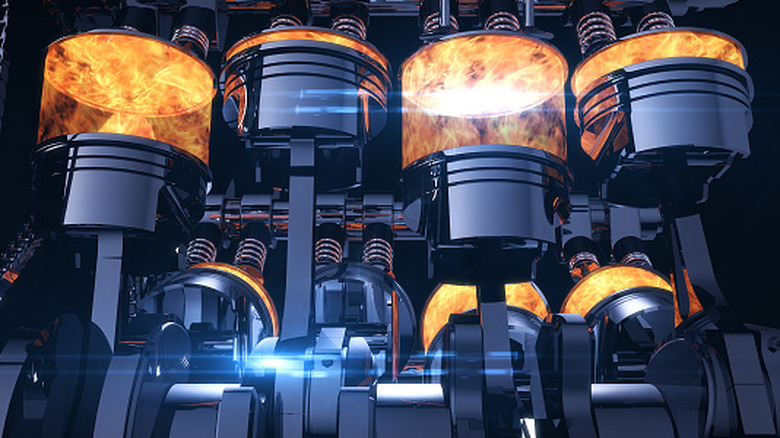
As you may know, an engine's compression ratio is directly linked to its combustion efficiency. All else being equal, higher-compression engines tend to make more power while offering better fuel economy. Researchers have found that by increasing the compression ratio of a diesel engine from 16:1 to 18:1, its thermal efficiency improved by 13%, while fuel consumption reduced by roughly 30%. By increasing an engine's compression ratio, you're effectively improving its thermal efficiency, meaning more mechanical energy from the same chemical reaction.
At this point, you're probably familiar with what compression ratio means. Still, for those who aren't in the know, compression ratio is the available cylinder volume when the piston is at BDC (Bottom Dead Center) to the volume when the piston is at TDC (Top Dead Center). So, a 10:1 compression means the air and fuel mixture (or just air in the case of a diesel) is compressed to occupy a space that's 10 times smaller than its original volume.
This, of course, is the static compression ratio, or in other words, the ratio when the intake valves are fully closed. Dynamic/effective compression takes into account how the engine works in the real world, factoring in variables like throttle position, engine speed, load, exhaust scavenging, and so on. Engineers fine-tune the variables to make the powerplant more efficient.
However, it's worth pointing out that the compression ratio-versus-efficiency curve is non-linear, meaning that beyond a certain ratio, you reach a point of diminishing returns, which is a fancy way of saying you'll run into several practical constraints.
Compression ratio and its impact on efficiency
So how does increasing the compression ratio improve engine efficiency? Let's take two hypothetical Otto cycle engines, with one running a 10:1 compression ratio and the other running 12:1. For the sake of simplicity, we're sticking to static compression and not dynamic.
Understand that three of the four strokes in a four-stroke engine consume power. The said power, or usable work, comes from igniting the air and fuel mixture after compression. The more you can compress, the better it is for thermal efficiency, i.e. more mechanical work from the fuel burnt. Think of it this way: The more you squeeze the air-fuel mixture, the harder it can push back after ignition. Ergo, more work done by the engine and less energy wasted as heat.
Enter expansion ratio, which is exactly the opposite of compression ratio, i.e., how much volume the compressed mixture expands to. It is the expansion/power stroke that gives us an idea of the amount of force exerted on the piston. Unless it's an Atkinson cycle engine, the compression and expansion ratios are typically the same. By that logic, if you look at our example engines, the one with the higher compression ratio gets more useful work done through more expansion, making it more efficient.
But to run higher compression, you'll typically need high-octane gasoline to avoid pre-ignition. That's not always the case, though. Take Mazda's Skyactiv-G engine. It's capable of up to 14:1 compression (13:1 for the U.S. market) while on regular pump gas, which is not what's usually recommended for an engine running that kind of compression. Ask anyone with a Ferrari 458 Speciale.