

5 Cool Cars That Use Motorcycle Engine Power
Cars need torque; bikes need revs. This assumption has divided the automotive sphere for decades. While both share the same working principle, there are significant differences between a motorcycle and a car engine. One is tiny and makes high revs where most of its powers delivered. The other is heavy and slow-revving, but capable of delivering ample torque at near-idle revs.
A motorcycle engine lacks the rotational inertia and low-end torque required to move a 3.5-ton sedan from standstill. Motorcycles also lack a reverse gear (although we think they should), so plonking them into a car would mean re-engineering the gearbox. They're designed to make most of their power and torque at higher revs because the focus is speed, not pulling power. This works because the heaviest production motorcycle weighs less than 1,000 pounds. Plonking a motorcycle engine in a car is like trying to run a marathon with an industrial safe strapped to your back. If the car weighs under 1.5 tons, though, that changes things.
A lightweight car with a superbike engine is a niche category. They feel more like four-wheeled superbikes than cars. If you manage to strip away enough from a project car to get it to the featherweight category, the power density delivered by a superbike engine can become a cheat code for performance. You get a racecar that revs to the moon, shifts with lightning fast-sequential precision, and offers a raw, visceral experience that even a turbocharged V6 can't match. Or you can look up companies that offer cars with motorcycle engines. Five such models can be found from Morgan, Ariel, Radical, Caterham, and even Honda.
Morgan 3-Wheeler
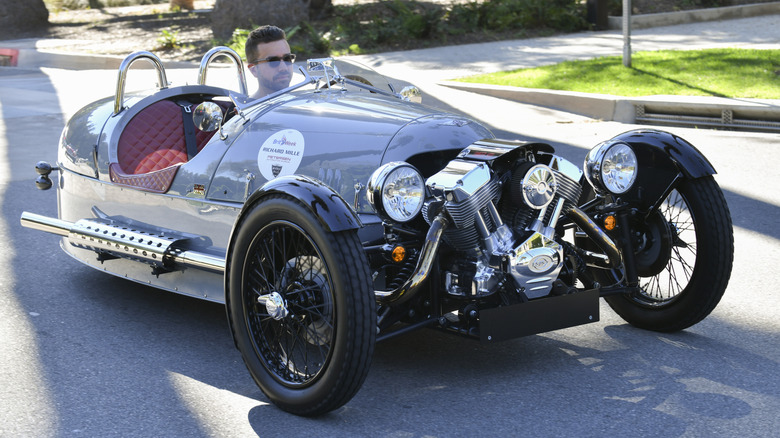
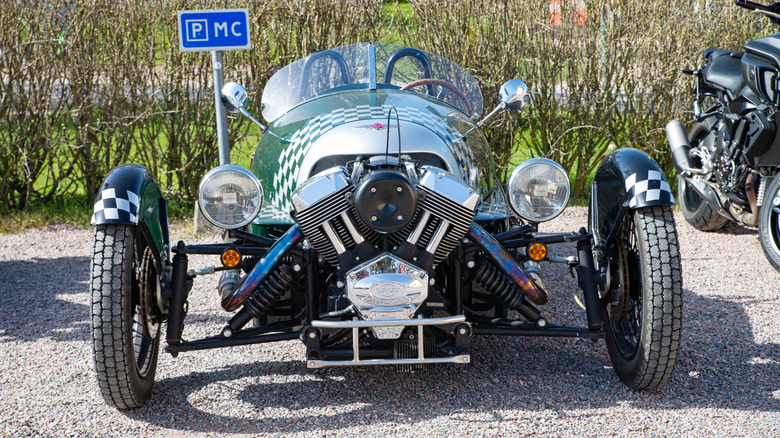
The Morgan 3-Wheeler is a British sports car that's dripping with character. This open-top contraption is a leather-capped, goggle-wearing middle finger to modernity. Morgans are hand-built icons, manufactured through a process that remains practically unchanged since 1909, the year it was founded. A Morgan is put together using steel tubing, aluminum, wood, glue, and leather. While other four-wheeled Morgans use BMW car engines, the British Morgan 3-Wheeler uses a special motorcycle engine that's made in America. The very front of this three-wheeled bathtub-shaped contraption seats two large, chromed, finned cylinders placed in a V-configuration. It's a massive 121-cubic inch V-twin from S&S, which is the same type of engine used to make Harley-Davidsons go faster.
That engine is the first thing you notice when you see the car for the first time — and the first thing you feel when you fire it up. At startup, the whole car shakes and pulses, providing an experience similar to riding a Harley-Davidson. Unlike other motorcycles on this list, the Morgan does not deliver a high-pitched scream; just a low-frequency rumble from its massive V-twin lump. We mentioned it previously as one of our favorite slow cars to drive fast. It feels faster than its 81-horsepower output suggests as you're made to sit mere inches above the ground, skimming the asphalt. The experience is amplified with the S&S motor emitting pops and bangs through its side exhausts. It's a brilliant analog experience that makes driving feel like an adventure rather than a chore.
Ariel Atom V8
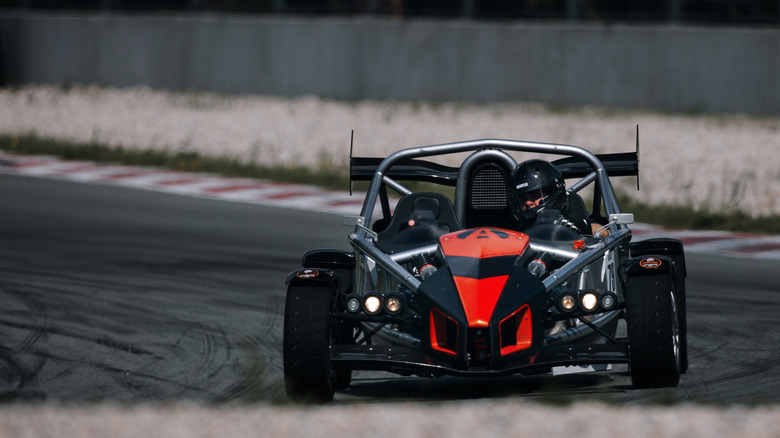
If the Morgan is a leisurely-paced open-top vehicle, driving the Ariel Atom V8 is the closest you'll get to being strapped to scaffolding while traveling at warp speed. The standard Ariel Atom is quite a fast car, with a Honda Civic engine strapped to a bodywork weighing next to nothing. But the model we're talking about here goes even further.
The Ariel Atom V8 takes two Suzuki Hayabusa engines and fuses them at the crank, creating a 3.0-liter V8 that revs over 10,000 rpm and delivers nearly 500 horsepower in a car that weighs a scant 1,200 pounds. That's an insane power-to-weight ratio that pushes the Atom V8 into hypercar territory, as do the acceleration figures. The Atom V8 accelerates to 60 mph in under 2.5 seconds, and to 100 mph in under six. The motor revs as quickly as a motorcycle due to lightweight internals, and the lack of a turbo means instantaneous, visceral acceleration.
This visceral experience is amplified as there's no windshield to protect you from the relentless wind blast, and the acceleration is intense enough to temporarily rearrange your facial features if you decide not to use a helmet. It's a good thing, then, that the top speed is limited to 170 mph (although the race version can go as high as 200 mph). The Ariel Atom V8 is the ultimate expression of motorcycle technology pushed to its absolute extreme.
Radical SR1 XXR and SR3 XXR
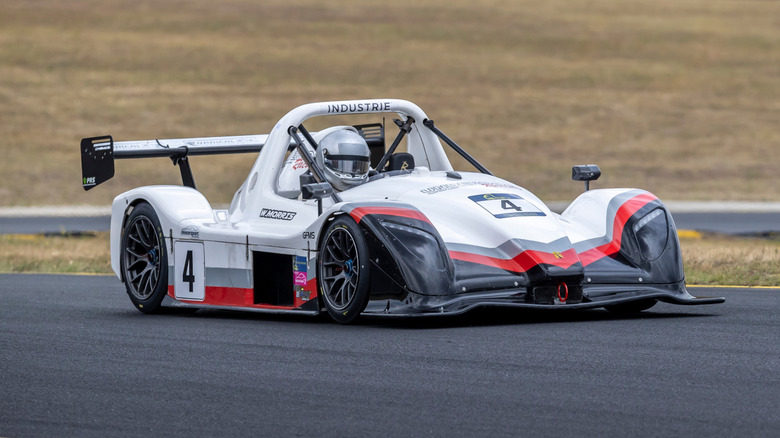
You'll probably see most cars powered by motorcycle engines opting for the Hayabusa motor. Besides being comparatively large, it is compact, revs high, has fantastic torque, and delivers an excellent power-to-weight ratio. That's why it's preferred even in track specials like the Radical SR1 XXR and SR3 XXR. While both use the 1.3-liter Hayabusa engine, the SR1 is an accessible low-powered (185 horsepower) model compared to the more hardcore SR3 (205 horsepower).
Radical doesn't just buy the engine and plonk it into their track cars. They get re-engineered to be able to withstand g-forces with tech like dry sump lubrication. The SR3 also gets a more powerful 1.5-liter option, which basically is a stroked-out Hayabusa engine. It uses lighter connecting rods, a reworked cylinder head, and a sportier ignition system to help deliver around 232 horsepower in a car that weighs a shade below 1,370 pounds.
It's no backyard contraption, either. Driving a Radical is the closest you'll get to a Le Mans prototype. You sit low, surrounded by a carbon-fiber composite body and a 1.3/1.5-liter motor just behind your ears. The potent, quick, and high-revving motor in a lightweight frame with ample downforce makes for a match made in heaven. The Radical is incredibly light, so you can brake late, and acceleration from corners is pretty much instantaneous. It provides an incredible racing experience, proving that you don't need a heavy V12 motor to post insane lap times.
Caterham Seven
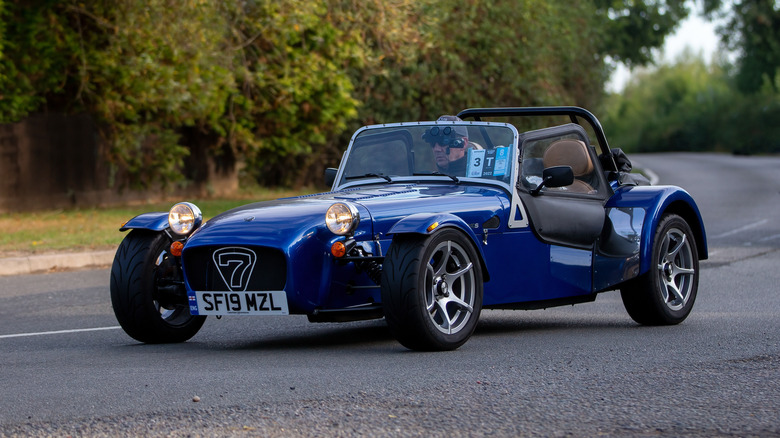
The Caterham Seven is a car that has spent the last 50 years perfecting the art of minimalism, focusing on nothing but the essentials. It's a design that goes back to Colin Chapman's iconic Lotus Seven, which was based on a single pure idea: "Simplify, then add lightness." While most Caterhams used Ford or Rover engines, the legendary Seven variants also experimented with motorcycle engines, especially the Blackbird and Fireblade editions that used the engines from the Honda CBR1100 and the CBR900RR Fireblade.
Plonk a 130 horsepower Fireblade engine (which weighs less than 150 pounds) into a Caterham thats known for its featherweight demeanor and you create a machine that defies logic. Caterham even set the world record back in 2001 with that engine for the fastest speed achieved in reverse, reaching a head-spinning 102.52 mph. Of course, helping that liveliness is the lack of weight.
The beauty of a bike-engined Caterham is in its balance. Because the engine is so compact, the car does not have to be overengineered for mass. The automakers could get away with weight-saving materials like lighter engine mounts and smaller brake discs. Besides providing explosive performance, this also allows the car to have lightning-fast reflexes. The open layout means you can clearly hear the engine – every induction roar, every tickover, and every high-rpm scream. In the end, this model made a strong argument for the idea that the best car engine is a bike engine.
Honda N600
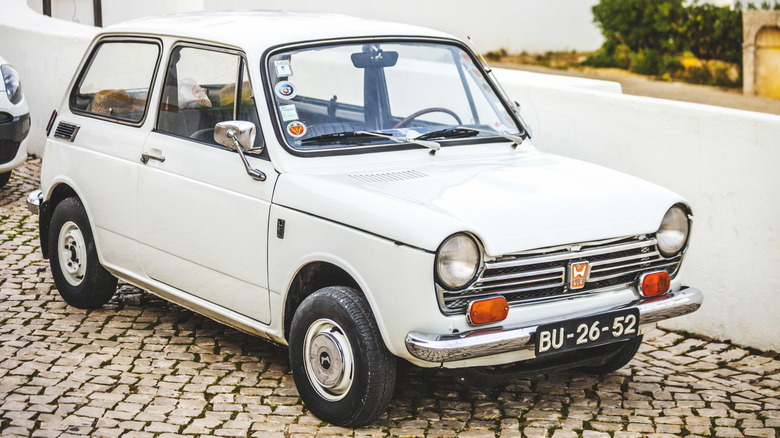
Before Honda was a beacon of four-wheeled sensibility, it was a motorcycle company trying to get into the four-wheeled space. The Honda N600 was the first-ever car imported by the Japanese brand to the U.S., arriving in 1967. It was a tiny model that used a bored-out 598 cc twin-cylinder motor taken from the Honda CB450. While it looked like a toy car, it carried the DNA of a motorcycle. (And it wouldn't be the last, thanks to this genius who dropped a BMW motorcycle engine into a Fiat 126.)
Honda's tiny car was a culture shock to an audience used to big-bore V8s. Even driving it felt different. The engine revved up to 9,000 rpm, and even though it only made around 36 horsepower, the fact that the car weighed a mere 1,200 pounds meant it could effortlessly zip around the city at decent speeds. The engine also featured a constant mesh gearbox, similar to Honda's motorcycles at the time.
This simplicity makes the N600 highly sought after in the custom car world — and it also makes the car into a perfect test bed to push the motorcycle engine theory further. Custom builders have pushed the envelope on the N600, fitting it with a V4 engine from the Honda VFR, and even the high-revving inline-four from the CBR1000RR. Today, the N600 remains as one of the oldest and most charming links between car and motorcycle.