

What're The Differences Between The Ford 427 And Chrysler 426 HEMI Engine?
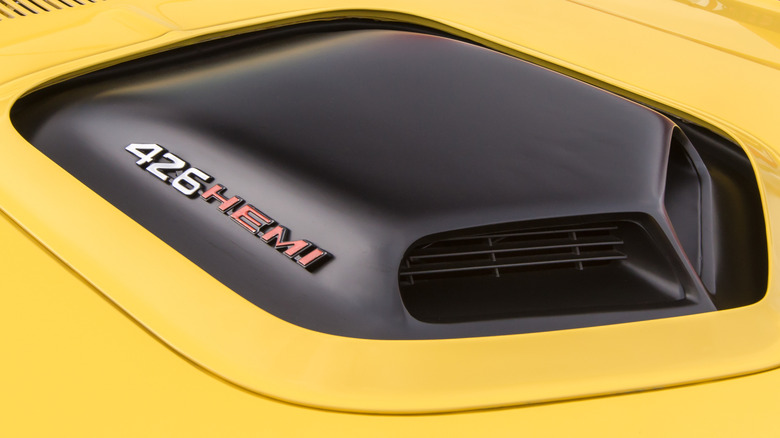
There are many comparisons to be made against Ford's 427 engines and Chrysler's 426 Hemi. In the interest of keeping things fair, though, we'll focus on pitting the 426 against the Ford SOHC "Cammer," and not the 427-FE. Frankly speaking, it only makes sense to compare the two engines that were so good for oval racing that they both got banned. At least, Chrysler's Hemi V8 had NASCAR wins under its belt, unlike the Cammer, which never competed.
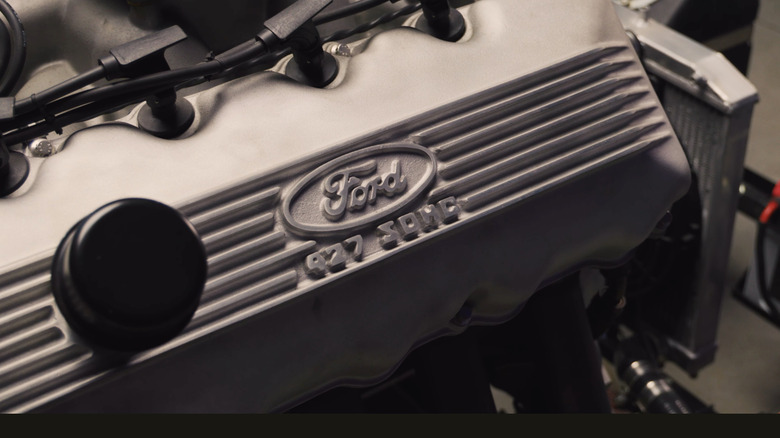
If you weren't aware, the Cammer was a direct response to the Hemi. It was basically a 427-FE with a single overhead camshaft, a quick and cheap swap, featuring cast-iron heads and a six-foot-long timing chain for the roller cam. The block's cylinder casing was reinforced, and the oiling system was upgraded, with later versions of the Cammer even getting aluminum cylinder heads, similar to the 426's racing version. Pre-'65 Hemis had iron head castings.
Perhaps the biggest thing shared by both the Cammer and the 426 is the hemispherical combustion chambers. So, by definition, the 427 Cammer was Ford's take on a Hemi V8 (as was the Boss 429 engine, in a way). Both the Cammer and 426 have two valves per cylinder, though Ford uses a narrower valve angle than the Hemi. Chrysler, however, used pushrod cams instead of the 427's SOHC design.
Something else of note is that the Cammer runs 12:1 compression while the Race-Hemi runs a much higher 12.5:1 compression ratio. However, the 427 could rev more — up to 7,500 rpm – while the 426 could only muster a lower 6,000 rpm ceiling. Although some sources point to the Race-Hemi still making power past 6,100 revs. Regardless, the real difference between the two engines can be found in the power figures.
Ford 427 Cammer versus Chrysler 426 Hemi
In the early '60s, dyno runs of the 426 Race-Hemi showed upwards of 500 horsepower, whereas the Cammer put out 616 horsepower and 515 pound-feet of torque with a single carburetor. Both muscle-era race V8s used almost similar valve specs. Intakes were the same at 2.25 inches (2.23 for aluminum head Hemis), while the Hemi's exhaust side measured 1.94 inches against the Cammer's 1.90.
It's worth pointing out that while 426 Street-Hemis had "official" ratings of 425 horsepower and 490 lb-ft, dyno runs reveal the Hemi's actual output as being closer to 495 horses. Mind you, this is an engine running much lower compression than the Race-Hemi (10.25 versus 12.5) with relaxed cam timing. By putting in a bit of cam work, higher compression, and some intake and exhaust shenanigans (which would've been the case on the Race-Hemi), the 426 Street-Hemi can pump close to 650 horses – or even more on race fuel.
Because NASCAR wouldn't play ball, Ford made the Cammer available to the dragster community. But the engine wasn't flawless; it had timing chain issues caused by the added slack under load. So the racers went back (not immediately, though) to the tried and tested pushrod Chrysler Hemi. However, Ford's "Cammer" led to Chrysler developing an experimental A925 "Doomsday Hemi," which featured dual overhead cams, four valves per cylinder, and potential revs of up to 7,000 rpm. The project was canned, of course, because NASCAR decided to play the fun police.