

Why You Should Always Check Your Tires After A Cold Snap
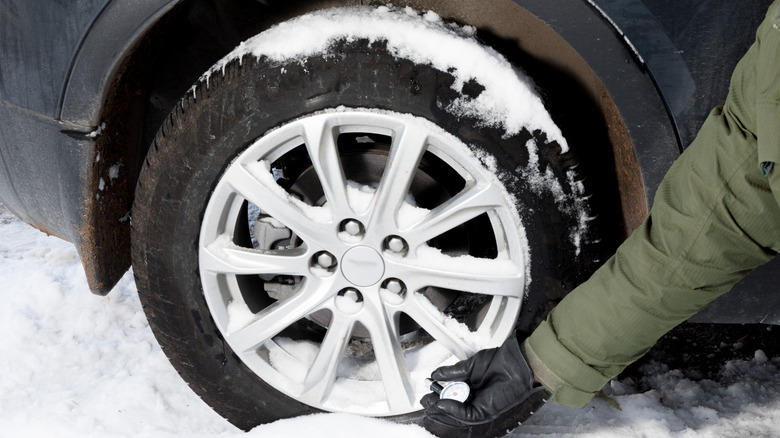
Have you ever noticed your car's tires look somewhat flat and need air when the weather gets cold, or are the TPMS sensors on overdrive and shining the tire pressure warning light in your sleep-deprived mug? The worst-case scenario is that you either have a puncture, a slow leak, or faulty tire pressure sensors, which, despite raising the driver's awareness of underinflated tires, are not entirely as accurate as handheld tire gauges at displaying the actual tire pressure.
However, you probably just need to add air after a cold snap, especially if your tires are relatively new and in tip-top shape. Cold weather causes air molecules to move more slowly, contract, and take up less space inside the tire, which tends to drop the air pressure by a bit. By how much, you ask? The onset of winter and frost can cause tire pressure to drop about 1 pound per square inch (psi) for every 10 degrees Fahrenheit drop in the mercury.
Now, a 1 psi drop in air pressure may seem tolerable and inconsequential, but consider this: Tires can routinely lose 1 psi monthly due to osmosis or permeation of the air through the rubber. Combined with temperature fluctuations or a 20-degree drop over a snowy weekend, and it's no wonder that car owners line up for air at the pumps when the weather gets cold.
Check the tire pressure weekly during cold weather
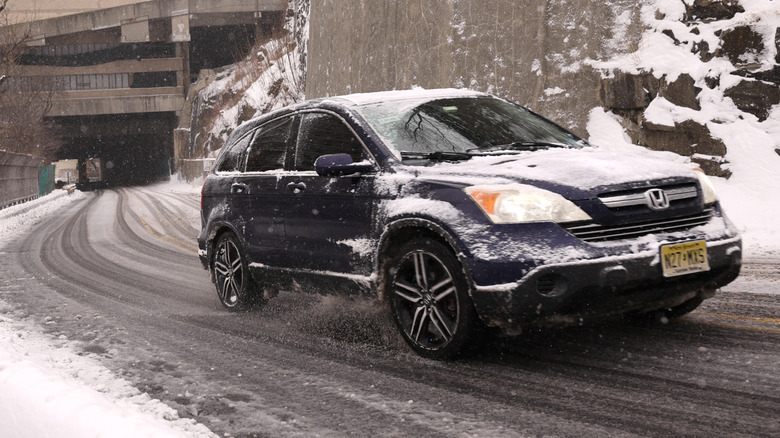
You probably know that driving with either overinflated or underinflated tires is a bad thing and can cause some damaging tire wear patterns. The former will cause noticeable balding patterns of the treads, particularly in the middle, while driving with underinflated rubber will wear out the edges or shoulders more quickly. Worse, vehicles with underinflated tires are three times more likely to get involved in a crash, and the risk of overheating the tire gets greater with every drop in air pressure.
Meanwhile, underinflated tires in cold weather will have a harder time maintaining steady traction and grip, and you don't want that on wet, icy, and snowy roads. It also happens that tire pressure can significantly affect your car's gas mileage by increasing the rolling resistance, sometimes causing as much as a 2% to 3% drop in fuel economy for every 25% drop in air pressure.
Also, considering that gas and diesel engines generally consume more fuel during winter, we highly recommend checking the tire pressure on all wheels (including the spare) at least weekly if you drive a lot. You shouldn't wait for the tire pressure warning light to illuminate on the console or wait for the tire to look, well, flat.
After adding air, it's not unusual for the tire pressure warning light to stay lit, since you'll need to drive for a mile or so for the sensors to register the change in pressure. Get yourself a decent tire pressure gauge to be completely sure, and try staying away from those overly cheap gauges that can be wildly inaccurate.