

Do One-Way Streets Really Help Traffic Flow (Or Are They Just Annoying)?
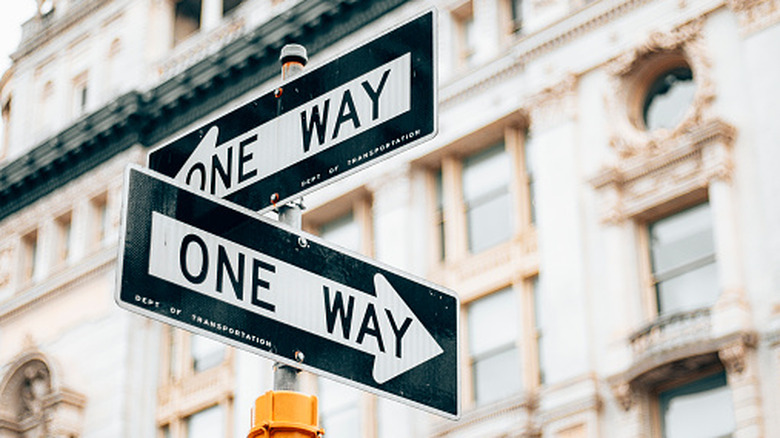
Automobiles are widely celebrated, but that doesn't mean it's always fun to get behind the wheel. According to a GM study, 65% of drivers aged 16-34 experienced negative emotions during driving. We reached out to you looking for your local driving gripes, and many responses noted issues with the speed of other motorists. Urban driving presents some especially challenging scenarios, and although one-way streets have been a longtime method for managing the flow of vehicles in downtown areas, they're being increasingly called into question.
Pitched by transportation engineers of the 1950s as the way forward for large American cities, recent arguments paint a different picture. While they do enhance traffic flow in many instances, it unfortunately comes at a cost. They can be confusing, less environmentally friendly, detrimental to businesses, and more dangerous, making a strong case for the removal of one-way streets and the return of bi-directional vehicle travel. Today, issues continue to be reported, such as when an NYPD officer found out the hard way why you're not supposed to drive the wrong way on a one-way.
The idea behind one-way streets
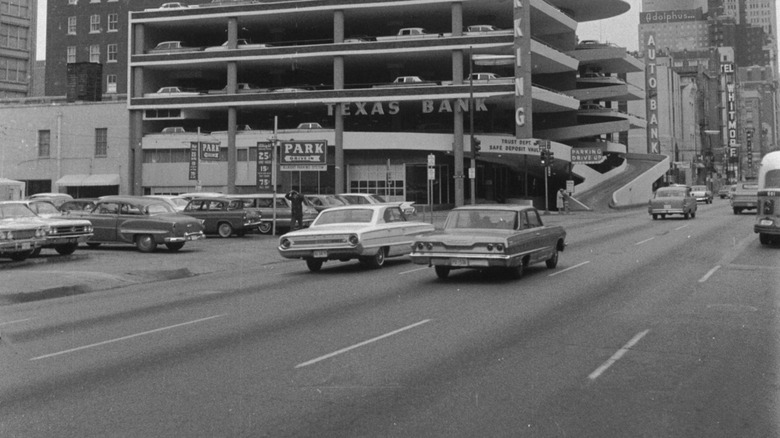
Following the second World War, there was a rise in population that led to baby boomer generation and a growing appreciation for automobiles. According to History.com, by 1955, vehicle sales had grown four times in size from just a decade earlier. So, transportation engineers got to work in an effort to accommodate more motorists. Unfortunately, in highly-developed urban streets, adding additional lanes wasn't always feasible. However, if there were two thoroughfares running parallel, you could have them operating in opposite directions, opening more lanes to vehicles.
In some cases, converting to one-way streets eased slow-downs and effectively sped up vehicle traffic, especially during peak congestion. In addition, it was thought that those on foot or using bicycles were at less risk from being hit, as the motorists would all be traveling the same direction. It's also easier to coordinate signals along a one-way stretch of road. However, in the last few decades, many have begun pointing out the unintended side-effects of this system.
Complicated routes and added pollution
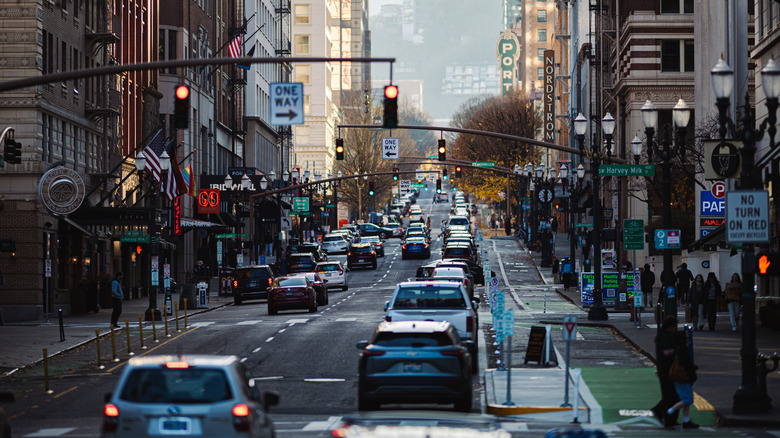
While advocates for one-way streets tout the model's efficiency, in practice, it can actually be more detrimental. Transfersmagazine.org performed a study of San-Francisco, which is dominated by one-ways, and created a model envisioning the city converted over into a two directional road system. The model with multi-directional streets took an average of 1.7% less travel time from point to point, with the real-world one-way system typically requiring an additional three blocks for the same trip.
Plus, while they're certainly not the sole catalyst of anger behind the wheel, you can imagine plenty of scenarios where one-ways might contribute to road rage. Motorists unfamiliar with the area may slow their speed when identifying which cross streets flow what direction, looking for parking, and understanding street-specific restrictions. Some downtown one-ways have different rules for peak hours, such as temporarily eliminating street parking in order to extend an extra lane. A motorist residing in the area could become frustrated by visitors struggling to navigate complex indirect routes.
Those extra minutes behind the wheel have another negative byproduct in the form of more vehicle emissions. According to the U.S. Transportation Sector, among the sources producing greenhouse gas emissions, light-duty vehicles (passenger cars and standard trucks) make up 57% of the total. While this figure encompasses far more than just one-way streets, a road system that results in longer travel times doesn't help. Some have pointed to autonomous EVs as a solution, but others argue that self-driving cars will ruin cities, not fix them.
One-ways are bad for business
One of the original intents of the one-way street system was to quickly funnel more drivers in and out of downtown areas. While more vehicles could travel through city centers, this didn't have a positive effect on urban retailers, restaurants, or venues. For one, increased speeds don't allow motorists as much time to take in all the storefronts vying for attention.
The main issue is how the nature of a one-way narrows a driver's perspective. It's impossible to safely look down cross streets during travel, and that effectively hides businesses from view. Even if a motorist spots a store that interests them, if it's further up the street in the opposite direction of traffic flow, they may be less likely to want to circle all the way around to stop there. As an example, Cincinnati's Vine Street transformed from a bi-directional street to a one-way. Afterwards, reports indicated that around 40% of the businesses on that street shut down.
Pedestrian safety issues
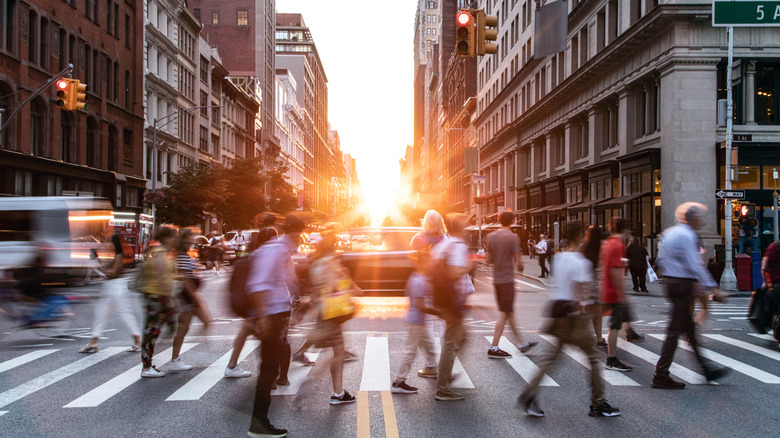
One-ways have been criticized for creating a car-centric environment that's actually less safe for pedestrians and cyclists. One of the potential hazards involves multi-lane one-directional turns, which can result in blind spots. For example, if two lanes of traffic on a one-way street are turning, depending on the size of the vehicle in the inner lane, the outer lane motorist may not even be able to see a person in the crosswalk until it's too late. According to a 2016 study from NYC.gov, when left turns led to cyclists and on-foot pedestrians getting injured by an automobile, 70% of those incidents were on one-way streets.
This figure becomes even more eye-opening when you consider that one-ways facilitate a greater amount of turns for motorists. One research study by the Transportation Research Board found that one-ways increase turning up to 160% over bi-directional street systems. More turns put pedestrians and vehicles in close proximity at greater frequency, and that just calls one-way streets into further question — especially when seeing how pedestrian deaths in the U.S. keep rising.
Increased vehicle speeds are also a significant hazard for pedestrians, especially in one-way streets with several lanes. Without the slowing impediments of adjacent traffic flowing the opposite direction, one-ways facilitate faster speeds. While it's not an intentional act, as a car travels faster, a driver can experience tunnel vision. Essentially, the higher the speed, the narrower the driver's peripheral vision gets, raising the chances of collisions with unseen pedestrians.