

Why Are European License Plates So Long And Skinny Compared To American Ones?

Sometimes, items can become such a frequent sight in everyday life, that we don't even question their existence and origin story. Of course, we all know why license plates exist. They are a form of identification for each vehicle, and work alongside Vehicle Identification Numbers (VINs) and other such features to ensure each car can be traced and identified.
However, why are license plates the way that they are, and why do they differ from one part of the world to the next? For instance, in the U.S., license plates measure six by twelve inches, or seven by four in the case of motorcycles. Cross the pond to Europe, though, and it's a different story altogether.
There, two (very similar) sizes are most commonly used. They're usually 20.5 inches wide and either 4.3 or 4.7 inches tall, meaning they look far longer and skinnier than the plates with which American motorists are familiar. Nobody's being different just for the sake of it; there are good reasons for the differences, and it's actually really rather simple.
Simply put, while the reasoning behind having license plates was largely the same the world over, the regulations set up for them were different — no global standard was decided. In the same way some countries have left-hand drive cars, and others have right-hand drive, there is no right or wrong, just what one specific country decided its regulations would be.
A closer look at European plates
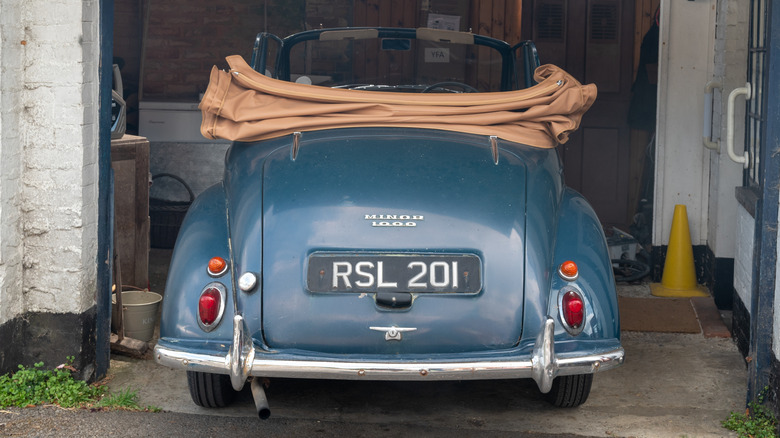
While American licence plates can vary quite dramatically in terms of style and appearance, especially when it comes to the amazing array of vanity plate ideas, it's a different story over in Europe. The designs are far more uniform, as can be demonstrated by exploring the history of them.
For instance, in the U.K., while the formats have changed over time, they have always conformed to a particular and strict style. Pre-1963, they had what are now known as 'dateless' plates; these were typically (but not always) in a 3 X 3 format, with a group of up to three letters alongside a group of up to three numbers. And while the combination of letters and numbers would be unique, it would not include information that would date the plate or vehicle.
That changed in '63. At this point, most plates adopted a 3 X 4 "suffix" style; three letters, followed by three numbers, then one letter — that final letter would be the date designation, referring to the year the car was first registered. Once the alphabet was depleted, minus letters like 'I' and 'Z' which could be misread as numbers, the suffix style swapped to a 4 X 3 "prefix" style, with a date-designating letter preceding three numbers, then three letters. Some prefix and suffix plates would be shorter, with just one or two numbers rather than three, although the date number always remained.
Come 2001, a new design was implemented. All plates would now be seven digits long. Two letters, which designated the area in which the car was registered, followed by two numbers for the date, and then three random letters at the end. Over time, British plates also moved from silver-on-black colors to black-on-white at the front and black-on-yellow at the rear.
Most EU countries operate similar systems. German plates, for example, are all black-on-white and use a one-to-three-letter area identifier, then either one or two letters and one to four numbers to create the unique identifier. Combine such systems with prescribed font sizes — too small may make them harder for police and speed cameras to read, and too large might be considered unnecessary — and the standard European Union (E.U.) plate size effectively decided itself.