

What Do The Letters LS Actually Mean In Chevy Engines?
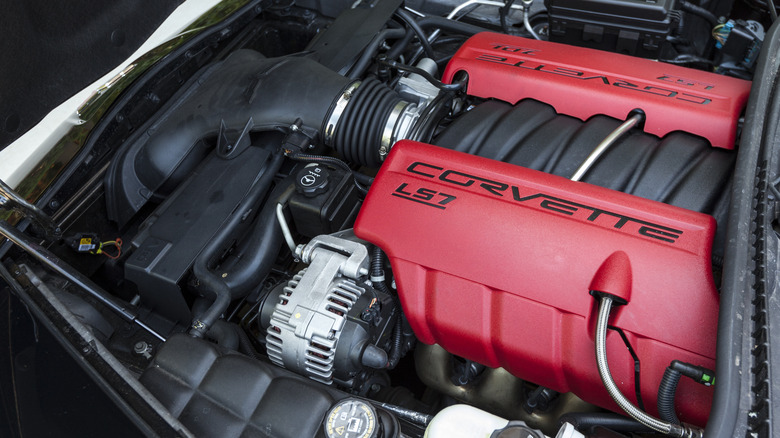
Few engine families go down quite so well in the history books as Chevrolet's iconic LS series. The family consists of powerful small-block V8 engines, and they've been seen in everything from track-prepared Corvettes to family-hauling SUVs. Anyone who has even a passing interest in cars will be at least vaguely familiar with the LS series, especially if they're part of the aftermarket tuning crowd. LS engines provide an immensely popular and powerful solution to those looking to engine-swap classics. And yet, despite the huge popularity of these engines, we doubt many actually know for sure what "LS" even stands for.
There isn't one singular answer, although the majority of folk will agree that "Luxury Sport" is the best-fitting answer, in place of a direct answer from Chevy itself. Others have argued that it stands for "Long Stroke," "Longitudinal Short-Block," or that it may even represent the initials of some prominent GM engineer — although there isn't much evidence to suggest this. In truth, it's simply a code given to denote a certain family of engines. Back in the golden era of muscle car motoring, Chevy began using letters and numbers to denote certain options; Z would relate to suspension and tire packages, C would indicate an interior option, and L would refer to an engine. The S just signifies a particular family, while additional information tacked onto the end — such as LS1 or LS7 — helps to highlight the exact engine being referred to.
A brief history of the LS engine series

Regardless of which definition you personally feel fits best, it's impossible to ignore the impact Chevy's LS range has had on American motoring. Now, the LS family of aluminum small-block engines first debuted in 1997 under the hood of the now boomer-friendly C5 Corvette, but this wasn't the first time we'd seen an LS-designated engine from Chevy. In the 1970s, the Bow-tie brand gave us big-block lumps designated as LS5, LS6, and LS7. These were some of the most powerful and prominent engines of the time, even becoming part of iconic Chevys that were the real stars of the big screen.
While they do indeed share a name, those early LS engines belong to the big-block Mark IV generation of engines, and not the Gen III/IV family of small-block engines that 'LS' generally refers to today. Once the C5 debuted in '97 with an LS1 under its hood, it wasn't long before other variants came along. The LS6 joined the LS1 in the Gen III family, while the Gen IV gave us the LS2, LS3, LS4, LS7, and LS9. The latter debuted under the hood of the 2009 Corvette ZR1 as a 638 horsepower supercharged 6.2-liter V8, allowing it to stand proud as the most powerful factory-supplied LS engine ever.