

The UK Government Once Provided Free Invacars That Could Flip And Catch Fire
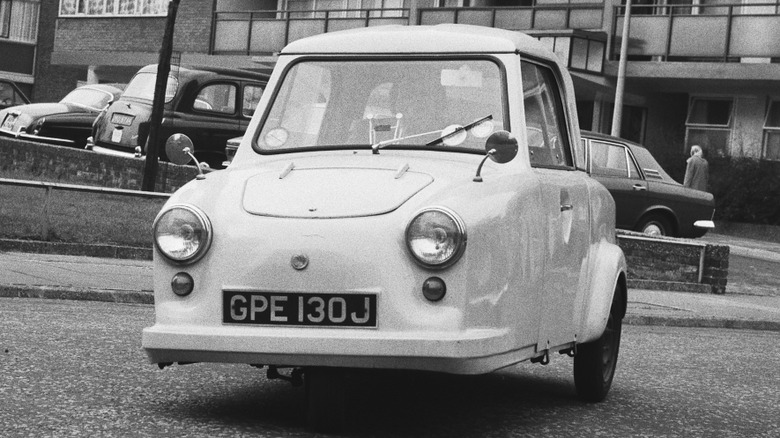
The journey of the Invacar — a term derived from "invalid carriage" — starts in the 1940s. Men were returning from World War II with disabilities that left them unable to operate a typical automobile. So the U.K. government decided to provide them with a small vehicle operated by hand controls. It looked like a car, but was actually more of a tricycle hiding beneath a crude fiberglass shell.
The Invacar was produced by eight separate automakers, and it enjoyed a career that spanned three decades. Early models were powered by a lethargic 147-cubic-centimeter air-cooled Villiers engine, but later ones sported "big-block" 500cc or 600cc four-stroke Steyr-Puch engines. Obviously, performance was never at the forefront of anyone's goals for the car. They were all about returning independence to British people with disabilities.
That's exactly what it did, and successfully too. Around 21,000 were produced, and while they were flawed and mocked by many, they did enable folk to return to the roads without having to rely on friends, family, and public transport.
But back to the flaws. The Invacar leaked and would bounce around with every speed hump and dip in the road. Chief among its problems, though, was the fact that it could quite easily topple over, and occasionally burst into flames, which left users scared to venture out in one. Formula 1 legend Graham Hill was familiar with driving's dangers — he raced in one of the most pivotal F1 eras when it came to safety — and as recorded in the proceedings of the U.K. Parliament, he declared that "such vehicles should not be on the road."
A brilliant idea, with poor execution
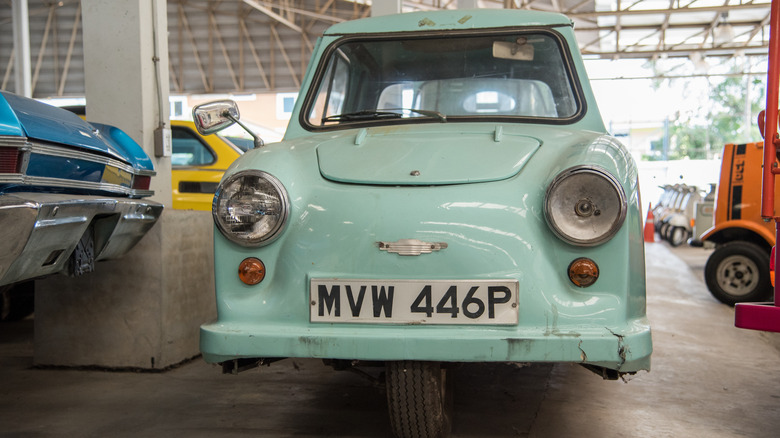
It appears that most users of the Invacar were thrilled to be presented with the option of getting out on the road, independently. As one user named Colin Powell told the BBC: "The excitement of this vehicle coming into your possession, after years of being dependent on ... my parents to take me anywhere, was an absolute delight and thrill."
But the pleasure of being getting such a vehicle was soon met with complaints about its effectiveness. The BBC reported that 85% of users found issues with them. Powell recalled: "They were not reliable, they were unstable, they were fundamentally unsafe."
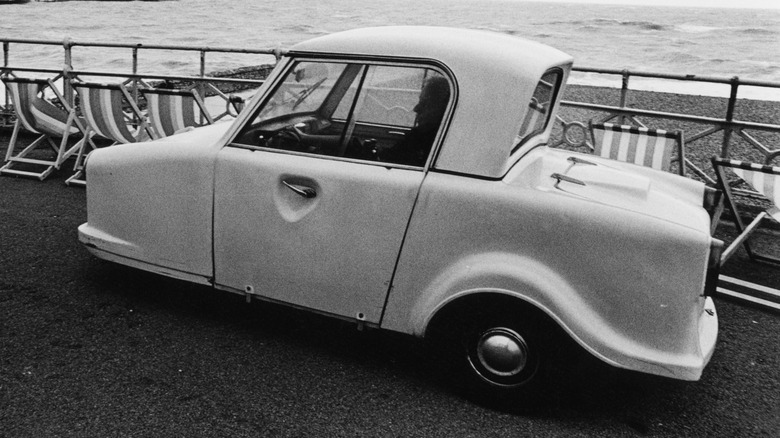
The Invacar's road manners weren't the only problem with the design. Users also complained about the lack of amenities inside; there was no heater, no radio, and space only for a wheelchair — other passengers were forbidden, as highlighted by a plaque in the cabin. As a result, mothers would have their children lie on the floor to conceal themselves. There was no padding, no additional seat belt, nothing for them. Pair this with the Invacar's interesting handling characteristics, and it's probably fair to dub the thing a death trap like a Morgan 3-Wheeler (though less exciting) — certainly by modern safety standards.
The Invacar's enduring legacy
As the years rolled on, users began to protest about the Invacar's unsuitability. Sure, they were grateful to be given wheels of their own, on the taxpayer's dime, but surely something more suitable could be offered. They wanted the government to adapt regular four-wheeled passenger vehicles instead, and these wishes were met in the '70s. One example was a Triumph Spitfire not unlike this old gasser, which — at a cost of 115 pounds, or about $1,700 today — had been adapted to boast hand controls.
From the desire for change came Britain's Motability Scheme. Under this initiative, disability payments cover or, for more expensive cars, help cover the cost of leasing a new vehicle, allowing eligible users to get about in a far more comfortable and well-equipped manner. Included within the Motability Scheme are the user's servicing, insurance, and towing costs, but of course, they don't actually own the vehicle.
While the Invacar was certainly troubled and flawed — its tendency to flip and combust did eventually lead to it being banned from British roads in 2003 — it did its users with freedoms they deserved. And it paved the way for the far-safer modern system now in place.