

iPhone And Ferrari Luce Interior Designer Says Touchscreens Are 'Wrong Technology' For Vehicle Interfaces
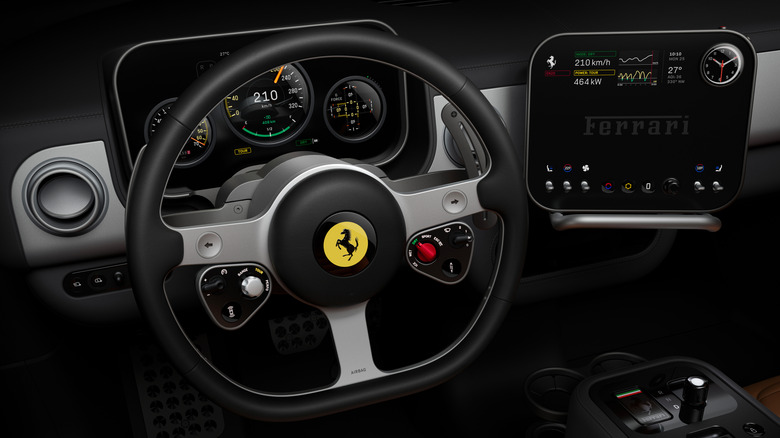
The Apple iPhone and its main designer, Jony Ive, made the touchscreen a pretty much ubiquitous interface for interacting with tech. Car designers have widely credited Ive as a reason why touchscreens are so prevalent in the cars on sale today, but he doesn't necessarily think that's a good thing.
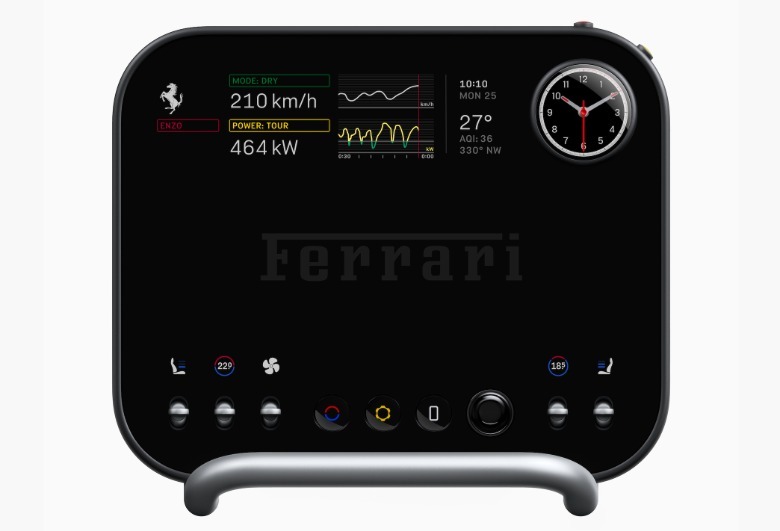
Ive just unveiled his latest creation — a new interior for Ferrari's upcoming Luce electric SUV — and while it is thoroughly modern with plenty of screens, it's also got a hell of a lot of buttons and other tactile controls. As it turns out, he's just not a huge fan of touchscreens in cars, saying they're "the wrong technology to be the primary interface" in a vehicle's interior, according to Autocar. Of course, this doesn't mean the Luce is completely void of touchscreens — it's got one that can pivot from driver to passenger right in the middle of the car, but it seems to be more of a complement to the physical buttons, dials and switches in the rest of the Luce's interior, rather than something that dominates the space.
I've gone on record saying I don't mind touchscreens at all, and online rage about them is overblown, but even I can admit that the Luce's interior is an incredibly fresh take on what a car's interior is supposed to look like. I really, really dig it. To be fair, I've always been an Apple fan, and I actually own an Ikepod Isopode, a watch designed by Ive's partner on the Luce, Marc Newson. So, the interior was sort of made for me.
Bucking the trend

I know that it sounds sort of wild for the guy who brought touchscreens to our phones to be so against them in cars, but his reasoning does make a lot of sense, and it echoes what we're hearing from other parts of the industry as buyers ask for buttons to be put back in their vehicles. Here's what he told Autocar about the difference between a touchscreen on a phone and a touchscreen in a car:
"The reason we developed touch [for the iPhone] was that we were developing an idea to solve a problem. The big idea was to develop a general-purpose interface that could be a calculator, could be a typewriter, could be a camera, rather than having physical buttons. I never would have used touch in a car [for the main controls]. It is something I would never have dreamed of doing because it requires you to look [away from the road]," Ivy told Autocar. "So that's just the wrong technology to be the primary interface."
 Ferrari
In the Luce, Ivy says the touchscreen is designed in a way so that it can be used "intuitively" and "safely." He described the central screen as "thoughtful" and pointed to the idea that the majority of the car's interfaces were actually controlled with physical switches.
Safety has always been one of the big concerns when it comes to touchscreen in cars. A few years ago, we told you about a study that showed just how much harder it was to do basic tasks like changing the radio station or adjusting climate settings with a touchscreen versus simple knob or button. The study found that participants traveled 1,000 meters less in an old Volvo than they did in a modern car while trying to adjust some settings — taking their eyes off the road.
Hell, as far back as 2019, we were talking about touchscreens in cars being "a failure." I'm not really sure I agree with that, but it's hard to argue with the evidence we may have strayed a bit too far into the world of touchscreens.
Ive blamed automakers trying to one-up each other (and themselves) as a driving reason why touchscreens have gotten so prevalent over the past decade or so, saying that they are seen "like fashion."
It was the most current technology, so [companies thought] 'we need a bit of touch', then the next year 'we're going to have an even bigger one', and it will get bigger and bigger," Ivy explained to Autocar.
I suppose we'll see if other automakers follow the trend of Ferrari and pare down their reliance on touchscreens inside their cars. While some will say we're "going backwards" when it comes to technology, there are certainly real safety benefits to having more physical control, and who doesn't like a nice, clicky button?