

GM Thought This Concept Was The Future Of Off-Roading Back In 1987
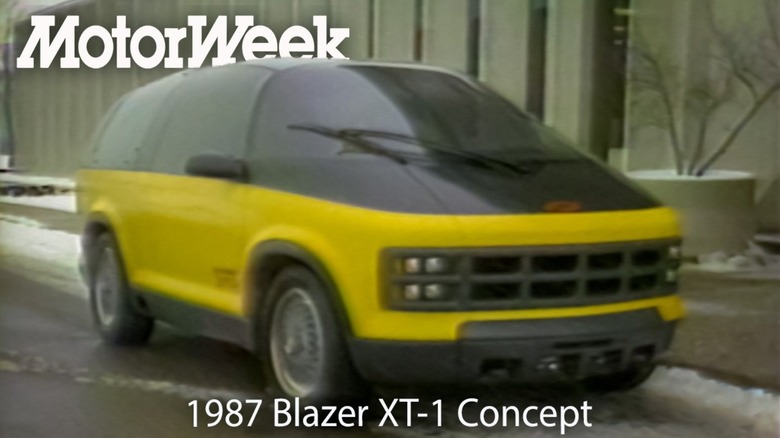
These days, it feels like anything designed to go off-road has to look angry and project an image that screams, "So what if I just ran over your grandma? She deserved it." Heck, just look at what Subaru's last redesign did to our beloved Outback. But all the way back in 1987, the folks at General Motors had a slightly different vision for future off-roaders in the form of the sleek Chevrolet Blazer XT-1 concept.
We've written about the Blazer XT-1 concept before, but what prompted this particular post was our good friends at MotorWeek posting their old Blazer XT-1 video on YouTube. If you're old enough to remember when this concept was new, you probably won't like being reminded that it's been four decades since Chevy first showed off its bright yellow, glass-topped 4x4, but everything about this really is a blast from the past, including the hosts' fashion choices. John Davis, however, is timeless, and I wouldn't be surprised to hear that suit's still hanging in his closet.
As a concept from the late '80s that's pitched as possibly being "the future of 4x4s" that "could change things" with its high-tech solutions, the Blazer XT-1 concept was anything but timeless. Sure, it used some of the most advanced technology available at the time, but that was also a time when almost all phones were still tied to the wall, and a TV weighed more than your oven. If you wish modern cars had more buttons, though, you're going to love the interior.
A future that never happened
While the Blazer XT-1 can be referred to as a concept, it was really more of "testbed for new light truck technology" designed by GM's Advanced Vehicle Engineering and was actually driveable. Power came from a 4.3-liter V6 with an aluminum block that was closely related to the Chevrolet Astro's Vortec V6. It also reportedly made 202 horsepower and 250 pound-feet of torque, which younger readers may have a hard time believing was impressive at the time. For comparison, a 1987 Ford Mustang GT made 225 hp from a 5.0-liter V8.
The engine sent that power to the wheels via a "computerized four-speed automatic transmission that shifts between two and four-wheel drive as road conditions demand," and it could monitor slip to shuttle torque between each axle. And while it didn't have an old-school live-axle setup like a lot of off-roaders, you still got 10.5 inches of travel out of the fully independent suspension. You could also adjust the ride height, and the suspension was self-leveling. Throw in the "fly by wire" four-wheel steering system, and you're looking at concept vehicle full of tech that's actually pretty common today.
Inside, there's no steering wheel. Instead, you pilot the Blazer XT-1 with a fighter-jet-inspired yoke. Thankfully, no one in the future actually tried to put one of those in a production vehicle. That would just be silly. And in addition to a sea of buttons everywhere, you also got a driver display that appeared to be three-dimensional. Sadly, when Mercedes-Benz eventually added a 3D driver display to the S-Class, it didn't give it nearly as cool of a name as Chevrolet did with "Future Vision."
So, while GM's exterior design team may have failed to predict that buyers would soon be demanding off-roaders that looked like they all have cauliflower ear, they got a lot more right about the future of SUVs than the Blazer XT-1's appearance would suggest. Including the part where a technologically advanced SUV "would be for more upscale buyers, not for people who measure a four-wheel-drive vehicle's effectiveness by ground clearance alone."