

9 Japanese Sports Cars That Are Cheaper Than A New Mazda Miata
Miata is always the answer (M.I.A.T.A.). Yup, this saying is as tired as a 100,000-mile clutch, but at just $31,665 in the U.S., Mazda's MX-5 Miata is the cheapest dedicated sports car — and perhaps the most engaging, fun-to-drive machine currently on sale. It's light, balanced, fast enough, and equipped with a stick shift. As a cherry on top, you can even enjoy it with the top down. Good luck finding the same set of characteristics in any other new sports car.
And Mazda isn't ready to give it up anytime soon. The next MX-5 Miata will be even lighter and still offer a manual transmission. In this electrification era, that's something to be celebrated. But let's not act like $30k is approachable. You can only really use the MX-5 Miata as a second car, and in an era marked by the fallout of the middle class, paying that much for an adult toy is a significant financial burden for most young people.
So, maybe the M.I.A.T.A. saying is fading in relevance? Well, it has never been entirely true — not with these Japanese sports cars that are cheaper than a new Miata. Yes, we are talking about used vehicles that weren't always perfect when new. Still, they'll scratch the sports car itch you've always had, put a massive grin on your face, and won't leave you cash strapped. They even come with a manual!
Toyota MR2 Spyder (2000-2005)
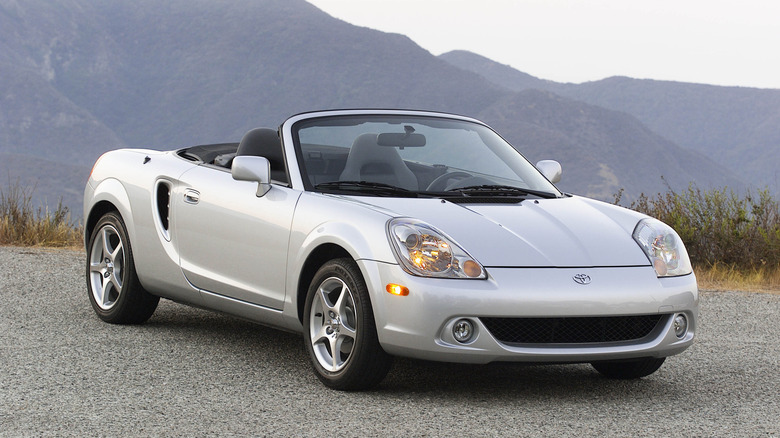
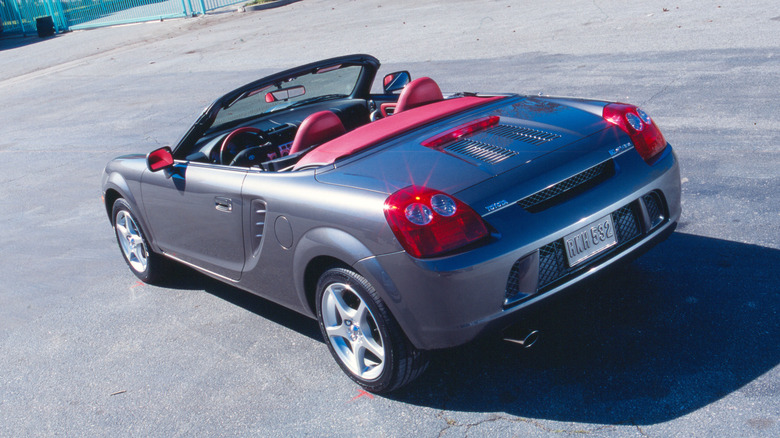
MR2 enthusiasts like to forget about the third-gen Spyder. After all, how could anybody like a newer sports car that's significantly less powerful than the one it replaced? The second-gen MR2 produced up to 200 horsepower from its 2.0-liter turbo-four. The third gen only managed 138 horsepower from a 1.8-liter naturally aspirated unit. Having driven both, though, I can say that Top Gear's description of the Mk2 MR2 as a GT is just right, especially when compared to the Mk3.
The Mk2 weighs 2,915 pounds, and the Mk3 is just 2,195 pounds. You also don't need to deal with turbo lag on the Spyder. Oh, and the Mk3 still carries the engine in the middle, giving you — dare we say it — a better-handling MX-5 Miata. To put it bluntly, the way the MR2 Spyder rotates around its axis is simply unattainable in a front-engine machine. It's perhaps not as predictable and requires more driving knowledge, but once you master the driving dynamics, it's a joy to drive. No wonder one of our writers fell in love with the MR2 Spyder.
And, despite what everyone says, it's not slow. Back in 2001, in a comparison test to the Miata, MotorTrend clocked the MR2 Spyder to 60 in 7.16 seconds. You can also swap in a 2ZZ from the Lotus Elise and make it faster than a new Miata. Even without that swap, the MR2 Spyder is an incredible a bargain now, with prices ranging from $11,000 to $15,000.
Nissan 370Z/350Z (2002-2020)
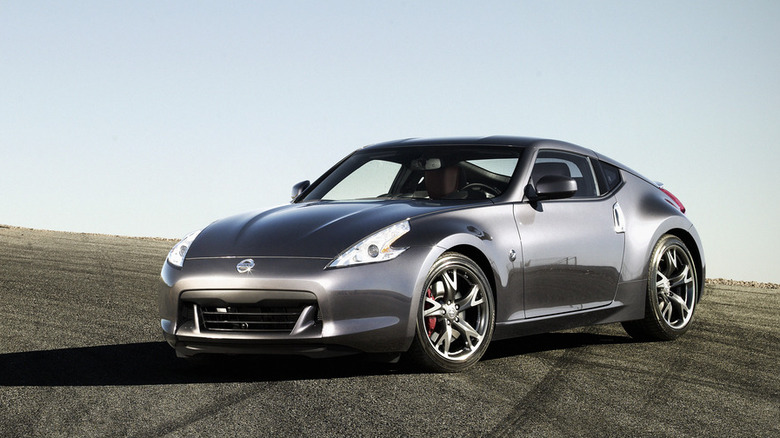
When people use the M.I.A.T.A. saying, it seems like they forget about the Nissan 370Z. Writing off Nissan's V6-powered sports car is foolish, especially with good examples priced at below $20,000. Yeah, you'll be buying a used car, but it's one with a six-speed manual and a 3.7-liter V6 that produces up to 350 horsepower and 276 pound-feet of torque with the Nismo package. MotorTrend clocked a 0-60 sprint of 4.89 seconds, meaning it would leave the MX-5 Miata in dust.
True, at 3,400+ pounds, the 370Z is significantly heavier than Mazda's lightweight roadster. But it's still a rear-wheel drive stick-shift machine with a naturally aspirated engine that needs to be celebrated. The Nissan 370Z brings the old-school simplicity everyone loves about the Miata, but in a bigger, more mature package. It was even available as a roadster, allowing for open-top thrills. Still, the coupe is more practical. Its cargo capacity is relatively small at 6.9 cubic feet, but that's still significantly larger than the Miata's 4.5 cubic feet.
You can go back a generation and save even more money. A low-mileage 350Z roadster/coupe costs under $10,000 today while still offering significantly more power than a Miata thanks to a 3.5-liter V6 that can make 306 horsepower and 268 pound-feet of torque. It goes from 0 to 60 mph in 5.6 seconds and boasts a top speed of over 150 mph. The 350Z is rear-wheel drive, too, and has been available with a close-ratio, six-speed manual. It won't be as agile as the Miata, but it still offers engaging, fun-to-drive dynamics.
Subaru BRZ/Toyota 86/Scion FR-S (2012-2020)
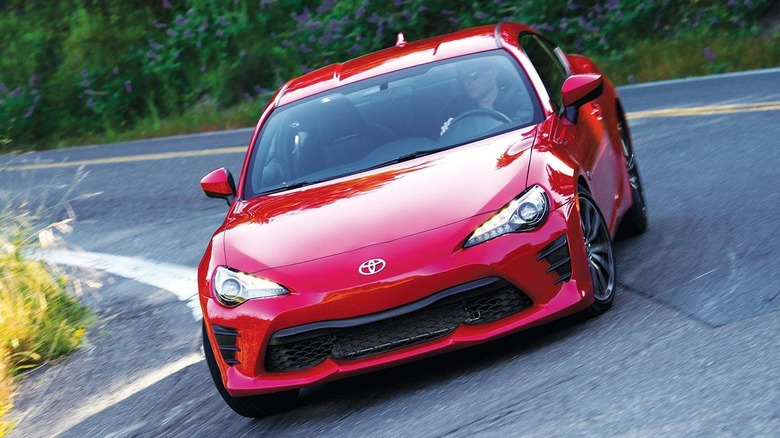
The first-gen Subaru BRZ/Toyota 86 duo (or trio, if you also consider the Scion FR-S) would be the second-most obvious alternative to a new MX-5 Miata — next to an old Miata, of course. These coupe cousins offer the same old-school, front-engine, rear-drive driving dynamics. No turbochargers, no heavy batteries, just you and a cheap machine designed to offer thrills at a budget. Currently, that budget would be down to around $12,000 for a high mileage FR-S and up to $25,000 for an almost-new 86 or BRZ. You won't get open-top action in these cars, but they can sit two people in the back and fit significantly more cargo with seven cubic feet of space.
They're also fantastic corner carvers. It's hardly surprising, as they weigh around 2,740 pounds depending on the trim. That weight is also distributed perfectly across the axles, and the 2.0-liter boxer engine enables a lower center of gravity than a regular inline-four engine. The result is a natural, analog driving experience that few other cars can match. Even 12 years after I've extensively tested a European GT 86, I can still recall the great handling balance, natural steering, and excellent stick-shift action. These cars are a joy to drive, particularly on twisty roads.
As a downside, the boxer engine only produced up to 205 horsepower and a lowly 156 pound-feet of torque. These cars are not fast, sure, but they still have enough power to keep you engaged. Besides, the 2026 MX-5 Miata only has 181 horsepower, itself.
Acura RSX Type S (2001-2006)
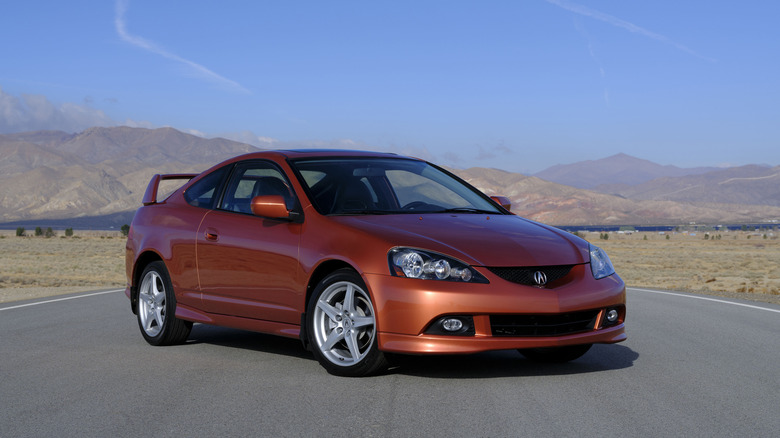
If you can accept front-wheel drive, you can enjoy the high-revving K-Series engine that Miata owners often swap in their cars in the Acura RSX Type S. You can expect 210 horsepower and 143 pound-feet of torque at 7,000 rpm — at least, from the 2005 model. Earlier versions made "only" 200 horsepower. Still, each model comes with Honda's short and precise six-speed manual, which makes chasing the redline that more engaging.
The bigger upgrade in the 2005 Type S was the body stiffening and chassis retuning. According to reviewers at the time, it improved lateral grip and steering response, making Acura's coupe a more engaging car to drive. The larger disc brakes in the 2005 model also shortened stopping distances. Thanks to the relatively low curb weight of 2,848 pounds, the car measured a brisk 0-60 time of 6.2 seconds, making it faster than a Toyota 86/Subaru BRZ.
However, the RSX Type S is a front-wheel drive car without a limited-slip differential, so it's prone to understeer. Fortunately, conversion kits for it won't add much to the sub-$20,000 price of a used mode. What sets the RSX Type S apart from most sports cars on this list is that it's a genuinely good daily driver, providing the comfort you'd expect from an Acura product. It even features a sizeablecargo area with 16 cubic feet of space — or 25.3 cubic feet once you fold down the rear seats.
Toyota Celica GT-S (1999-2005)
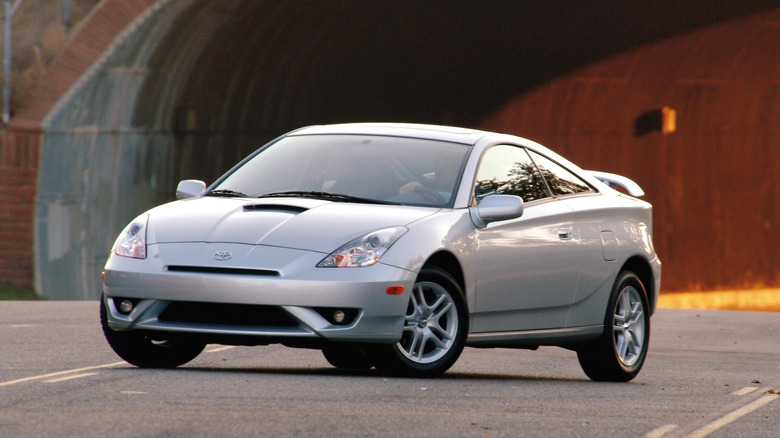
Yes, Toyota also had a front-wheel drive sports coupe with a high-revving four-cylinder engine. And it wasn't just any four-cylinder, but the 2ZZ-GE we mentioned as a favorite among MR2 Spyder owners. In the Celica GT-S, this Yamaha-tuned 1.8-liter unit produced 180 horsepower at 7,600 rpm and 130 pound-feet of torque at 6,800 rpm, with a redline as high as 8,300 rpm. The TRD exhaust and intake bits offered by Toyota boosted the 2ZZ to 194 horsepower.
Yes, you need to rev this thing, but it's oh-so enjoyable. The VVTL-i valve train on this engine introduced high valve lift at higher rpm, acting like a boost. The six-speed manual also helps to make the most out of the engine, with the Celica arriving at the 60 mph mark in 6.6 seconds and reaching a top speed of 129 mph. The engine is the star of the show here, but the 2,500-pound Celica GT-S is also surprisingly good in the corners. I've driven the European Celica T Sport (same car with a bit more power) a decade ago, and it handled beautifully for a front-wheel drive machine. Still, I'd highly recommend adding a cheap LSD kit, which should improve the handling quite dramatically.
The aesthetic design is polarizing, but you can't deny its uniqueness. The front end is sharp and purposeful, and it transitions nicely to the rear liftgate. That also makes it practical, as the large aperture reveals a useful trunk with 16.9 cubic feet of space. Recently, Celica GT-S prices hiked from sub-$10,000 in 2024, but good units still sell for less than $20,000.
Honda Prelude Type SH (1997-2001)
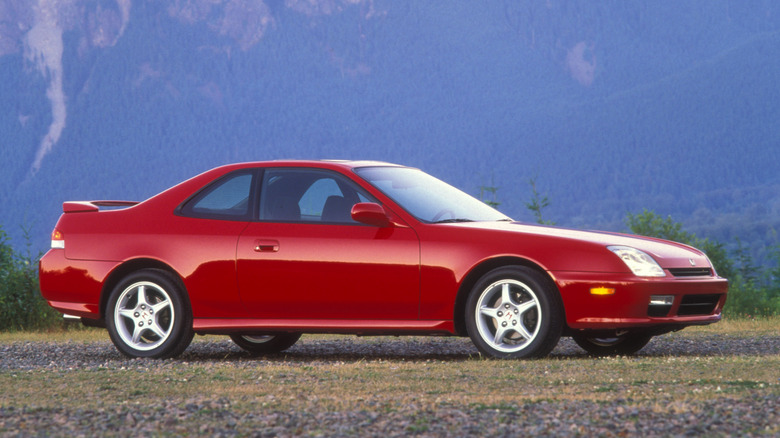
If the mere mention of another front-wheel drive sports car makes you feel like you just bit into a lemon, we get it. But the Prelude SH is the Miata of FWD machines. In a 1997 Car and Driver handling test, the Prelude even ended up beating out the Miata, the BMW 318ti Sport, and the Chevrolet Camaro Z28. The fact that the Prelude SH was Honda's grand tourer and not an enthusiast-oriented sports car makes this feat even more impressive.
The key to this success was the car's Active Torque Transfer System, which you probably know as active torque vectoring. This sends more power to the outside front tire to kill understeer. And this is not torque vectoring through braking like what most modern systems use. Instead, Honda utilized a hydraulically-actuated planetary gearset that could transfer torque to the outer wheel without using the brakes. It was controlled by a system that monitored speed, steering angle, and lateral acceleration. Indeed, that "SH" stood for Super Handling, and the model delivered on its promise.
Spice this up with some high-revving VTEC goodness and you have one of the best 1990s canyon machines. The 2.2-liter four-cylinder produced 200 horsepower and 156 pound-feet of torque, with a 0-60 time of seven seconds and a top speed of 140 mph. The chef's kiss came in the form of a short ratio five-speed manual. Prices range from $10,000 to $16,000 today. This 1998 Prelude SH sold for $15,800, but with a swapped-in JDM H22A engine and some other upgrades.
Infiniti G37 Coupe/Convertible/IPL G (2008-2014)
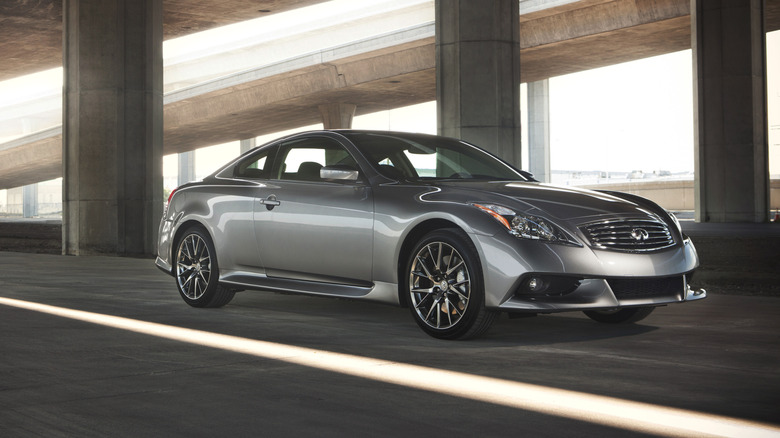
If you want a cheap sports car without sacrificing luxury, the Infiniti G37 offers the whole shebang at around $12,000. You can choose between rear-wheel drive or all-wheel drive, a six-speed manual or a seven-speed automatic, and coupe or convertible.
What you might miss is that the G37 Coupe and Convertible are based on the Nissan 370Z platform. Infiniti's models come with two more seats, though, which makes them heavier. Regardless, thanks to the 370Z's potent 3.7-liter V6 making up to 330 horsepower, the G37 Coupe will smoke the Miata in a straight line — its 0-60 time only takes 5.3 seconds. Naturally, the G37 feels way more luxurious on the inside than the Miata (or any other car on this list), and it's elegant on the outside, too.
But if you want something that pairs better with fresh Jordans, Infiniti also offered the IPL G – an amped-up, high-performance version of the G37 Coupe and Convertible. IPL G's V6 produced 348 horsepower and came with a six-speed short shifter or a seven-speed automatic with magnesium paddle shifters.The 0-60 time dropped to 5.2 seconds and the suspension was stiffened, too. Infiniti even tuned the sound to enhance the driving experience. On the outside, the sharp 19-inch wheels wore Bridgestone Potenza RE050A performance tires. Today, you can find an IPL G for $15,000, which is an incredible price for a luxury-oriented enthusiast sports car.
Honda Beat (1991-1996)
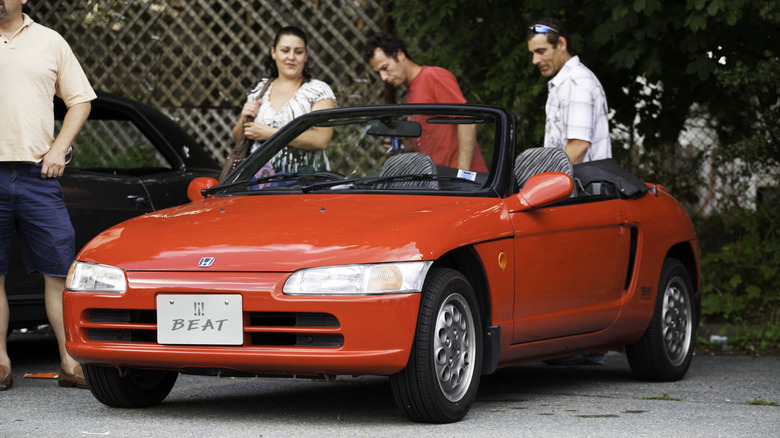
The Honda Beat is easily one of the most unique sports cars ever built. It boasts 9,000 rpm of naturally aspirated goodness, individual throttle bodies, and an exhilarating engine sound that frantically pumps blood into your veins – not to mention an F1-car-beating curb weight of around 1,675 pounds. No wonder it's the favorite car one of our writers has ever owned.
If you're into straight-line speed, though, the Honda Beat isn't for you. The 656 cc three-cylinder is surely impressive, producing 63 horsepower despite lacking any forced induction. But that's because the Beat is a kei car, and that's the maximum power these cars are allowed. Although it's incredibly light, Honda's micro supercar takes 13.3 seconds to reach 62 mph. The top speed is also limited to 86 mph.
Judging the Beat on numbers defeats its purpose, though. The mid-engine layout, skinny tires, and lack of weight make it fun to throw around corners. The high-end PP1-110 variant also came with a limited-slip differential, which further enhanced handling. Because it's so tiny at just 129.7 inches long and 55.1 inches wide, you can place it anywhere in the corner and sneak through traffic easily. Honda Beats start at around $6,000 in Japan, but prices go up significantly for mint, low-mileage examples. It's still fairly cheap, but keep in mind that you also need to pay for shipping and import charges, which vary depending on the state. Also, you can't move the steering wheel to the left.
Suzuki Cappuccino (1991-1998)
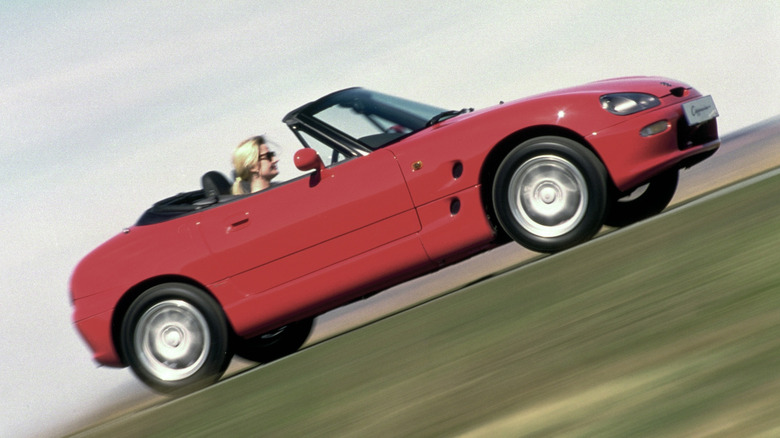
If the Honda Beat's acceleration figures and mid-engine layout don't cut it for you, how about a Cappuccino? Suzuki's 1990s kei sports car ticks the Miata boxes with a three-cylinder engine that's in the front-mid position, creating a 50:50 weight distribution. It's also turbocharged and intercooled.
Despite producing the highest allowed 63 horsepower, it has a much higher 62 pound-feet of torque. The Beat only got as high as 44 pound-feet. Cappuccino's tiny three-cylinder also manages to rev to a stratospheric 9,300 rpm, and it's lighter at just around 1,598 pounds. As a result, it blasts to 62 mph in just 7.6 seconds. Because it's turbocharged, Cappuccino's engine is easier to tune, so people are able to push it easily to 120 horsepower.
Of course, the Cappuccino is as tiny as the Beat on the outside. Still, the long-hood proportions are more Miata-like, and so is the handling. It has an advanced multi-link rear axle and double wishbones up front, which happens to be the same suspension setup as a new MX-5 Miata. Granted, Suzuki's offering has removable roof panels instead of an automated roof, but you can still store them neatly in the trunk. In 2024, an imported 1992 Cappuccino was on sale for $15,500. The owner did some upkeep and upgrades before putting the car on sale, though. If you decide on importing one, prices start at $10,000 in Japan, but they can reach highs of nearly $25,000.