

8 Years Ago, Automakers Were Forced To Equip Backup Cameras - What Might Come Next?
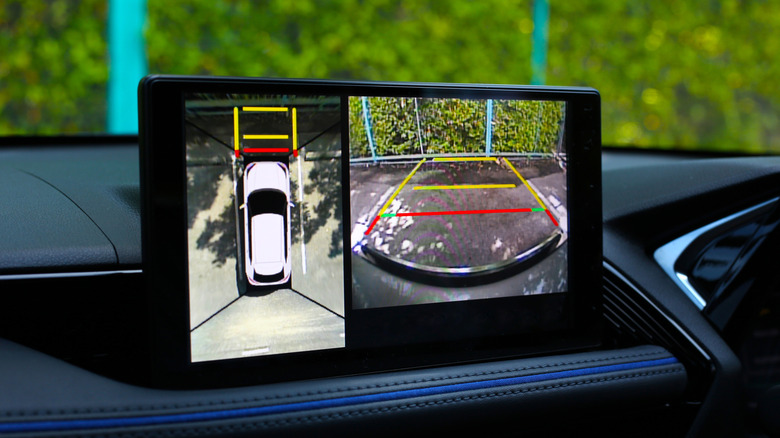
In 2014, the National Highway Traffic Safety Administration (NHTSA) completed a multi-year process that led to a new safety standard: all new cars and trucks sold in the United States must include rearview cameras as of May 2018. The initiative was aimed at preventing backover accidents, which, according to NHTSA, caused an average of 210 fatalities and 15,000 injuries each year. Even worse, the same studies noted that children under five and adults aged 70 or older were disproportionately affected.
However, no software is ever perfect, and there are many factors that ultimately determine whether an accident occurs. For instance, the GMC Sierra has a backup camera that's nearly useless at night (same with most other trucks), while Ford recently recalled 1.1 million trucks due to camera problems. Regardless, fast forward to 2026, and we have numerous safety technologies that can reduce accidents in a variety of environments, the same way a rearview camera can.
Innovations like automatic emergency braking, lane departure warning, and pedestrian detection systems have all proven effective in studies and real-world use. Yet — at least for now — their adoption has largely been left to the market to decide, with NHTSA able only to recommend – not mandate — them. This raises the question: what might come next? Here's our educated guess, along with all the challenges that might follow.
Automatic emergency braking is next
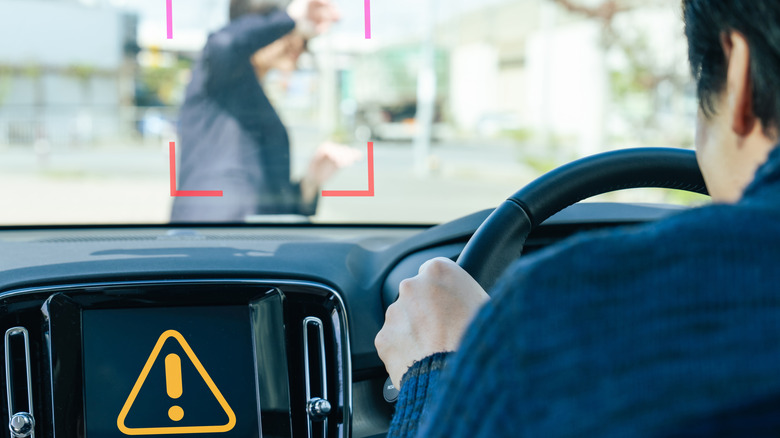
As of this writing, it seems like there is a strong chance that automatic emergency braking (AEB) systems could be next. This is because, back in 2024, NHTSA signed off on a new Federal Motor Vehicle Safety Standard (FMVSS) rule that effectively mandates that all new passenger cars and light trucks offer AEB systems by September of 2029. During the finalization process, then-Transportation Secretary Pete Buttigieg said in a press statement that "The new vehicle safety standards we finalized today will save hundreds of lives and prevent tens of thousands of injuries every year."
The rule requires all cars to come to a stop in order to avoid collisions; they must detect pedestrians in daylight and darkness, and apply the brakes up to 90 mph for vehicles and 45 mph for pedestrians. There is credible data to back up such a rule. According to a study published in Accident Analysis & Prevention, vehicles equipped with forward collision warning and AEB systems experienced up to a 50% reduction in rear-end collisions compared to vehicles without them.
However, AEB relies on code, and like all software, it can misinterpret data or experience glitches. For instance, AEB systems still suck at preventing crashes with motorcycles and semis. Even though automakers have filed lawsuits against NHTSA in an effort to challenge the rule's feasibility, it is still set to take effect in 2029.
Lane keeping assistance systems could soon follow
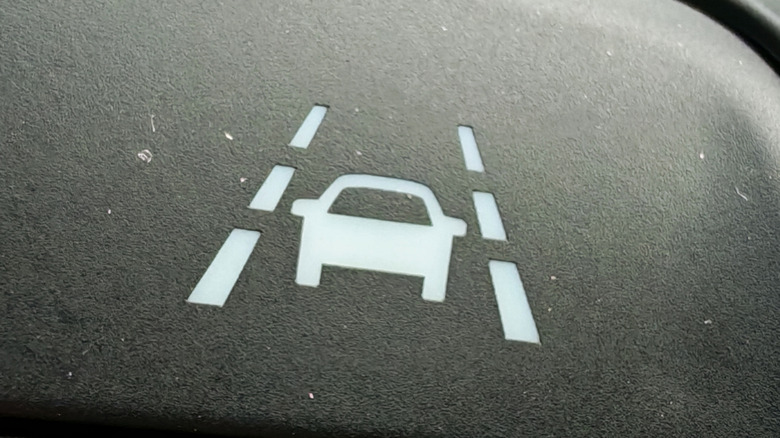
Before the turn of the millennium, Mercedes was one of the very first brands to offer lane-keeping assist (LKA) systems — not for top-end models like the S-Class, but for the Actros semi truck. After that, the technology continued to evolve. Nowadays, it is difficult to find a car that does not come with LKA from the factory. More specifically, a recent market study by PARTS found that adoption of LKA in the U.S. grew from 1.4% in 2015 to 86.3% in 2023.
This makes LKA a viable contender for official adoption by NHTSA. LKA is usually paired with lane departure warning (LDW), but automakers handle it differently. Some vibrate the wheel, some sound alerts, some flash the lights, some steer you back or apply the brakes, and others even wrestle the wheel for control. However, in an NHTSA press release from 2024, the agency updated its 5‑Star Safety Ratings program, officially set to evaluate LKA under the New Car Assessment Program.
This means that tests will be carried out, standardization might start, and ultimately, it could lead to the same outcome as AEB. LKA represents a vital part of the six levels of automated driving, meaning that it can also be a stepping stone for any future rule-based initiatives on self-driving cars. Regardless, a study of available crash data published in 2022 by SAE International showed that LKA can reduce lane-departure-related accidents by about 60%.
Blind spot assistance systems are also candidates
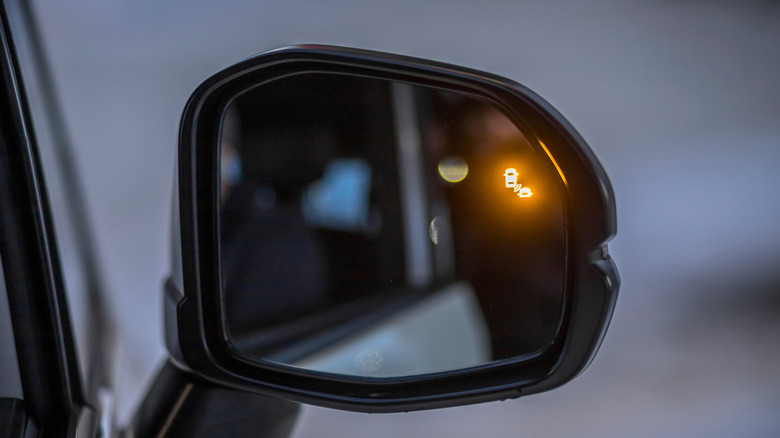
Besides lane-keeping assistance systems like LKA and LDW, the aforementioned NHTSA 5-Star Safety Ratings program also included blind spot assist and even an active blind spot system that can intervene. The world's first 2003 Volvo XC90 blind spot assist monitor worked by using cameras and radars in the rearview mirrors to detect vehicles. The more modern systems supplement this with improved radars, smarter object recognition, or even LiDAR systems, which can effectively provide high-resolution 3D mapping.
Research by the Insurance Institute for Highway Safety (IIHS) showed that blind spot assist systems can reduce all lane-change crashes by 14% and lane-change crashes with injuries by 23%. Some automakers have even gone a step further. Hyundai and Kia use a very convenient piece of technology that broadcasts the camera feed from the car's blind spot whenever you signal to make a lane change.
On his YouTube channel, reviewer Doug DeMuro commended Hyundai and Kia's blind spot camera system, saying, "It works beautifully. It is fantastic the way this operates; I love this feature." Another good thing about blind spot monitoring systems is that they typically aren't active. This means that the car only alerts you when something might be in your blind spot, but it does not intervene in the same way LKA or AEB do.
Driver attention monitoring might arrive later

Distracted driving is one of the leading causes of crashes and fatalities on U.S. roads. Per the IIHS, as many as 8% of all crash deaths on American roads can be at least partly attributed to distracted driving. With the looming presence of attention-grabbing dashboard screens, smartwatches, phones, and other gadgets, this problem won't go away on its own.
To make matters worse, many driver-assist systems are making us more distracted. Nevertheless, this is an area where driver attention monitoring (DAM) systems can help when properly designed. It all started back in the 1990s when Toyota showcased its DAM that used an infrared camera to monitor the driver. However, the Department of Transportation currently relies on a set of comprehensive guidelines to reduce driver distraction.
Because of that, there are no official statements from NHTSA to suggest DAM systems are likely to be legally required soon, or ever. In an information-driven world, where car interiors are sometimes a distraction, DAM systems could certainly help catch inattention. Still, one drawback of DAM systems is privacy — having a camera watch you while driving is not something most drivers would rush to accept as a legal requirement.