

How Iceland Built A Car Culture At The Edge Of The Arctic
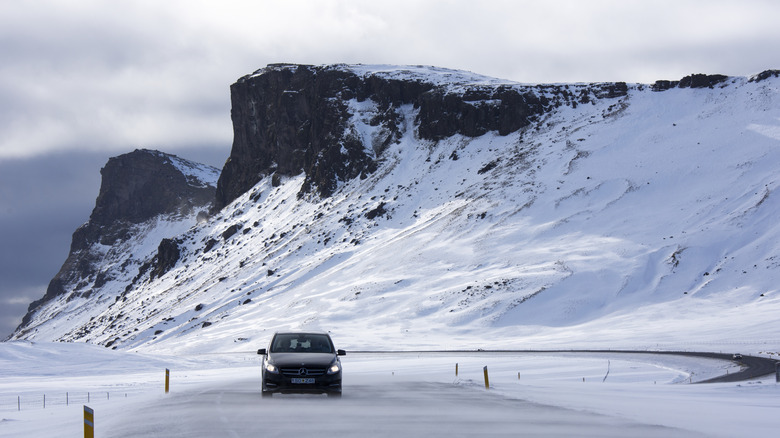
Iceland is the second-largest island that's a part of the European Economic Area — and the 18th-largest in the entire world. The nearly 40,000 square-mile country is more than four times the size of the Dallas-Fort Worth metropolitan area. But while around eight million people live in that block of Texas, Iceland is home to just about 400,000.
The answer to why this land is one of the smallest sovereign nations on Earth is, among many other historical factors, a tale of environment. Its weather is unpredictable, hovering at or below zero degrees Celsius in the winter and spring. The landscape is covered in at least 30 active volcanoes alongside ancient glaciers and jagged mountains, making much of the country nearly uninhabitable. So what makes it such an appealing place to live? And how, among all the factors of Mother Nature's wrath, has this tiny population curated one of the most interesting and lively car cultures we've ever seen?
Well, to answer the first question, Iceland is the third-happiest country on Earth (according to the World Happiness Report) and the literal most peaceful nation in the world. Thus, the fact that its population manages to reach six digits isn't too surprising. As for the second question, the answer is a bit more involved.
Iceland embraces roads
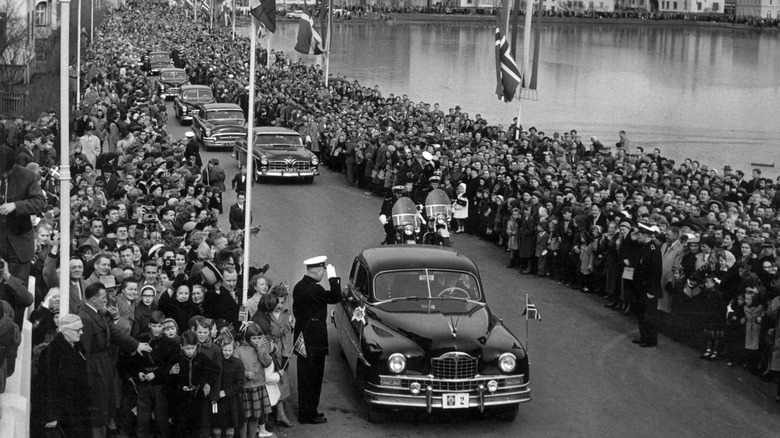
It wasn't until around 1894 that Iceland's governing bodies, namely the Iceland Road and Coastal Administration (IRCA), committed to developing a road system throughout the livable areas of the country. The IRCA was first tasked with building gravel pathways for carriages hauling goods, people, and whatever the population needed at the time. A few years later, purpose-built bridges were constructed, and in 1904, a pivotal moment would occur. A car originally from Germany, the 1901 Cudell, would arrive on Iceland's shore.
This revolutionary piece of equipment was the first to roll its tires on the island, and eventually, other motor-powered cars would guide the country into the era of the automobile. The IRCA soon upped its road development, paving 612 kilometers of roadways and 712 kilometers of carriage roads throughout the country by the mid-1920s.
World War II and the arrival of American and British militaries brought along a boost to the island's economy — as well as the Jeep. Iceland's rugged landscape was the perfect fit for this small, capable machine, and utility vehicles like it would permeate the country's car population into the future. By the 1970s, the country began large-scale paving projects around the nation. This led to the creation of Iceland's iconic Ring road, which circles nearly the entire perimeter of Iceland. From 1904 to 2018, the car population had grown from just one to over 300,000. And yet, the preservation of its insanely beautiful landscapes can still make a road trip through Iceland one of the best you've ever taken.
Walking on water: Iceland creates Formula Offroad
In the 1960s (and still to this day), Iceland's volunteer rescue and support teams that aid in natural disasters or domestic accidents need specialty four-wheel-drive vehicles capable of handling the treacherous terrain of the nation. But because these were mainly volunteers, they had to fundraise in order to support their efforts. So, they put on a spectacle, holding small, friendly off-road competitions to see which vehicles were the best, all in view for the public to enjoy and financially contribute to.
The first formal championship was put on by a group called Reykjavik Car Club in 1965, in which a man named Egill Gunnar Ingólfsson was crowned as the winner. It was these early years that birthed the Formula Offroad title, and as the decades rolled by, it only grew to more spectacular scales. In modern times, the vehicle classes are fairly straightforward. There's a Street Legal Class that requires the trucks to pass the regular traffic inspections, a Modified Class where competing vehicles have to resemble the production vehicles they are based on, and then the Unlimited Class in which all bets are off, allowing drivers to use paddle tires like the kind you see in dirt drag racing.
Today, buggies and trucks powered by 1,000 horsepower V8s are commonplace, competing on various tracks that include near-vertical hill climbs, mud bogs, rock mines, and river crossings where these machines can literally skate across the surface of the water. In any given event, drivers may encounter six different tracks, receiving 350 points for finishing each one, and gaining extra bonus points for finishing quicker than their opponents.
Heart-shaped lights: The Akureyri Car Club and Motorsport Festival
In the early 1970s, an Icelandic man named Steindór Geir Steindórsson (also known as Dini) was worried for his peers. They enjoyed fast cars, racing, and everything that could get them in trouble in their capital city of Reykjavik; he needed a place that could allow them to enjoy cars in a safer manner. Dini decided on Akureyri, a town in northern Iceland that had an airport he envisioned as a future place for car culture to come together. In the end, the Akureyri Car Club he would found in 1974 would provide Iceland with entertainment that could rival the best automotive events ever organized.
Over the course of many years, Dini and other volunteers reached out to local news for coverage, held car shows, hosted off-road exhibition races, and begged anyone in the area with an interesting car to show up. Eventually, the Akureyri Car Club was fully established and began hosting yearly one-day car shows that brought folks from all around the country.
Today, the same club is bigger than ever, and that same event (held every June) lasts five days instead of one. Dubbed The Motorsports Festival (or Bíladagar), this event houses Formula Off-Road events, mud-bogging, sand-based and traditional drag racing, drifting, auto-cross racing, and — of course — a car show. Not only is the Akureyri Car Club's festival one of the oldest in the country, but it's easily one of the most important and influential automotive events to ever touch Iceland. Just watch out for the town's heart-shaped stop lights if you want to drop by.
Rally Reykjavik and familiar automotive faces
Though specific records of the origins of Iceland's own rally racing series are sparse, the Iceland Rally Championship has been going on for years, featuring some of the most insane roads in the country. One of the more famous stops in Iceland's rally calendar is the Rally Reykjavik, named after the nation's capital city. This three-day battle covers about 330 kilometers in the southwestern part of the country.
One of the most interesting parts of the Reykjavik rally is the lack of the World Rally Championship's involvement. Of course, it still follows FIA-sanctioned rules, but most of the teams involved aren't using state-of-the-art all-terrain machines. Rather, they use production-based rally cars from generations removed.
In the most recent running of the Reykjavik Rally (2025), the list of competitors looks like a blast from the past. Some of the machinery used consisted of Mitsubishi Lancer Evos and Subaru Impreza WRXs like the GC8. There are even some more obscure models like the Ford Fiesta Proto and BMW E36 Compact.
Iceland's off-road Pikes Peak
If Formula Offroad and traditional rally racing are too polarizing for your tastes, perhaps you'd enjoy the Iceland Hill Rally. It combines some of the modified and production-based off-road vehicles from Formula Offroad, putting them in a more standard long-distance rally. Still, this is no run-of-the-mill event. At 66 degrees North latitude, it is the northern-most baja-style rally on the planet.
It all begins with the crown jewel of the Iceland Hill Rally: the hill climb. It ascends over 600 meters and spans over five kilometers of distance to reach not the finish, but the start of a completely new 50-kilometer stage. The rally is completed over three consecutive days, with competitors racing over 620 kilometers total. That's longer than the entire state of Washington from East to West.
These days, the race is sponsored by Can-Am, which is a company that makes plenty of small off-roading buggies. Because of this, among the different classes, you can find tiny trail-ready Can-Ams racing alongside Dakar-style race trucks in the same event.
Arctic Trucks was founded in Iceland
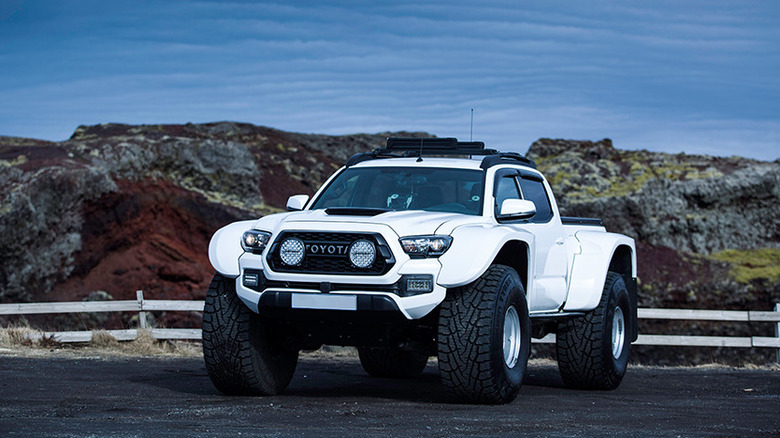
Not every automotive item from Iceland is rooted in motorsport. One particular company has been building highly-capable 4x4s that assist in recreation and even research expeditions for decades now. In 1988, a small team of engineers formed Arctic Trucks in Iceland and began modifying four-wheel drive vehicles to fit larger-than-stock tires. This engineering feat allowed those vehicles to manage Iceland's diverse landscapes.
The team's work didn't go unnoticed, as Toyota's Icelanding division would sell Arctic Trucks' upgraded version of the Land Cruisers and Hilux as factory options within the country. Over the next several years, Arctic Trucks' custom Land Cruisers would become the first vehicles to cross Greenland's famous ice cap, as well as assist in a glacier research project in Antarctica.
As the years passed, it would establish operations in the United Arab Emirates, Norway, Russia, the U.K., and several other regions, where it would start to offer guided tours and expeditions of remote areas across the world. Currently, Arctic Trucks' inventory of vehicles includes monstrous versions of trucks like the Toyota Land Cruiser, Izuzu D-Max, and Nissan Patrol, as well as downright ridiculous stuff like the Toyota Hilux 6x6. You may actually remember the "Polar Special" episode of "Top Gear" which features a Toyota Hilux driving in the northern arctic. That just happened to be one of Arctic Trucks' own beefed-up, wide-body examples.
American relics, preserved in Iceland
While Iceland is a part of the European Union's economic area and follows many of its guidelines, it's not an official member. The country doesn't have much in the form of domestic automotive manufacturing, so the small population relies heavily on imports — and one of Iceland's largest trading partners is the United States. The U.S. also has long-standing relations with Iceland for the sake of NATO and other military ties, so it's no wonder that many American automobiles have ended up on Icelandic roads.
Several car clubs and museums in Iceland focus specifically on classics, with much of their inventory consisting of American steel from the pre-war era through the 1980s. For example, the Ystafell Transportation Museum's FaceBook page highlights countless older cars. It also describes the museum as having "one of the largest collections of cars in the country," so it's no surprise to see so many different models there.
Another important group of note is the Icelandic Vintage Car Club, also known as Fornbílaklúbbur Íslands. Founded in 1977, this group had similar starts to the aforementioned Akureyri Car Club, hosting small events and gaining notability in the community. The group organized both national and international trips for its members, eventually offering storage and maintenance services for folks' classics. In addition to the club's own stash of American cars, including a 1937 Chevy rescue truck, the club's members take huge pride in their own American imports. The club's official website includes images of 1969 Camaros, early Plymouth sedans, mid-'60s Lincoln Continentals, and big-body mid-century Cadillacs.
Pavement or sand, Iceland finds a way to drag race
America's drag strips are shutting down in many places, but Iceland has plenty to spare. While this type of racing isn't as popular in the country as Formula Offroad or rally racing, there are a few places in Iceland that feel and look a lot like old 1,320-foot America raceways. One such drag strip is the Kvartmíluklúbburinn Motor Park in the capital city of Reykjavik, which was actually the very first drag strip to open — not just in Iceland, but in all of Europe, too.
Holding its first passes in 1980, Kvartmíluklúbburinn seems to be one of the only places in Iceland that has a paved quarter-mile drag strip (the aforementioned Akureyri Car Club has a 1/8-mile paved strip at its festival grounds). Kvartmíluklúbburinn also houses a paved circle track, autocross and drifting courses, and even a sand drag strip.
Just like in the U.S., the Icelandic sand drag cars range in class from production-based modified trucks and buggies to Top Fuel dragsters. They house massive V8s, blowers, pro-chargers, and — as you might expect — giant paddled sand tires. Some of the quicker sand dragsters can travel 300 feet in about 2.2 seconds, with trap speeds of over 150 mph.
Tractor Racing -- what else did you expect?
It seems like Icelanders have no limits to what they'll race in, be it dirt, mud, or water. Another popular automotive pastime in the country is tractor racing. Similarly to Formula Offroad races, tractors in these events typically run over giant dirt mounds, through waterways, across muddy banks, and up elevated hills within a small course in an effort to reach the end without breaking something or tipping over.
While they aren't as fast-paced as Formula Offroad, the racers in these "tractor rallies" have fun with them. Competitors modify their tractors with engine upgrades, more aggressive tires, and even big banners secured atop their tractors that might display silly and heartfelt messages. But tractor racing isn't just for recreation, as they're overseen by the Icelandic Motorsports Association (AKIS), the country's racing governing body.
The safety rules laid out by the association are actually quite strict. According to AKIS, a tractor's engine cannot exceed 50 horsepower and must be the original engine from the manufacturer. They prefer drivers wear a proper fire-proof race suit, but it's stated that a welding suit is fine, too. And yet, among all the other typical safety measures such as helmet and harness rules, AKIS allows children under the age of 18 to compete with signed permission from their parents.
Sideways is the right way
There probably isn't a car-loving country on Earth that hasn't embraced drifting, and Iceland is absolutely no exception. Considering how AKIS sanctions tractor rally racing, it's not surprising to see it overseeing drifting, too. Currently, the Icelandic Drift Championship has three main classes: Small Street Cars, Street Cars, and Open. While each class is different, they all must abide by an overarching set of rules. All vehicles must have a tow hook, be rear-wheel drive only, weigh less than 2000 kilograms, and use internal combustion engines only — no electric motors or hybrid power trains.
In the Small Street Car class, output is limited to 300 horsepower, and tires are a maximum of 225 millimeters. In the Street Car category, tire size maximums are bumped up to 245 millimeters, though the rules on extra horsepower aren't quite as clear. As for the Open Category, according to our best research, this is the wild one. Cars are now welcome to use tires up to 285 millimeters, and as far as we can tell, they can produce at least 400 horsepower.
The Icelandic Drift Championship is dominated by all kinds of BMWs. The E30, E36, and E46 chassis are all represented here. Of course, other brands and models are featured, too, as old Toyota Cressidas can also be found at Iceland's various drift events. On top of showcasing brands from across the world, Iceland's drifting culture is spreading, too. Last year, an Icelandic driver named Hrafnkell Runarsson was selected to represent the country in the FIA Intercontinental Drifting Cup.