

Ramps Vs. Jack Stands: Which Is Better For Working Under Your Car?
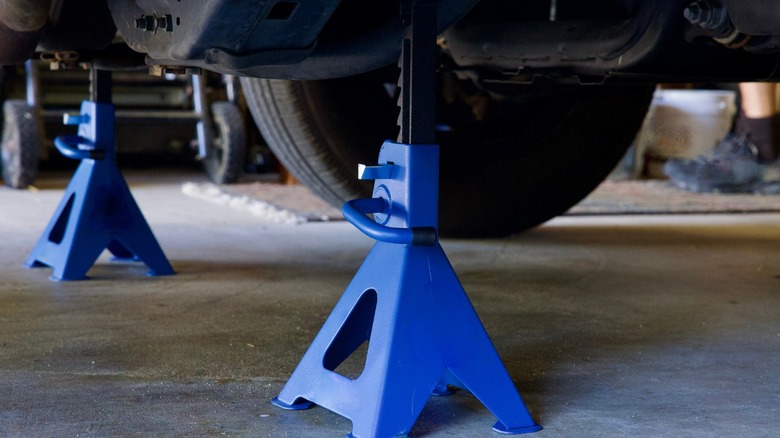
There comes a time in every amateur gearhead's life when they're underneath a car wondering if they set the jack exactly right — that's when it's time to invest in some ramps or jack stands. But which should you get? You should have a set of jack stands if you're going to do more under your car than check the oil. That's because there are jobs you can't do when your vehicle is up on ramps, which don't allow you remove the wheels. That's important for tasks like tire rotations. And unlike ramps, jack stands have adjustable heights. They also take up less room to store. Just beware of cheap jack stands, which are dangerous.
That's not to say you shouldn't bother with ramps. Ramps can be great additions to your garage because they are simpler to use than jacks stands and can greatly cut down the time it takes to do certain tasks, like the aforementioned oil changes. As far as we're concerned, tools that save us time are often well worth the investment. If you just need to take a quick look under your car, ramps are the better choice for just that reason. However, if your budget only allows you to have one or the other, we recommend getting jack stands so that you're able to keep your car lifted for any job you need to do. Later, you might give some thought to adding ramps to your repertoire.
Pros and cons of jack stands and how to use them
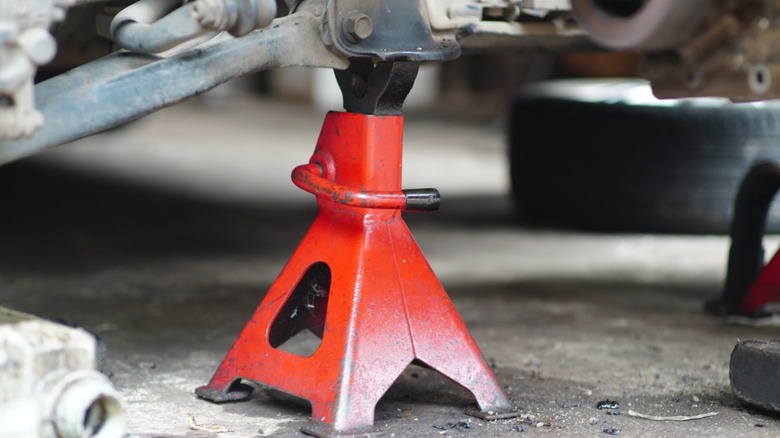
Every DIYer should have a set of jack stands in their garage. Their biggest advantage is probably their versatility. There are, in fact, several jobs that you can do with jacks stands that you can't do with ramps, like changing a tire, for instance. Jack stands also take up a lot less room in your garage than ramps, and you don't need space to drive up to jack stands like you do with ramps. Jack stands also have adjustable heights, unlike most ramps.
Jack stands have their downsides, of course. They can't be used by themselves and must be used in conjunction with your jack. Also, setting up with jack stands takes longer than using ramps. Jack stands are stable, but only if they are precisely placed under the frame of your car (or the points indicated in your owner's manual if you have a unibody vehicle) and on even pavement or very solid ground. Otherwise, they can slip, which is the last thing you want when lying under your car.
To use jack stands, place them on solid, level ground, preferably pavement. Jack the car up using the correct jack points, slightly higher than the desired height. Position the jack stands, and adjust them to the proper height, locking them in place. Then lower the car on the stand. Don't remove the jack. Jack stands are to be used in pairs, one pair per axle.
Pros and cons of ramps and how to use them
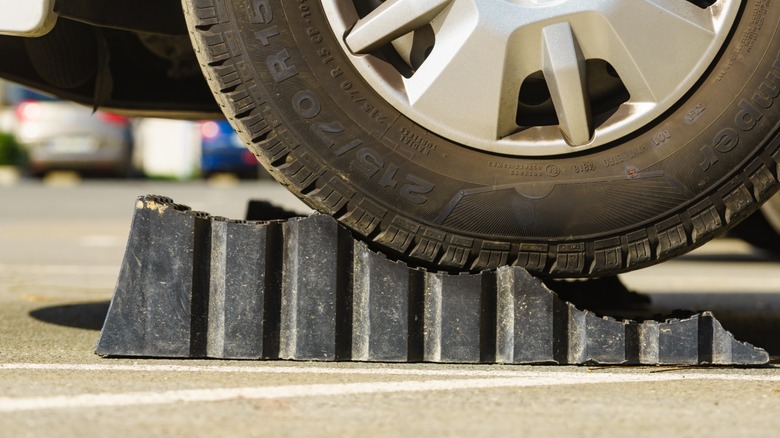
The great thing about ramps is that they are simple to use. All you have to do is drive your car's wheels up onto them when you want to raise your vehicle, then back down when you're done. It shaves off a ton of time from jobs like oil changes. Ramps can be safer as well, since they provide a much wider surface to support the car. Also, you can use ramps by themselves, without getting out the jack.
There are a lot of jobs that can't be done when the car is on ramps. If it involves taking off a wheel or accessing the entire undercarriage, forget it. You also need more space to use ramps than you would for floor jacks. That includes space to drive up to and onto the ramps, as well as space for storage. Another disadvantage is that they are difficult to use for low-riding cars, though they do make low profile ramps, and some use 2x10 "run-up boards" to mixed results.
To use your ramps, make sure your wheels are straight, and place your ramps directly in front of the tires. Then, slowly drive your tires up the ramps. Some recommend having a second person to guide you up the ramps. Once you're on the ramps, engage your emergency brake and place a chock behind the wheels that are on the ground. When you're done with your project, carefully back down the ramps.
Jobs that are better for jack stands
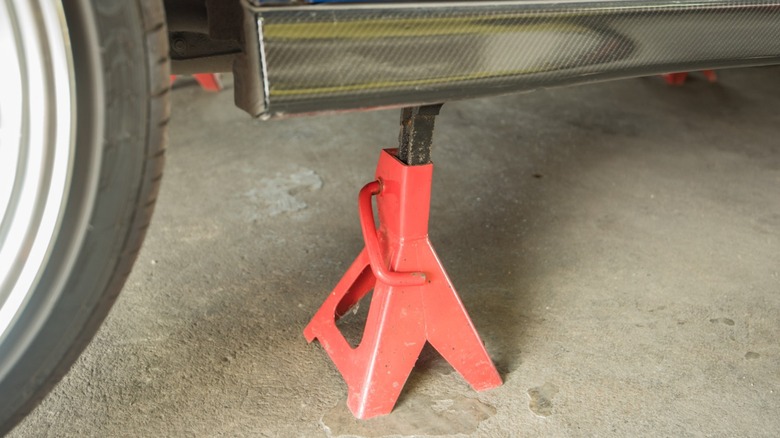
Like we said, there are some jobs you just can't do with ramps. For anything that requires accessing the wheel or taking the tires off, you're going to have to go with jack stands instead. We love jack stands for tire rotations, for example. The job goes pretty quickly once all the tire lugs are loosened and the car has been jacked up and placed on the stands.
Of course, brake jobs can't be done on ramps either. Removing your drivetrain is another job where you'll need to go with jack stands. Are you working on your suspension or replacing wheel bearings? Pull out the jack stands.
Jack stands are a better choice for exhaust work where you need access to the entire undercarriage. If you're just checking the exhaust, you can usually get by with ramps. However, if you're doing more intricate work on the exhaust, it's often just easier to go with jack stands. This is, in part, because ramps aren't really designed to be used for all four wheels at once. They are supposed to be used for one axle at a time. Some have put their cars on four ramps at once, but we don't recommend it. It's better to put the car up on jack stands when you need to lift both ends, but be sure to use four jack stands instead of making do with two.
Jobs that are better for ramps

While we've talked about the limitations of ramps, they certainly have their uses. What kinds of jobs are well suited for ramps? Pretty much anything that doesn't require you to take a wheel off or access the brakes or suspension. Ramps are pretty handy when you're changing your oil. The whole job goes more quickly since you don't have to jack up the car, set it down on the jack stands, jack it up again to take the jack stands out, and then jack the vehicle down. Since your car is tipped up from the front, the oil may actually drain better if the plug is on the back of your oil pan. Of course, this won't work the same if the plug is on the front side. Ramps can also be used when changing transmission fluid.
Sometimes, you just need to get under your car to inspect the undercarriage, look at the exhaust, or try to find a leak. Ramps can be great for that as well. Depending on the ramp height, you'll generally have sufficient room to get far enough under your car to get a good view. Basically, if the job is simple and you need it to be quick and easy, ramps are usually the way to go. If you're looking for a set of ramps, check out this comparative torture test of car ramps.
Let's talk about weight ratings

We should talk about weight ratings and checking that your jack stands or ramps can handle the weight of your vehicle. In most cases, jack stands are rated as a pair for axle load. For example, a pair of stands that are rated for 4 tons can handle, as a pair, an axle load of 4 tons. To figure whether jack stands can handle the axle load on our vehicle, we like to compare their weight rating to the GAWR (gross axle weight rating) of the axle in question (front and rear axles carry different weights). The GAWR is the maximum weight the axle can handle, not the actual load on the axle, but using the GAWR gives you a margin of safety.
In comparison, ramps are often rated for the GVW (gross vehicle weight) of the entire car. In other words, if a pair of ramps is rated for vehicles with GVW ratings up to 4 tons, that means they can handle either axle of a car that has a GVW of 4 tons. Together, they can actually handle around 2 tons, since they can only lift one axle at a time. Make sure to read the specs closely to determine whether the ramps' weight rating is for GVW or some other weight.
Depending on the job, jack stands or ramps can be a good choice. Just be safe, and don't get crushed.