

What Ecotec Means On GM Engines
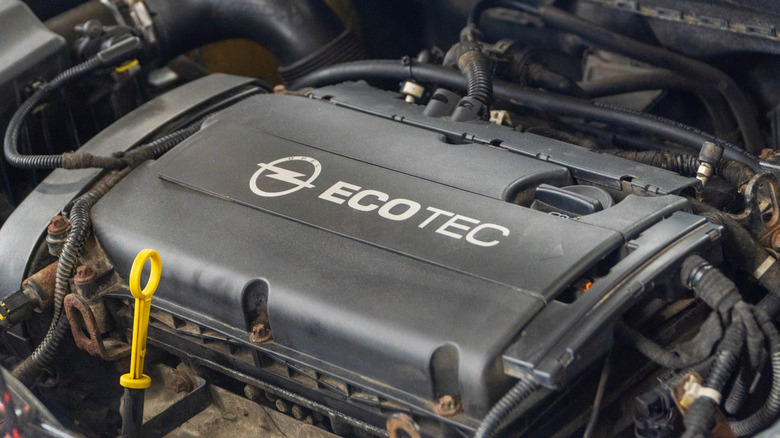
General Motors is one of the most storied and well-established automakers on the planet. Sure, it might have ruffled some feathers in the past, like when it introduced leaded fuel, or when the decision was made to cut brands like Oldsmobile and Pontiac from the line-up, but GM usually gets things right.
One area where GM has traditionally performed particularly well is in the development of truly excellent engines, from the big-block V8s that powered the golden era of muscle cars to the smaller, more efficient units that re-introduced muscle, like the beloved LS family. However, one range of GM engines that often gets overlooked in favor of bigger and more powerful offerings is the Ecotec family. The reason GM opted to adopt the Ecotec name is actually quite clear. The word itself is actually an acronym, standing for Emissions Control Optimization Technology, which tells us a little more about what GM was looking to accomplish when forming the Ecotec range.
Much like the LS series of engines, the Ecotec mills vary in capacity and output, but share plenty of common features, too. For instance, each of the Ecotec engines sports either a three- or four-cylinder configuration, and they are constructed of aluminum. Capacity ranges from 1.0 liters through 2.5 liters, and therefore power and torque figures vary. Some, such as the 1.2-liter inline-four lumps, are naturally aspirated and best suited to zipping around town and city centers, returning impressive fuel economy. Others, such as some of the larger 2.0-liter Ecotec engines, make use of turbochargers to prioritize performance in some of GM's sportier offerings, such as base-model Camaros.
Understanding Ecotec
Emission regulations have been getting tighter and tighter over the years, hence why so many automakers have been downsizing, fitting smaller, boosted engines in the place of larger, naturally aspirated mills. The Ecotec family is part of GM's approach, which apparently involves developing a series of smaller engines that use technology to be both efficient enough to please the bureaucrats, but also powerful enough to get the job done.
Trademark features of these Ecotec engines include direct fuel injection, continuously variable valve timing, lightweight aluminum construction, variable intake manifold airflow, and turbocharging. This is how GM was able to downsize the powerplants in performance models like the Camaro, yet still provide ample performance. The benefits are clear: solid performance, improved fuel economy, and reduced emissions.
There are, of course, downsides to downsizing. A V6-powered Camaro probably sounds a whole lot sweeter than a four-pot model, and it might even prove to be more reliable too, as turbocharging does complicate matters somewhat. The Camaro is actually an unusual case, as Chevy reverted back to the use of V6 engines in base models — presumably four-cylinder muscle cars are a tough sell — but the Ecotec series had otherwise ingrained itself into the larger GM family as a whole.
Ecotec versus EcoTec3 - understanding the differences
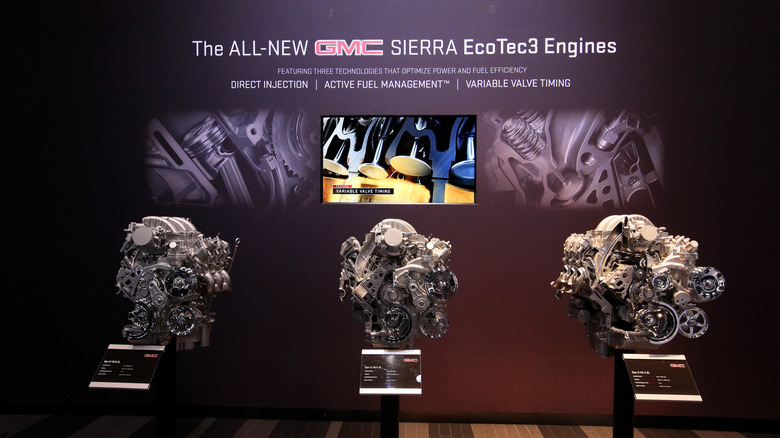
The Ecotec engine family is largely built up of four-cylinder engines that power a smattering of smaller cars within the General Motors model range. However, you might peek under your car's hood and notice that familiar "Ecotec" name adorning the top of a punchy V8.
These are the EcoTec3 engines, and while they do share a name with the core Ecotec range, they are entirely different, hailing from GM's Gen V small-block series instead. Popular EcoTec3 engines include the 5.3-liter V8 and 6.2-liter V8, neither of which share anything in common with the smaller Ecotec engines from an engineering perspective.
EcoTec3 engines are instead designed mostly with truck and SUV use in mind. They prioritize towing, hauling, and durability. Key differences — aside from the obvious size gap — include the fact that EcoTec3 engines employ a pushrod construction, and no turbochargers — at least not in standard guise anyway. So, while similar in name, finding an EcoTec3 under your hood is very different to finding an Ecotec under there.