

The Incredible Engine That Powered The Legendary McLaren F1
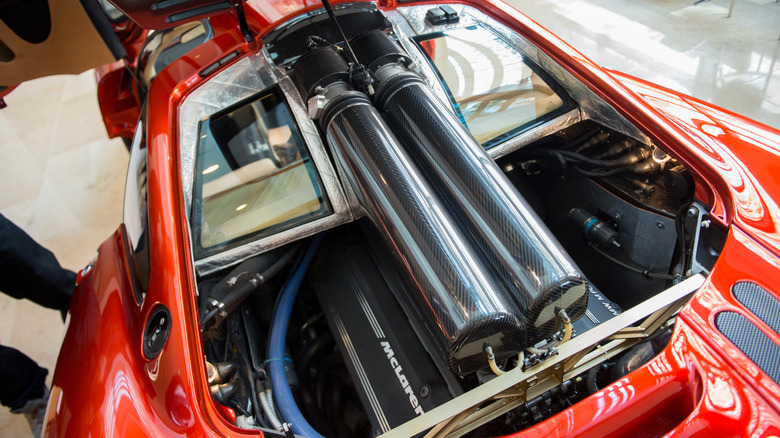
Conceived by motorsport visionary Gordon Murray and brought to life by McLaren in 1992, the F1 was built to be one of the best sports cars of all time. Fast forward to 1998, when the F1 went on to shatter the world's top-speed record, reaching 240.1 mph (386 kph), making it the fastest naturally aspirated (N/A) production car ever built — a title it still holds to this very day.
McLaren F1s routinely sell at auction for tens of millions of dollars these days. And while its carbon-fiber chassis, gold-plated engine cover, and an iconic central driving position play a big role in bringing those high-dollar auction prices, every great performance car lives and dies by its engine. In this case, a BMW-derived S70/2 6.1-liter V12 is what provided the power. This engine was developed by an equally coveted BMW engineer, Paul Rosche.
Making 627 horsepower and 479 lb-ft of torque, the V12 is characterized by superbike-quick levels of throttle response, a carbon clutch, a dry-sump, and individual throttle bodies. The Le Mans variants of the F1 were able to produce even more power – 680 horsepower and 520 lb-ft of torque. Murray was also behind the unreal Cosworth GMA V12 engine, which was influenced by the iconic F1 and its engine.
The history behind the McLaren F1 engine
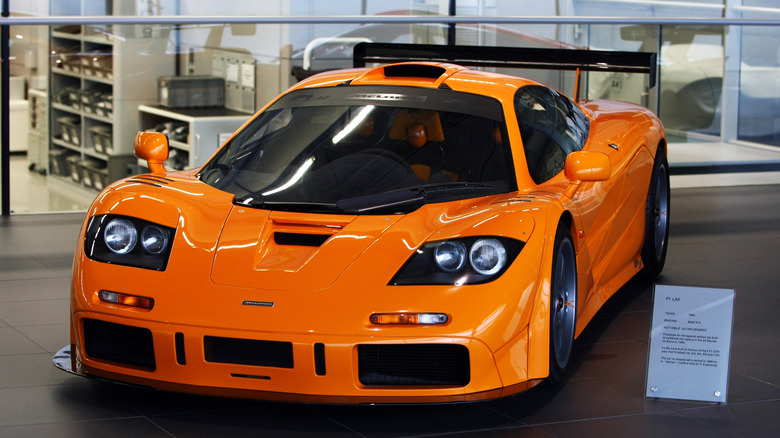
In the very early days of the F1, Murray approached Honda in an attempt to secure an engine, but the partnership never materialized. At that time, BMW had a 5.0-liter N/A V12 in development and was a suitable candidate because of its motorsport credentials. This very engine later found its way into the E32 BMW 750i and the E31 BMW 850i. However, for the F1, the 5.0-liter was not sufficient because it was too heavy and didn't rev quickly enough, according to Murray.
In an interview with GQ, Murray recalled approaching Paul Rosche, and laying out his demands in no uncertain terms: "I want big displacement in the smallest possible overall package-size – absolutely no more than 600mm long, revving to around seven-five, 550-plus bhp, maximum weight 250kg, rigid enough to work as a load-bearing structural member, dry-sump lubrication to minimise overall height and avoid surge in high-G cornering."
Rosche, known for his work on BMW's Formula 1 engines in the 1980s and 1990s, accepted Gordon's requirements. In March of 1991, the work began, and the result was an engine full of engineering wizardry. Nikasil-coated cylinder bores, extremely tight tolerances, quad overhead cams with hydraulically actuated, per-cylinder VANOS variable timing, a carbon clutch, an Inconel exhaust (also used in the new Ferrari 849 Testarossa), a 7,500 RPM redline, and a light aluminum flywheel that enabled the F1 to rev as quickly as a superbike.
The racing pedigree of the McLaren F1 engine
The McLaren F1 GTR's version of the V12 engine was limited to 600 horsepower due to regulations, so the racecar was technically less powerful. However, that did not stop it from winning the overall 1995 24 Hours of Le Mans, the first time McLaren won the race. The GTR also won the 1995 and 1996 BPR Global GT Series. The S70 was also used for the road-going F1 LM, where it was pushed to 680 hp. The extra power was courtesy of a higher overall compression ratio, different cams, new pistons, and new air pressure sensors.
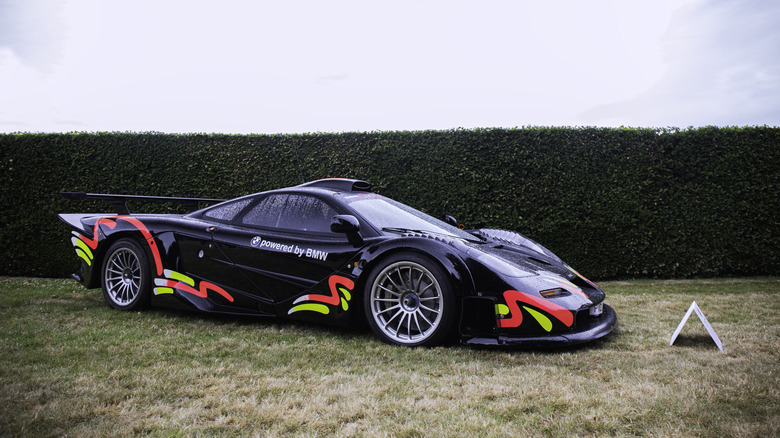
Le Mans and BPR weren't the only places you could catch a glimpse of the F1 GTR, as McLaren also used it to make the 1997 F1 GTR Longtail, a more aerodynamic version of the car. For the Longtail, the engine was downsized to 5.9-liters and was made 25 kg lighter. It was also mated with a 6‑speed sequential XTrac transmission. This helped the Longtail to win five rounds of the FIA GT Championship, and ultimately finish second overall (first in its class) at the 1997 24 Hours of Le Mans.
Some of the aforementioned F1 race cars were eventually converted for road use by Lanzante. This is the same company that made the Lanzante 95-59 — a McLaren F1 tribute car, also built on McLaren underpinnings. Overall, the McLaren F1, along with its various evolutions, stands firmly among the greatest icons of automotive history. It was a time when giants from the racing world came together to create something truly special and timeless, all powered by the legendary BMW S70/2 V12 engine.