

The Tough Questions To Ask When Deciding Whether To Repair Or Replace Your Car

According to real-world data compiled by Junk Car Medics, the average final mileage of a car that ends up on a junkyard in the U.S. is about 156,000 miles. No matter how well you maintain a car, it just isn't designed to last forever. Some vehicles can be upgraded to theoretically reach a million miles, but those offer no guarantees on actual longevity. Accidents, write-offs, and unexpected mechanical failures can end a car's life far sooner than planned.
For routine maintenance, minor dings, small scratches, or occasional repairs, the answer is usually straightforward. However, the decision becomes much harder once a car is involved in a serious accident or is constantly plagued by major mechanical issues. When repair bills start piling up and your mechanic spends more time with your car than you do, replacing the vehicle may make more financial and practical sense than keeping it on the road.
So how do you actually make that call, and what should you consider when deciding whether it's time to repair your car or upgrade to something newer and more dependable? That's where emotion, sunk costs, old habits, and uncertainty can cloud clear judgment. Here are the four tough questions to ask when deciding whether to repair or replace your car.
Is this repair worth more than the car?
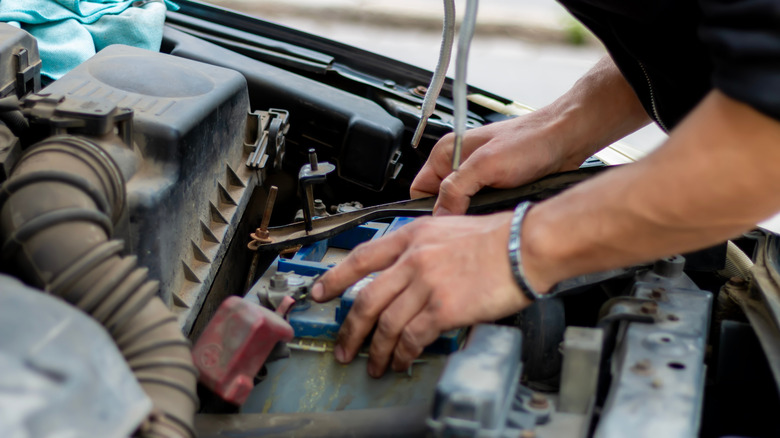
This is the standard question, one where you should compare the car's current value with how much it would cost to fix it. It's also what your insurance company will look at to decide whether the car is "totaled," turning it into a write-off. For example, if the car's pre-accident value is $10,000, but the repairs are above $7,000 (70%, in other words), the car will likely be declared as a write-off in many states. In the U.S., as many as twenty-percent of crashed cars are being totaled.
If the constant repairing and fixing is likely to come dangerously close to what the car is worth, you're really just subsidizing a depreciating asset. Many argue that once a fix costs around half the car's value, it's time to stop fixing the car and start shopping for a new one. The best thing to do here would be to ask a professional about what the car would be worth today before you commit to any major repairs.
Even if the car is fully paid off, it can become an unnecessary financial liability. These insurance thresholds don't even include the cost of downtime, rentals, surprise labor overruns, or simply the chance that the estimate is wrong. Once a car reaches the shop, the bills can always go up with surprise costs that come from nowhere while repairs are being carried out.
How often do I repair it?
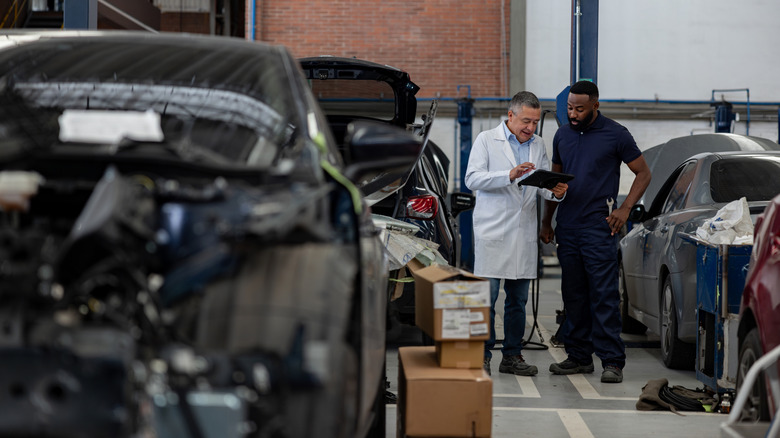
Some fixes are definitive, meaning that once you carry them out, the car should be good to go. Other fixes are nothing more than temporary band-aids. Once you come to a point where large repair expenses are becoming common, think about whether such repairs are actually going to fix the car long-term. For instance, if you spend a lot of money on repairing your transmission, but issues related to it come back, it might be time to consider that the problem is actually the car itself.
Some car repairs are simply too much, either because they cost a lot, they happen too often, or they'll never fully solve the underlying problem. Fix one thing, and suddenly five other issues pop up, and that's when you should ask whether the repairs make sense. If you can't rely on your car to take you places without breaking down, then it's not really a car — it's a liability. Think about all of the repairs you did in the past two years, and how their costs could contribute to payments for a new car.
On top of all of that, constantly having to repair your car can also be a safety issue. Even if you were lucky enough that all of the previous breakdowns didn't make your car unsafe, there's no guarantee that the next one will stick to that pattern. As The Car Care Nut puts it: "Don't own a car until the wheels fall off... It's kind of dangerous. Have a plan."
Is the car too old?

Cars have come a long way in the past couple of decades, and for some people, that's not necessarily a good thing. However, even though cars used to be a lot simpler, that simplicity often means less progress. If you still own an old beater that you constantly keep on fixing instead of replacing, it would be a good idea to go ahead and test something new.
Being attached to an old car is something we're all guilty of. It might be your first car, or it might be the car you associate with high school memories. But sometimes a person needs to ditch the emotional perspective and assess the situation as rationally as possible. A car is, among many things, a tool. It takes you, your family, and your friends from point A to point B — and to be a good car, it needs to do so safely and reliably.
If your beloved classic has no safety features, bad headlights, or a wonky braking system, it may be too old to continue spending money on. It's hard to put a dollar amount on something you love, but AAA estimates that 10+ year old vehicles are twice as likely to break down as newer ones. All cars will eventually become too old for daily use, so there's not much sense in keeping them around for so long.
Is it even practical to keep repairing my car?
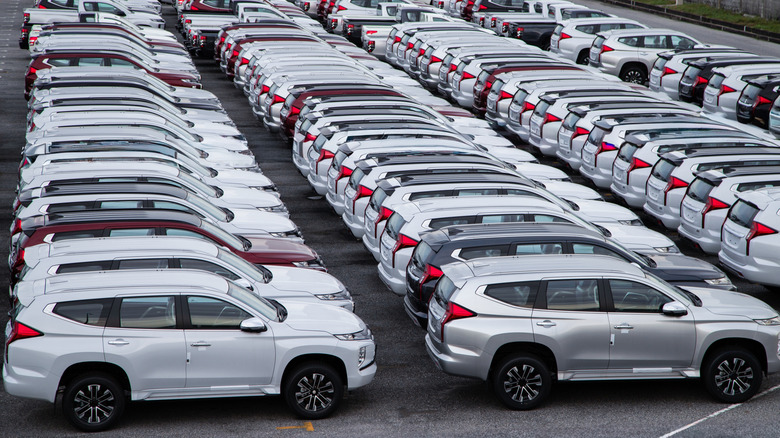
A car that fit perfectly when you were younger may no longer make sense because your life has changed. For example, if you own a two-seat convertible or a sporty coupe that constantly needs repairs, a growing family or new responsibilities can make that car impractical regardless of how much you love it. Your priorities shift from thrill and style to space, safety, and reliability.
At some point, the emotional attachment and sunk costs no longer outweigh the practical considerations, and replacing the car may actually be smarter. Maybe you live in a cold climate and you are better off with an all-wheel drive car, or you want a safe car your family members can use. Try to rationalize it like it's simply another piece of hardware. When technology like your iPhone becomes old and laggy, you probably don't have as much hesitation over simply replacing it.
On a national scale, the shift towards practicality is also quite apparent. Two decades ago, SUVs made up only about 20 % of U.S. vehicle sales. Today, they account for roughly half the market. In fact, SUVs are #1 in 48 states, and that's partly because as the average driver's needs have changed, the car industry decided to play along.