

Why Semi Trucks Last So Much Longer Than Cars

There are a number of factors which can affect the longevity of an automobile. Certain makes and models exhibit fewer problems than others. Take for instance, the worst cars on sale today, according to you, some of which come with potential reliability issues. Regular maintenance and driving habits are also a significant indicator of how long a vehicle might last.
In general, a car has the potential to reach 200,000 miles or more. According to the Bureau of Transportation, passenger cars on American roads in 2025 were typically around 14 years old. It sounds impressive until you consider semi trucks, which can outperform those figures by a considerable margin. With some big rigs reaching 1,000,000 miles on the odometer, a well-cared for semi can reach easily reach age 16.
There are a few reasons these transport behemoths can manage to stay lively for so long. The benefits of diesel engines and the type of driving semi trucks deal with contribute to their lifespan. And it's a good thing, too, as the difference between the average price of a new car and new semi truck is markedly different. While many might be surprised to learn that the average price of a brand-new cars has reached above $50,000 these days, that's little compared to big rigs. A factory-fresh semi sleeper, which is what over-the-road truckers essentially live in for weeks at a time, often goes for anywhere from $160,000 to $240,000 or more depending on its available features and trim.
Diesel engines last longer
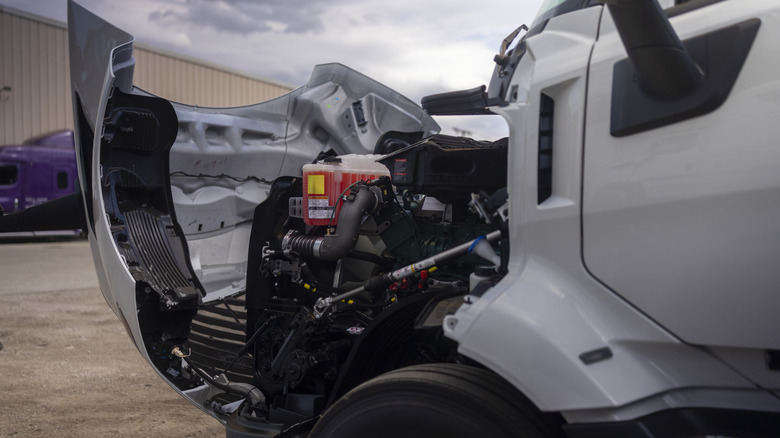
The primary reasons you'll find a diesel under the hood of a big rig has to do with torque and efficiency. Torque, which describes the twisting force applied to the truck's wheels, is extremely important for heavy towing. With a trailer attached, semis can legally weigh up to 80,000 pounds, which could be impossible to get rolling down the road without significant torque. A diesel engine can handle this better than a gasoline engine because its pistons have a longer stroke, creating a higher compression ratio. And because engines are essentially akin to a giant air pump, equipping a turbocharger — which compresses air and forces more of it into the engine — offers even greater output. Efficiency is aided by more potent diesel fuel, which provides energy with as much as 15% more punch than an equivalent amount of gasoline. In addition, fuel economy is the reason semi trucks don't use V8s.
Beyond torque and efficiency, with the way these big rig diesels are designed, the engine is running at low rpm and generally lower speeds than a passenger car. Typically, high rpm and high speeds on your average car don't contribute positively to engine longevity. Even vehicles designed to perform at exceedingly high rpm in motorsports burn out quick. F1 engines don't last long at all, and replacing one isn't cheap. On the other hand, a big rig's slow and steady approach influences longevity. Another advantage of a diesel engine is that it has far fewer parts. More parts can mean more maintenance and a higher chance of something going wrong under the hood.
Stop-and-go driving increases the amount of wear and tear on a vehicle

While it's impossible for most drivers to avoid traffic delays that have them repeatedly alternating between brake and accelerator, it's still a bad situation for engines. Carbon build-up can form more readily when there's an abrupt oscillation between slowly-creeping traffic and brief moments of acceleration. These deposits congregate around critical engine components like the fuel injectors, which can begin to negatively affect a vehicle's output and shorten its lifespan.
While a semi certainly can't completely avoid traffic congestion, long-haul truckers spend the majority of their time on the highway. While the average person behind the wheel covers around 14,000 miles every year, according to INRIX data reported by Forbes, nearly 50 hours of each year is spent in traffic. Meanwhile, long haul semis travel upwards of 600 miles a day, predominantly on interstates. Although these big rigs could be racking up around 125,000 miles annually, the consistent driving style and lack of constant stopping and starting places less stress on the engine.