

How Did Chevy's 3.0L Diesel Compare To Ram's 3.0L Diesel?

Well, General Motors' 3.0-liter Duramax diesel engine — first used in 2019 — has the same number of cylinders as the 3.0-liter EcoDiesel that FCA (pre-Stellantis Fiat-Chrysler Automobiles) debuted in 2014. Both mills are turbocharged, too. But beyond that, these two motors have what may be a surprisingly large number of physical differences that go on to impact their performance as well. In fact, despite their 3.0-liter descriptions, they don't even have the same exact displacement. The Duramax, as originally used in the Chevrolet Silverado 1500 (and GMC Sierra 1500), clocked in at 183 cubic inches of displacement; the EcoDiesel, which premiered with the 2014 Ram 1500 (and Jeep Grand Cherokee), measured at 182 cubic inches.
What's no doubt more significant are the engine layouts. The Bowtie brand relied on a smooth-running inline configuration, with all six cylinders in a single row, while Ram relied on a more traditional V setup, with its more compact dimensions and lower center of gravity.
Now, before we dive deeper into the details, let's understand just which engines we're going to focus on today. Both the Duramax and EcoDiesel have had multiple generations, but Ram's head start means that it's the third-gen EcoDiesel — available from approximately 2020 to 2023 before being discontinued — that best overlapped with the first-gen Duramax. The latter unit was in production from about 2019 to 2024. The latest Duramax diesel is still an option for not just the Silverado, but also the recently updated 2025 Chevrolet Tahoe and Suburban.
Engine characteristics
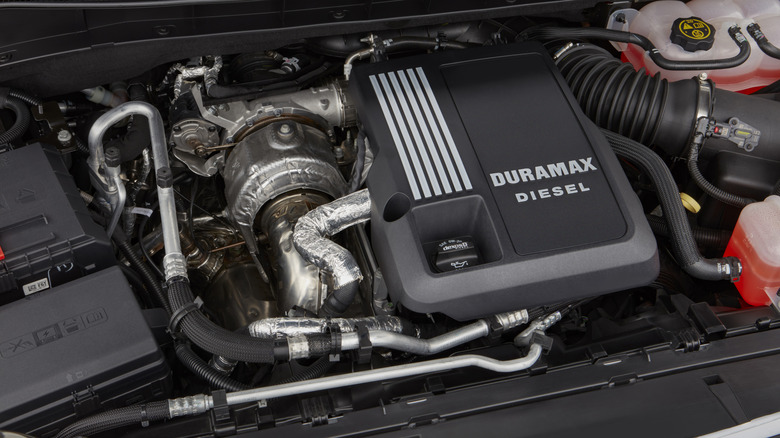
Gearheads get ready, because we're going to begin by checking out the engines' technical specs to see how they compare physically. The foundation for the Duramax diesel is a lightweight aluminum block capped with an aluminum head. While the heads for the EcoDiesel are also aluminum, the block is made from compacted graphite iron. CGI benefits include much more strength at much less weight than regular iron, which is partly why Dodge and Ram still use iron blocks in some vehicles today. Anyways, with those materials in play, the Chevy engine weighs in at 467 pounds, making it nearly 40 pounds lighter than the 505-pound Ram motor.
Among the few similarities between the mills, important ones include their bore and stroke measurements. These two numbers — representing the diameter of an engine cylinder and the vertical distance traveled by a piston inside — help decide an engine's power. So it's probably no surprise that, along with similar output ratings, the bore and stroke from each engine are within a few millimeters of each other — 84 and 90 mm in the Duramax compared to 83 and 92 mm in the EcoDiesel.
In addition, both engines can run on the same fuel, and we don't just mean regular diesel. The Ram EcoDiesel and Chevy Duramax are each compatible with blended diesel fuel like B20, which is 80% typical petroleum-based fuel mixed with 20% diesel made from renewable sources ranging from vegetable oils and animal fats.
Power and performance
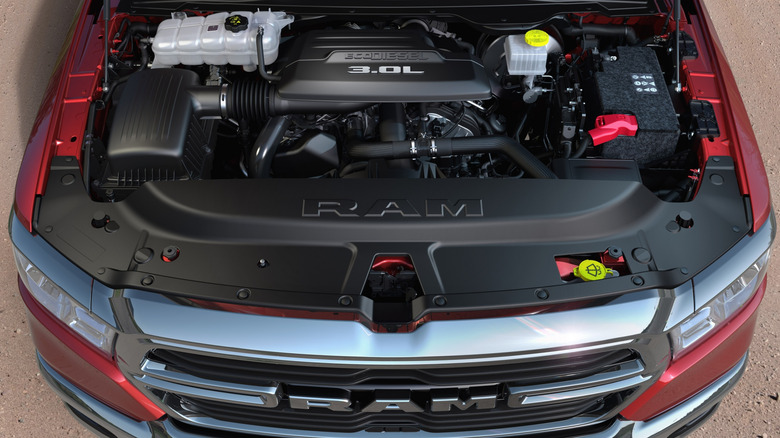
Diesel engines are known for combining muscle and efficiency, and the Chevy and Ram engines are no different. Let's look at some 2020 models, which represent the second year of the first Duramax and the first year of the third-generation EcoDiesel. For this model year, Chevrolet's I6 served up 277 horsepower and 460 pound-feet of torque in the Silverado 1500, and Ram's V6 alternative was rated at 260 hp and 480 lb-ft of torque.
How did those output ratings translate into the real world? Well, the relatively minor differences made for a fairly wide disparity when it came to pulling power. True, part of this comes down to the design of the trucks themselves, but there's no escaping the fact that the Ram 1500 could tow up to 12,560 pounds with the EcoDiesel — when properly equipped — and the Silverado was limited to 9,300 pounds. The Ram also led the way for payload, with a 2,040-pound diesel high point versus 1,870 pounds from the Chevy.
The flipside to the power equation is fuel efficiency. Yes, you can get better fuel economy from your diesel if you follow a few simple tips, but — despite that whole ugly Dieselgate business — these engines do tend to get pretty decent EPA ratings right out of the box. For instance, in 2020, the Duramax-driven Silverado 1500 put up an EPA line of 23 mpg city/33 mpg highway/27 mpg combined and the EcoDiesel Ram was rated at 22/32/26 — albeit with an eight-speed automatic transmission that was down two cogs to the Chevy gearbox.