

6 Performance Cars You Probably Didn't Know Used Yamaha Engines
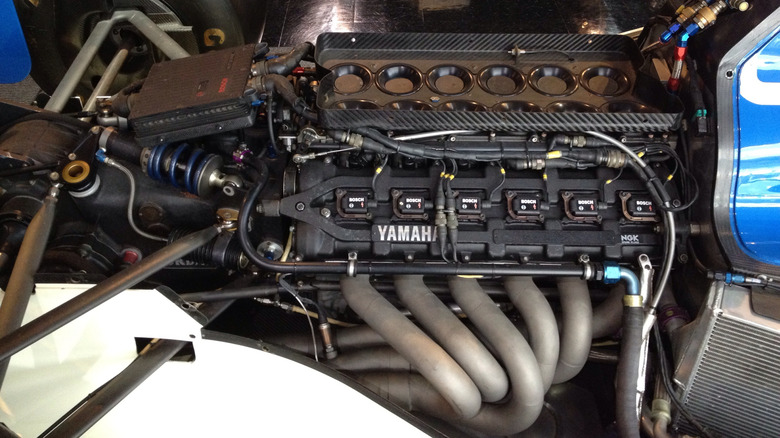
Yamaha has always had something of a split personality. Most of us at one point or another looked at the brand's name written on the side of a grand piano or on the front of a kick drum and wondered if this was the same company making the Yamaha motorcycles and ATVs at the powersports dealer up the street. The answer is sort of. While it's true that the music gear maker (Yamaha Corporation) and the powersports folks (Yamaha Motor) have been distinct companies since 1955, they both originated as a single entity, Nippon Gakki Co., before branching into their respective Yamaha brands.
Still, heritage is heritage, and it turns out that plenty of the same under-the-hood principles that let a piano make resonant music can make an engine sing, too. And since you probably don't come to Jalopnik to learn about Yamaha's culturally significant contributions to the evolution of cool Japanese synthesizers, instead, we're going to talk about some ways that Yamaha has quietly made waves in the automotive world, providing the beating heart of vehicles you've probably heard of through Yamaha engines that you probably haven't. To keep things tight, we'll be limiting this list to genuine production vehicles, even though we're so glad this insane Yamaha R1-swapped Fiat track beast exists.
Lexus LFA
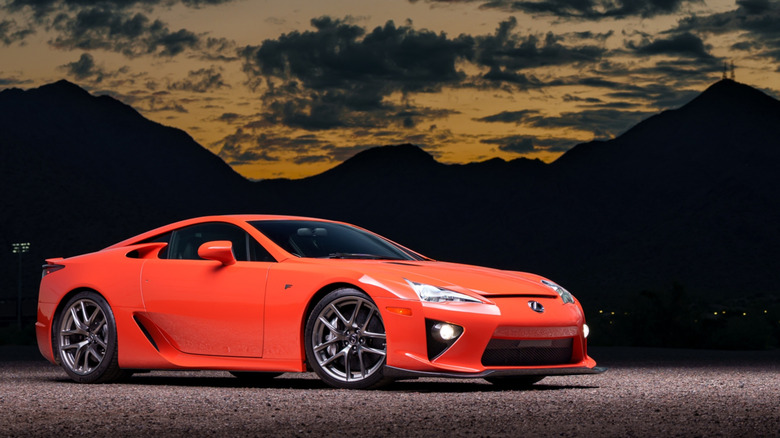
The LFA aimed to be a halo car's halo car, bringing supercar performance to Lexus with a 4.8-liter V10 that you'd be forgiven for assuming came right out of some Toyota skunkworks laboratory. While the project did begin its life firmly as a Toyota Motor Corporation endeavor, it was quickly handed over to Lexus, which turned to frequent Toyota engineering collaborator Yamaha for the beating heart of the machine.
The resulting engine, codenamed 1LR-GUE, produced 552 horsepower at 8,700 rpm and 354 pound-feet of torque at 6,800 rpm through a liquid-cooled, four-stroke, DOHC motor mated to the six-speed automated sequential transmission. With mass production running only between 2010 and 2012 and performance understandably eclipsed by competitors in the supercar set since then, it turns out that the one element of the LFA's legacy that has echoed most dramatically into today is one that was distinctly Yamaha — the sound. The incomparable engine note is the result of Yamaha doing real-time acoustic calibration with a purpose-built audio processing tool. They gave the LFA an engine sound that not only sounded great, but also provided acoustic feedback to the driver in real time, with no electronic amplification or interference.
As for a broader legacy, while some would ultimately call the Lexus LFA the worst halo car of all time, others would place it among the pantheon of the very best, including Top Gear's Jeremy Clarkson, who lauded the LFA as the best he'd ever driven.
Volvo XC90 V8
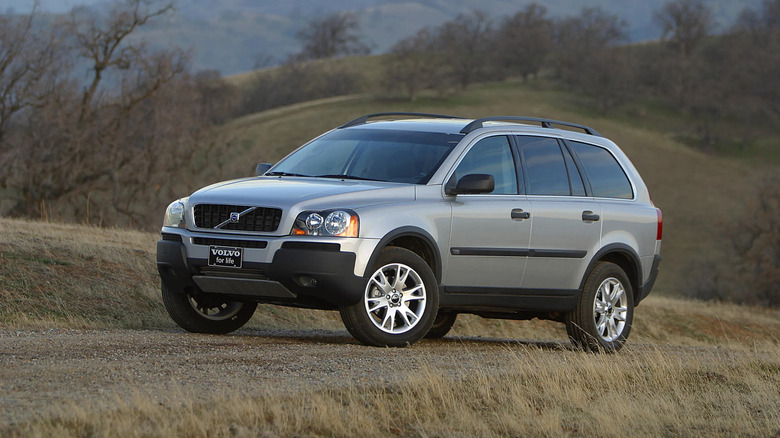
If the Lexus LFA represents Yamaha at its most indulgent, the Volvo XC90 V8 shows the company operating at the opposite end of the spectrum. Launched as Volvo's early 2000s flagship SUV, the XC90 was tasked with competing directly against V8-powered luxury SUVs like the BMW X5 and Mercedes-Benz ML-Class while retaining Volvo's emphasis on safety, refinement, and everyday usability. Still, when it comes to competing with those German mainstays, no amount of refined Swedish prudence was going to make up for anything less than a V8 under the hood, even if it was reserved for only the top-of-the-line model.
While the then-new XC-90 platform was developed with Volvo's less formidable five- and six-cylinder motors in mind, making a V8 fit into the transverse configuration they had to work with was going to take some doing, and that doing was brought to you by Yamaha. With compromising on the engine orientation not on the table, Yamaha came up with a compact V design that created a 60° angle where the cylinder banks meet. Solving the size problem led to further headaches, as the 60° setup challenges engine balancing, which threatens to rob the final product of the smooth acceleration you want from your high-end V8. This makes the engine feel less smooth on acceleration than a traditional 90° V8, so Yamaha introduced a unique balance shaft to improve smoothness. The result was a stout final product that ultimately delivered one of the reliable Volvos that withstood the test of time, so kudos on the engineering, Yamaha. Oh, and Yammie also built the engines, thus delivering the first V8s in Volvo's history.
Volvo S80 V8
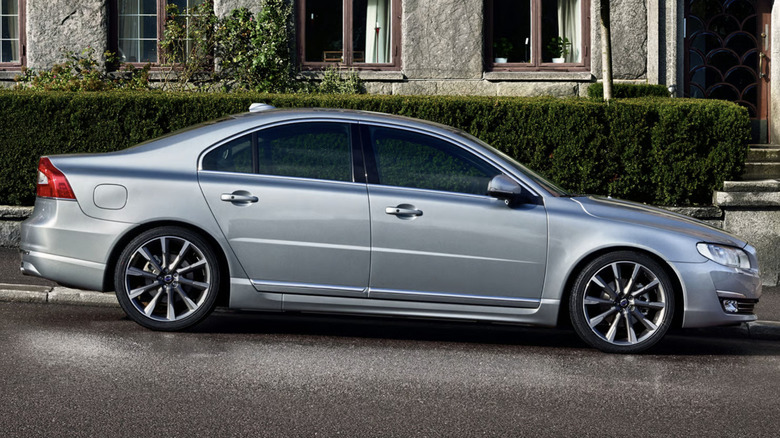
If the XC90 V8 proved that Yamaha could solve Volvo's packaging problem at scale, the S80 was an opportunity to take a stand against the V8 sedans of the day. After the XC90, the second-generation S80 used the same Yamaha-designed and Yamaha-built 4.4-liter B8444S V8, but deployed it in Volvo's flagship luxury sedan rather than an SUV. Because the underlying engineering problems had already been solved in the XC90 with transverse packaging, a compact 60-degree bank angle, and a balance shaft to counteract inherent vibration, the S80 was able to benefit directly from Yamaha's earlier work. The result was Volvo's very first V8 sedan, producing 311 horsepower and 325 lb-ft of torque. of torque, this time paired with the S80's line-topping AWD platform.
On the one hand, it's the same motor in a slightly more refined package. On the other, it's Volvo taking a swing at German sedan dominance during a time when that meant more than it does today as the SUVification of the industry continues mostly unabated. Either way, the V8 S80 stuck around until 2010 and indeed marked the end of Volvo's flirtation with the V8, Yamaha or otherwise. There hasn't been a V8 in Volvo's lineup since, which is honestly kind of a shame considering that, even a Volvo sounds absolutely glorious once you cut the pipes off (assuming it's the right Volvo).
Ford Taurus SHO
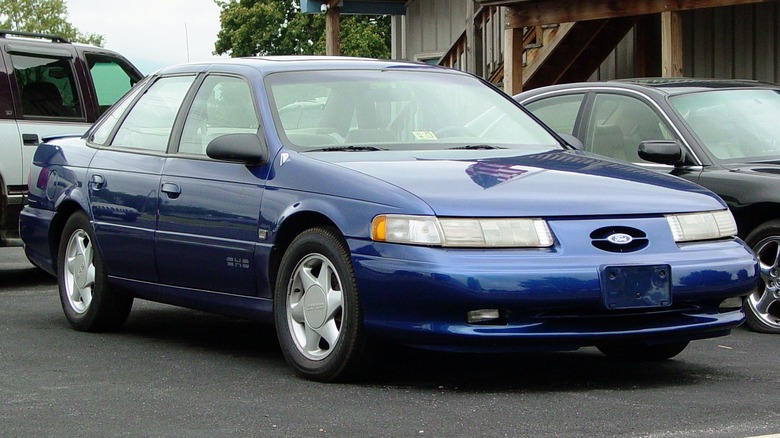
Before Yamaha was delivering Volvo V8s that only through exceptional journalistic storytelling could be made to feel halfway exciting, they were providing the powerplant behind something truly special: the Ford Taurus SHO. Since few people outside of the Ford performance community have ever bothered to wonder what "SHO" actually means, yes, it does stand for something — Super High Output. Even fewer realize that under the hood of that first SHO was a new version with roots in Ford's Vulcan V6, heavily reimagined and built in partnership with Yamaha to deliver a 24-valve 3.0 liter with dual overhead cams, an iron block, aluminium heads, and a trick intake manifold that put out 220 hp and 200 lb-ft of torque underneath an 8,000 RPM redline. The improved motor was built entirely by Yamaha in Japan and borrowed from what at the time was the cutting edge of Japanese high-revving sensibilities.
That V6 was an enthusiast darling, but the next generation of Taurus SHO demanded a V8. This time, Ford went with a 3.4-liter transverse-mounted V-8 with a 60-degree cylinder bank angle and, yes, you're right, this all sounds awfully familiar. It's a Yamaha co-development and potentially even a bit of foreshadowing as Yamaha worked with that Ford-designed 60-degree engine, which would later show up in its engineering for Volvo. That's speculative, but we do know that this time Ford handled design and manufacture from the block down, while Yamaha did the valvetrain and heads, which, when cobbled together (back in the U.S.), produced a modest power boost compared to the V6 with 234 horsepower and 230 lb-ft of torque. Regardless, we stand by our assessment that the Ford Taurus SHO's 60-degree V8 was brilliant and completely bizarre, even if it was partly paving the way for future Volvo products.
Noble M600
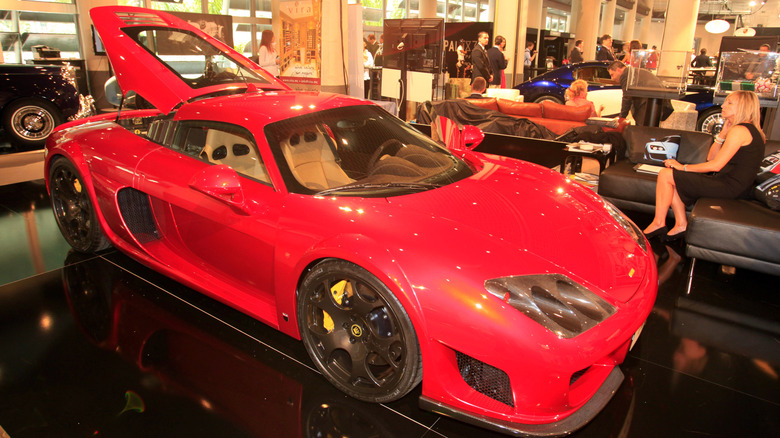
Now that we've dug into the surprisingly gritty backstory of Yamaha-built Volvo V8s, it's time to fast-forward to the part where someone decided the obvious next step was to stuff that engine into something absolutely ridiculous. That someone was Noble Automotive, which delivered the M600 firmly in line with a consistent ethos of eschewing cutting-edge tech and various flavors of electrification in favor of a focus on dynamics and driver engagement. We're talking about a British mid-engine two-seater with a carbon-fiber body and a stainless-steel tub, weighing in at less than 2,700 pounds.
And yes, inside you'll find the Yamaha-built, Volvo-proven B8444S V8, still 4.4 liters but now with twin turbos putting down 650 horsepower and 604 pound-feet of torque with a six-speed manual transmission. The stoic reliability that hammered away under the hood of the Volvos is something truly special when given the chance to let loose in the Noble, bringing the total package from 0 to 62 mph in 3 seconds and a top speed of 225 mph, all in 2010 when those numbers really meant something. Under the hood, you can call it a Yamaha or call it a Volvo. It doesn't really matter. It's exciting stuff, no matter how you look at it, so mostly we're just stoked to learn that apparently Noble still exists and has a new supercar to prove it.
Toyota 2000GT
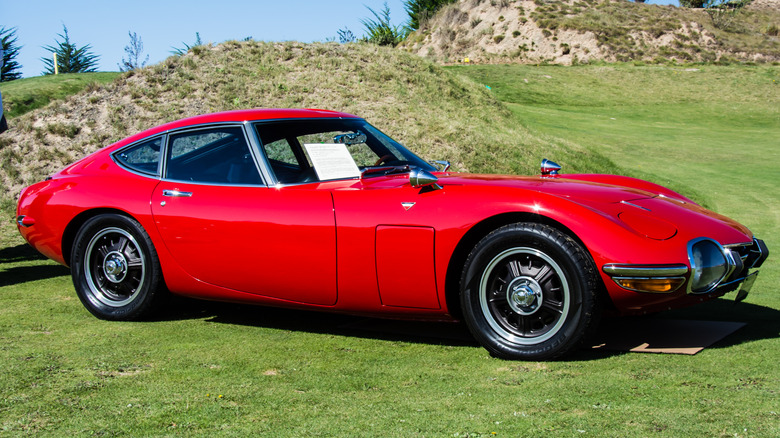
If the Noble M600 shows what happens when a Yamaha-built engine gets unleashed in the modern era, the Toyota 2000GT is largely where that whole story begins. Long before Yamaha was quietly solving packaging problems for Volvo or building engines for Ford, it was already deeply embedded in Toyota's most ambitious automotive project of the 1960s. In 1963, freshly bruised from a lackluster performance at the Japanese Grand Prix, Toyota set out to put together a proper GT car. In sharp contrast to the company's passenger car strengths at the time, Toyota eschewed its traditional all-hands-on-deck approach to development and instead assigned the effort to a small team that was as ambitious as it was inexperienced.
Toyota brought Yamaha on for support, with the core Toyota team actually relocating to Yamaha's offices for the project. The Yamaha team knew engines and loved cars, but had limited experience actually building the things. Regardless, the result was an iconic design powered by a water-cooled straight six with dual overhead cams putting out a staggering-for-the-period 150 horsepower at 6,600 RPM. The car would go on to set three world records in its class and ultimately solidify its legacy by becoming the best-looking and most expensive Toyota ever. It was also in the James Bond flick "You Only Live Twice," so, you know, there's that.
Ultimately, the 2000GT reframes everything that came after it. The Yamaha-built Volvo V8s, the Taurus SHO's improbably sophisticated engine, and the Noble M600's excess all trace back to this moment, when Yamaha proved it could build an engine that didn't just work, but changed how the world viewed an entire country's automotive ambitions.