

Long Vs. Short Wheelbase: How Each Changes Vehicle Handling
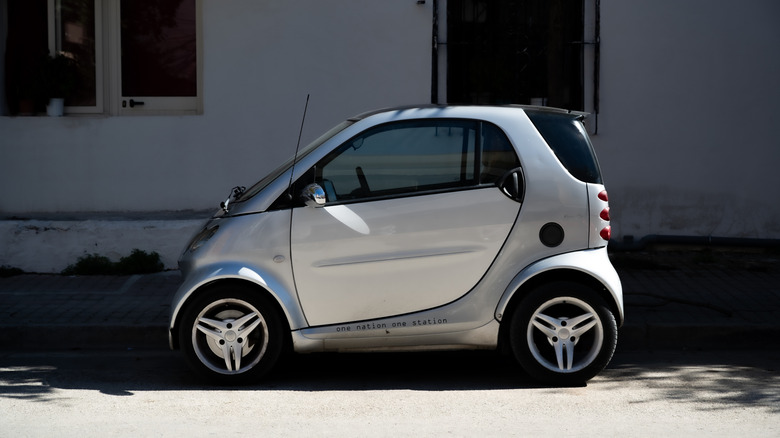
One of the most impactful design choices affecting several aspects of a vehicle's performance is the wheelbase. To properly understand wheelbase, imagine looking at the profile of a car, and picture a line extending from the center of the front wheel to the center of the rear wheel. The measurement of this line would be the vehicle's wheelbase. If you're wondering why this distance matters, let's look at some examples that illustrate the impact of wheelbase.
While it exited the U.S. market after 2019, the Smart ForTwo is coming back, and the 2014 model featured a minimal 74 inches between its sets of tiny wheels. Now, contrast that with the Mercedes-Maybach S-Class, a highly luxurious sedan often used as a limousine, which has a wheelbase stretched to 133.7 inches. Obviously, the Smart ForTwo is much shorter in length than the Maybach S-Class, which gives it superior maneuverability and a much smaller turning radius. Which one would you rather drive if required to navigate a compact urban parking lot?
While the Maybach S-Class may not be as agile due to its lengthy wheelbase, it features a significant advantage over the Smart ForTwo in terms of ride quality. The smoothness of your travel experience has everything to do with the suspension system and its ability to absorb the road's imperfections. The Maybach S-Class has an additional nearly 60 inches between its wheels over the Smart ForTwo, providing the suspension more time to react to bumps. Of course, there are other factors that influence suspension performance, such as larger tires, but wheelbase also plays a role. However, the differences between long and short wheelbase go even further, affecting aerodynamics and off-road performance.
Modern F1 cars have a long wheelbase for enhanced aerodynamics
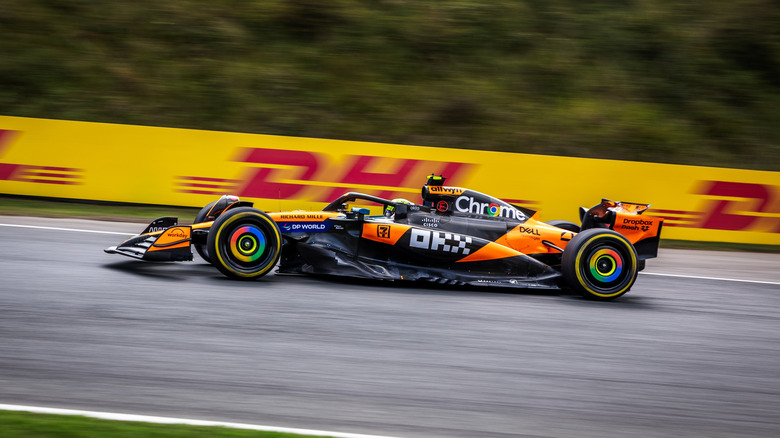
If you thought the distance between the wheels of the Mercedes-Maybach S-Class was sizeable, did you know that Formula One race cars have an even longer wheelbase? It's true, F1 car designs are required to feature a 141.7-inch wheelbase. One reason these high-performance motorsport machines are so long has to do with aerodynamics.
Often traveling 220 mph or more, F1 cars hit ridiculous speeds during an event. This is accomplished through meticulous engineering, which leans heavily on the physics of aerodynamics. One of the key components that creates downforce on these cars is the diffuser, which includes a scoop and fins at the rear of the car. Downforce is essential for an F1 car, as it helps to press the wheels into the track and enhances stability. But what does this have to do with wheelbase?
James Key, the technical director for Toro Rosso (now known as Racing Bulls), explained to Formula1.com, "I think this year [2017] the reason we're seeing a difference with longer cars than we've seen before is because the diffuser is more powerful. A longer wheelbase can mean more floor area and, in conjunction with the big, sucking diffuser, you can gain a bit more downforce out of it." Diffusers aren't just utilized in F1, but also in extreme hypercar models, like the Bugatti Tourbillon V16 hybrid.
Off-road vehicles need shorter wheelbases
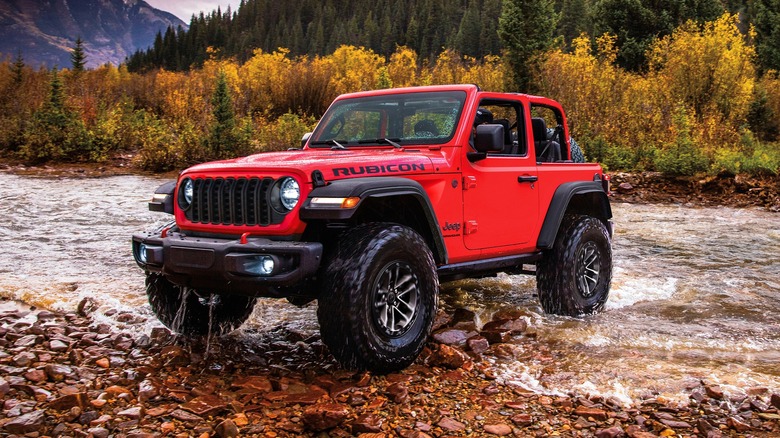
There's a reason iconic backcountry veterans like the Jeep Wrangler and Ford Bronco have relatively short wheelbases: A short wheelbase is essential for navigating tough terrain. By the way, here's how the Ford Bronco and Jeep Wrangler compare in terms of off-roading ability. Among the most sought-after specifications for off-road enthusiasts are the approach, breakover, and departure angles. These are measured in degrees and describe how well a vehicle can maneuver over steep obstacles without scraping the body or bottoming out while cresting a hill.
Imagine a section of trail that featured a hill, steep on both sides, and with virtually no space at the top. Essentially, just as the tires reach the apex, they immediately drop to a steep downgrade. A vehicle with a lengthy wheelbase could potentially end up stuck, with the underbody touching the ground with both wheels in the air.
In addition, depending on the technical difficulty of a particular trail, you're going to want the tighter turning ability provided by a shorter wheelbase. Not only does this allow for more nimble navigation, but on unlevel ground, it can provide more stable cornering.