

Do Police Cars Really Get Better Engines?
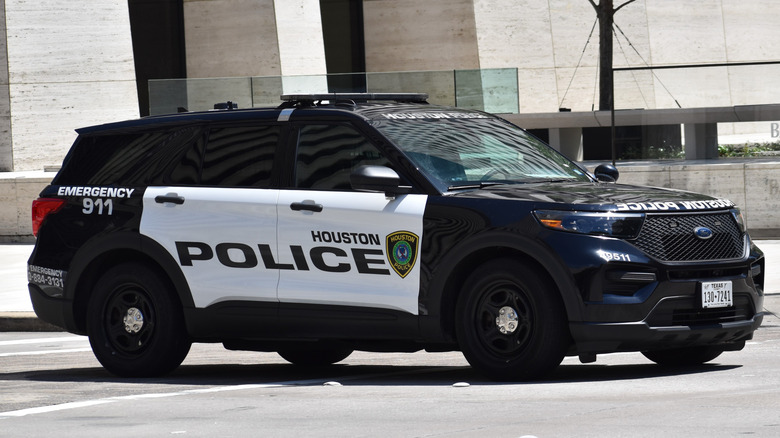
From Plymouth and Dodge to Ford and Chevy, American police cars have come a long way since their inception. While they feature enhancements when compared to civilian versions, understand that these are specialized vehicles built with durability in mind. For instance, these pursuit cars come equipped with beefier suspension that isn't standard on their civilian counterparts. Also, it's not uncommon to see patrol vehicles featuring heavy-duty brakes and upgraded cooling systems.
When it comes to engines, though, civilian and police models are often very similar. Interestingly, many modern pursuit vehicles (the ones that are available to order) share the same power and torque specs as the regular models. For example, the 2026 Chevy Tahoe PPV (Police Pursuit Vehicle) features the same 355-horsepower 5.3-liter V8 as the regular Tahoe. It's the same story across Stellantis' law enforcement lineup, with the 2026 Dodge Pursuit and Ram Special Service Vehicles (SSVs) getting similar flavors of the 5.7-liter and 6.4-liter Hemi V8 as their civilian versions.
There are, however, exceptions, like the Ford Explorer Police Interceptor Utility, which gets an exclusive 318-horsepower hybrid powertrain that's unavailable on a brand-new 2026 Explorer. The exclusivity tag has a caveat, though, as the powertrain can be seen in earlier 2020-2023 Explorer model years. The PIU's optional 400-horsepower 3.0-liter V6 is pretty much identical to what you get in a 2026 Ford Explorer. That said, the pursuit vehicle does come with a police-calibrated engine and transmission tune.
Modern police cars are more sophisticated
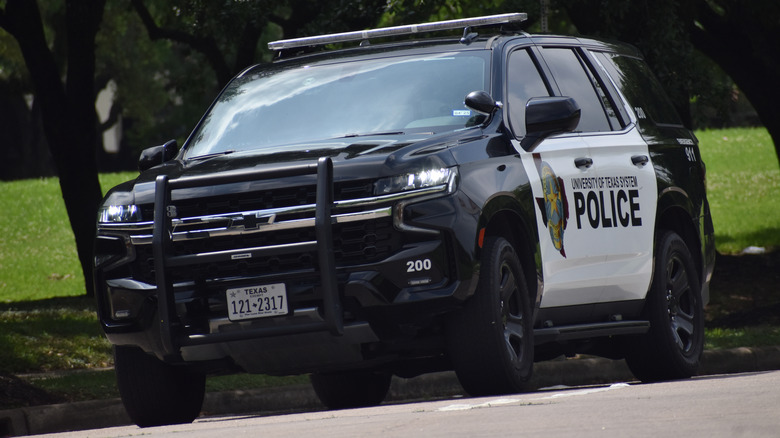
Not so long ago, police cars like the 2007 Ford Crown Victoria, for example, had a distinct power advantage over their civilian counterparts — 250 horsepower versus the regular Crown Vic's 239 horses. Rewinding back further to the late 1960s, at the behest of several muscle car enthusiasts, Plymouth took the engine and performance parts from the Belvedere Police Package to create the two-door Roadrunner. Mind you, this was when the Dodge Polara Pursuit could top out at 147 mph courtesy of its 375-horsepower Magnum 440. No wonder people had doubts about whether police cars got better engines.
Because patrol vehicles sit around idling for hours and may have to suddenly jump into pursuit, their engine demands are not the same as those of cars that are sold to the general public. According to Ford, the Explorer PIU's powertrain system is specifically tuned to optimize response and performance and is able to automatically detect when the vehicle switches to pursuit mode.
Other software tweaks common to police cars include what Chevy calls the Protected Idle, similar to Ford's Secure/Police Engine Idle. It's like an anti-theft system that prevents the transmission from shifting to drive when the law enforcement personnel exit the vehicle, while keeping the engine and electronics running. Patrol vehicles also feature an Engine Idle Hour meter, along with high-output alternators and heavy-duty batteries. Although, it's worth pointing out that the latter two features are available on certain civilian models, depending on the trim.