

Every Lexus V8 Engine Ranked By Horsepower
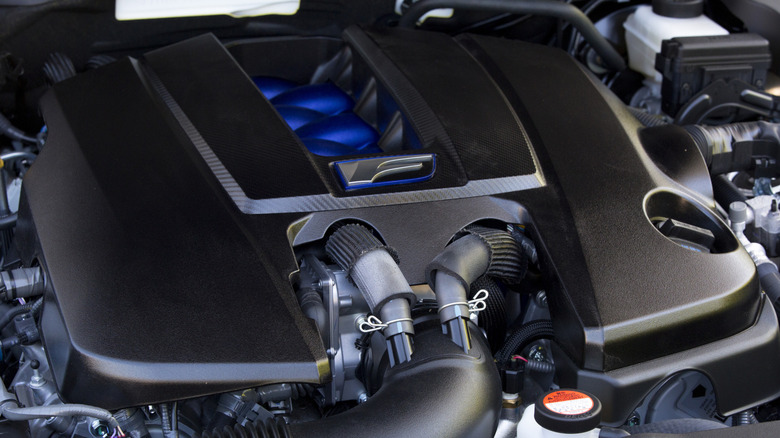
Nothing fuels nostalgia like the death of a naturally aspirated masterpiece. Lexus' famed 5.0-liter V8 might've lost the horsepower wars, but the aural extravaganza it plays won our hearts. Of course, we are sad that the Japanese luxury automaker is discontinuing its second-best engine after the LFA's legendary V10. Feel the same? Listen to LC 500's glorious V8. It might help you. Or not. Listen to it, anyway.
Let us tell you a story of all Lexus V8s that predated the F-division's 5.0-liter masterpiece. Of course, we'll rate all these engines by horsepower. Helps us with the narrative, you know. But it also puts things into perspective. Engines have become so much more powerful in the last four decades, even when we are talking about Lexus, the automaker that doesn't chase horsepower figures. Heck, Lexus never supercharged or turbocharged its V8s, yet power almost doubled in the past four decades.
Don't act surprised — you know Lexus had a propensity to build overengineered mechanical gems. Yes, Lexus' twin-turbo V6 had been failing at an alarming rate (though Toyota later solved the issue), but each of the brand's past V8s is ready for the apocalypse. So, without further ado, let's see how Lexus' V8s progressed over the years!
4.7L 2UZ-FE (275 hp)
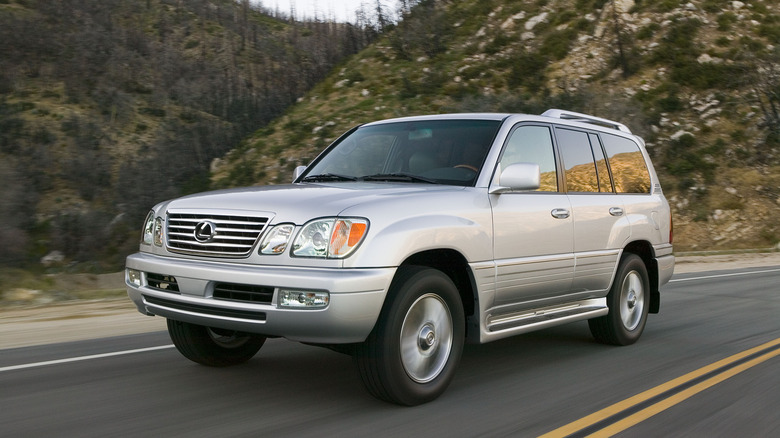
Lexus was already cooking with its 4.0-liter V8, the 1UZ-FE, in cars like the LS 400 and SC 400. But that engine wasn't fit for purpose in a utility vehicle. Instead, Lexus needed a larger V8 with higher low-end torque for the GX 470 and LX 470 SUVs, so it used Toyota's 2UZ-FE engine. First introduced in the 1998 Lexus LX 470, the 4.7-liter unit featured a cast-iron block, instead of the aluminum one in the 1UZ-FE. It produced a solid 320 lb-ft (434 Nm) at 3,400 rpm, but only 230 hp at 4,800 rpm.
Later, though, Lexus equipped the 2UZ-FE with VVT-i (Variable Valve Timing — Intelligent), which significantly enhanced the engine's output. Torque went up to 332 lb-ft (450 Nm), but more importantly, it produced 275 hp at 5,400 rpm in the 2005 LX 470. Performance was a whole different ballgame. The 60 mph sprint took 8.9 seconds, a full second faster than the previous model, and it had a top speed of 112 mph (180 km/h). The smaller GX 470 received a slightly tamer VVT-i variant with 263 hp and 323 lb-ft (438 Nm) of torque. Still, due to its lower weight, it sprinted to 60 in just 8.5 seconds.
So, yeah, not exactly Earth-shattering. What the 2UZ-FE lacked in sheer muscle, though, it made up for with its unrivaled durability. It's one of those engines that can cruise past 200,000 miles and is widely regarded as one of the most reliable V8 engines ever made. As reported by MotorTrend, Toyota tore down a million-mile unit from the Tundra, and it was still within factory specifications!
4.0L 1UZ-FE (300 hp)
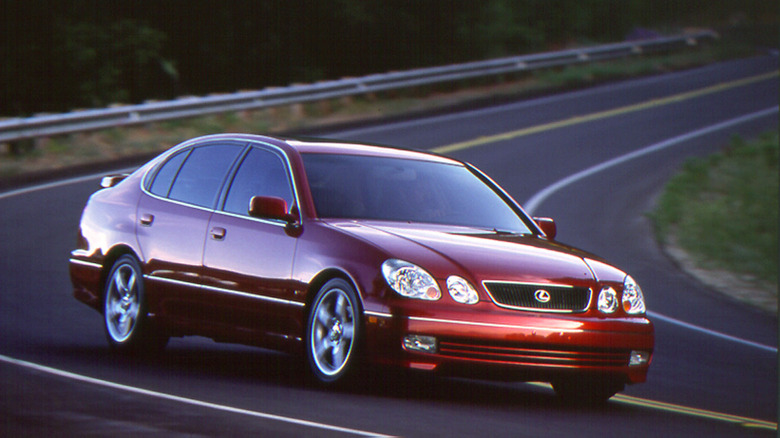
Development that cost over a billion dollars. Engineering good enough to shame the Germans. Unparalleled build quality at the price. To say that the Lexus LS 400 changed the luxury car game when it arrived in 1989 would be a massive understatement. Lexus' first car was nearly perfect, powered by a gem of an engine — the 1UZ-FE.
Because the LS 400 was mainly designed for the American market, that engine was a V8. But not just any V8. The 4.0-liter unit was state-of-the-art, equipped with 32 valves, hypereutectic pistons, forged steel crankshaft with eight counterweights, and six cross-bolted main bearing caps. Yup, these are things you mainly see in racing engines, only Lexus put them in a velvety, highly reliable V8. And for a good reason — the aluminum block was based on a race-spec engine Toyota intended to use in the CART series.
Even so, initially, Lexus prioritized 'not breaking' over 'going fast', so the 1UZ-FE produced just 256 hp and 260 lb-ft (353 Nm) of torque. Still, in 1995, the automaker raised the compression ratio from 10:1 to 10.4:1, resulting in a boost of 5 hp and 9 lb-ft of torque. Once Lexus implemented VVT-i and an even higher 10.5:1 compression ratio, the LS 400 had 290 hp and 300 lb-ft (407 Nm) of torque on tap, alongside a new five-speed automatic. The result: 0-60 in 6.3 seconds. Lexus was able to extract a bit more from the engine, bringing it to 300 hp and 310 lb-ft (420 Nm) of torque in the 1998 GS 400 for a0-60 time of 5.7 seconds.
4.3L 3UZ-FE (300 hp)
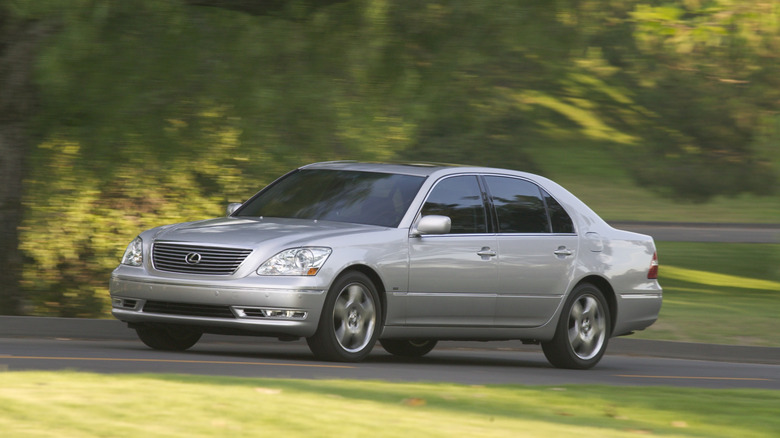
Ten years after the mega successful launch of its first car, Lexus launched its brand-new flagship — the LS 430. With a new design inside and out, an even more luxurious long-wheelbase version, and a newfound emphasis on handling, the luxury sedan was ready to once again take on the establishment.
As its name suggests, the LS 430 was also equipped with a new 4.3-liter V8. Based on its predecessor, the 3UZ-FE had the same cylinder bank offset and bore pitch. Forged steel crankshaft, forged steel connecting rods, and aluminum pistons were onboard, too. Surprising no one, the 3UZ-FE featured VVT-i from the get-go.
Sadly, more power wasn't on the table. Although larger, the 3UZ-FE still produced the same 290 hp as the 1UZ-FE in the LS 400. Still, thanks to the higher displacement, the torque figure was 320 lb-ft (434 Nm). The 2001 LS 540 took 6.3 seconds to reach 60 mph, and the top speed was limited to 131 mph (211 km/h). Like its predecessor, the LS 430 also came standard with a five-speed automatic. For the 2004 MY, Lexus refreshed the LS 430, which, alongside other improvements, brought a new six-speed automatic. As a result, 0-60 was down to 5.9 seconds.
As was the case with the 1UZ-FE, the second-gen GS 430 received a more powerful variant of the 3UZ-FE engine. It produced 300 hp and 325 lb-ft of torque, resulting in a brisk 0-60 time of 5.8 seconds. Top speed: 149 mph (240 km/h). The SC 430 convertible also received the same engine, but it was slower to 60 (6.1 seconds) due to its higher curb weight.
4.6L 1UR-FE (342 hp)
The smaller GS had the more powerful variant of Lexus' UZ engine family for the first two generations. The third-gen model, however, received a milder tune of the brand-new 1UR-FE engine. Still, with 342 hp and 339 lb-ft (460 Nm) of torque, the new 4.6-liter V8 was significantly more powerful than the predecessor, turning the already quick executive sedan into a speed demon. The GS 460 could hit 60 in just 5.4 seconds, thanks also in part to the new eight-speed automatic. Top speed: 155 mph (250 km/h).
Of course, the GS 460 was never intended to be an M5 competitor. In its 2008 GS 460 review, MotorTrend reported that the transmission was lethargic and lacked paddle shifters for higher engagement. Moreover, while capable in the corners, the V8 sedan wasn't too communicative and didn't offer the ride quality you'd expect from a Lexus sedan.
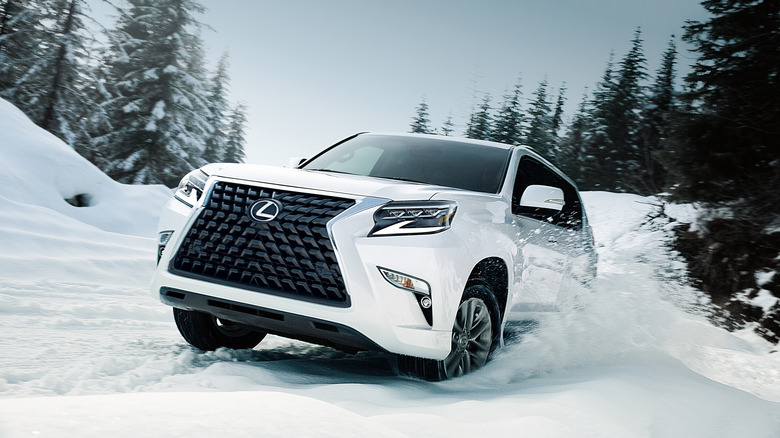
The 1UR-FE was also used in the GX 460 SUV. Although slightly smaller than the 4.7-liter 2UZ-FE, the new engine produced 301 hp and 329 lb-ft (446 Nm) of torque. The biggest change compared to its predecessor was the aluminum block, which reduced weight. Despite that, the 1UR-FE is still one of the most reliable Lexus engines ever built.
Unlike the GS 460, Lexus' off-road-capable SUV was equipped with a six-speed automatic. Even then, it sprinted to 60 in a respectable 7.8 seconds. And trust us — you wouldn't want it to go any faster. We experienced too much body roll when we reviewed the Lexus GX 460 back in 2014 and never asked for more power.
5.7L 3UR-FE (383 hp)
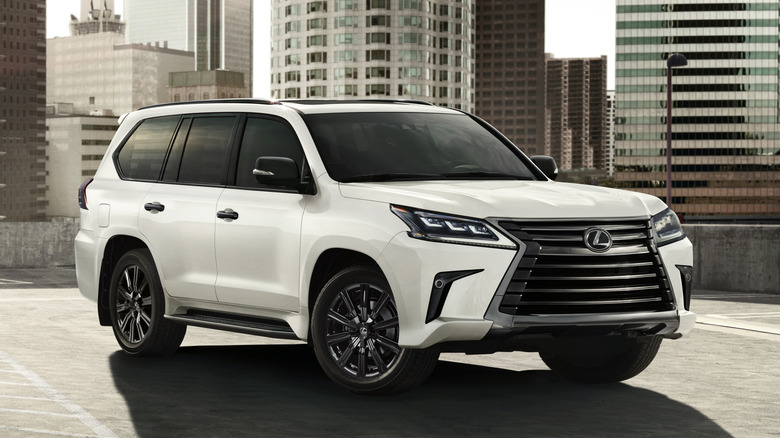
After showing to the world it can build potent and reliable V8 engines, Lexus was ready to unleash its big-block V8 — the 3UR-FE. The brand-new 5.7-liter unit debuted in the Toyota Tundra, and quickly after in the brand-new 2008 LX 570. The aluminum unit produced an outstanding 383 hp and meaty 403 lb-ft (546 Nm) of torque. Finally, Lexus' bigger SUV had an engine to compete with the big boys, and one capable of accelerating it to 60 in just 7.4 seconds. Not bad for a big, lumbering seven-seater that weighs 6,000 pounds!
But Lexus was far from done. As a love letter to the oil industry in the Middle East, the Japanese automaker also offered a supercharged LX 570, which brought the 3UR-FE engine to 450 hp and massive 521 lb-ft (706 Nm) of torque. Lexus produced only 200 examples of this engine, which is why it doesn't sit higher on this list. It was also never made available in the U.S., which is a shame.
You can get an aftermarket kit from Magnuson Superchargers, though, which boosts Lexus' big-block V8 to 543 hp and 535 lb-ft of torque. Holy hell. Oh, and apart from early issues with the oil rings, the 3UR-FE proved very durable, so it should handle those figures just fine. Let's also not forget about LX 570's incredible off-road capabilities — it's a Toyota Land Cruiser, after all. But it's perhaps even better, thanks to the four-wheel AHC + AVS (Active Height Control + Adaptive Variable Suspension) system. Put some 35-inch tires on it, and there is your luxurious Raptor.
4.6L 1UR-FSE (386 hp)
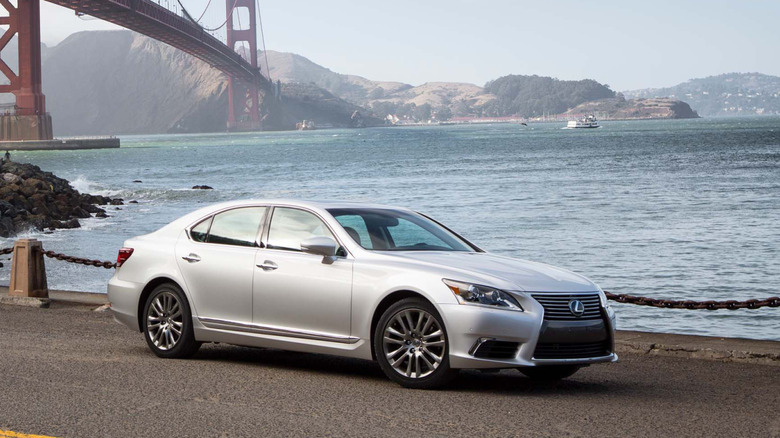
For the fourth-gen LS, Lexus went with another bump in displacement, this time to 4.6 liters. Crucially, the flagship sedan received the more potent 1UR-FSE version with 386 hp and 367 lb-ft (498 Nm) of torque, both sizeable improvements over the predecessor. Paired with an eight-speed automatic, the brand-new V8 propelled the large and heavy luxury sedan to 60 in just 5.4 seconds — quicker than many sports cars from the time.
Lexus used every trick from its arsenal to give the 1UR-FSE engine an edge over its rivals. Notably, the V8's D-4S system uses direct and port injection to leverage the benefits of both systems, i.e., more power and higher efficiency. It's also Lexus' first engine to use electrically driven intake cams, allowing the new VVT-iE system greater control over the valve operation until the engine warms up. In addition, Lexus mirror-polished the engine's sliding parts to reduce friction. Heck, to ensure creamy operation, Lexus engineers checked the engine's balance four times between initial dyno testing and in-car operation. Lest we forget, Lexus developed new dual-arm precision robots to produce this engine. Classic Lexus over-engineering at work!
And Lexus didn't stop there. Each LS 460 was driven over cobblestones to ensure that nothing squeaks or rattles. It can park itself, too. JDM models even featured an oxygen-conditioning system that ensures the cabin air stays in an optimal range. The genius bit is that at around $10k, the LS 460 is one of the best used-car values right now.
5.0L 2UR-FSE (389 hp)
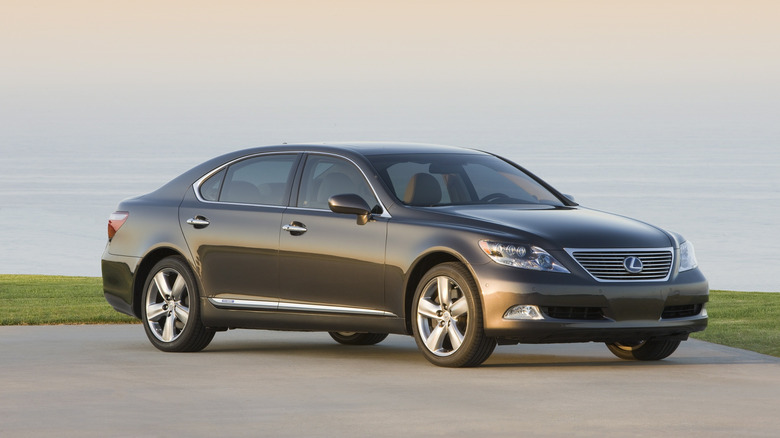
Take the already stellar LS 460. Then, equip it with a larger 5.0-liter V8, electric motors, and a battery. Stretch the body by 4.7 inches. Add standard AWD with a limited-slip center differential. You'll get one of the most complex and advanced luxury sedans ever made in the LS 600. With 438 hp on tap, Lexus' V8-powered hybrid flagship was designed to compete with larger 6.0-liter engines without the fuel consumption penalty. The 5.0-liter 2UR-FSE engine itself produced 389 hp before the additional electrical boost from the motors.
Still, due to the added heft from the battery, AWD system, and stretched wheelbase, the LS 600h L was a tad slower to 60 than the regular LS (5.5 seconds). Instead, Lexus touted the brisk 50-70 mph acceleration of just 3.5 seconds, which is more important for daily driving, anyway. And, yeah, like most hybrids from the Toyota Motor Corporation, the LS 600h L has an e-CVT transmission. Not that it matters; the LS 600h L is still mercilessly powerful yet incredibly refined.
But don't let that catch you off guard — this isn't a performance car. Instead, it's a car you'll want to be chauffeured around in, of course, in the back seats. As part of the Executive Class Seating Package II, the seats recline by 45 degrees, with an option for 17 degrees in the upper back, incorporate an ottoman, and include a massaging function. Oh, and if you are bored, there's a 9-inch ceiling-mounted screen that can play DVD movies. It even included wireless headphones in 2008! Did we happen to mention the rear climate control measures that use infrared sensors to measure your body temperature and adjust the temperature accordingly?
5.0L 2UR-GSE (472 hp)
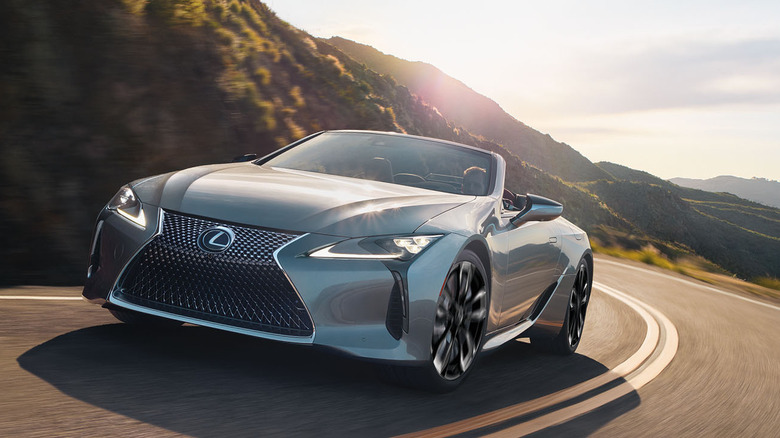
In 2008, Lexus revealed its final glorious middle-finger to downsizing, turbocharging, and electrification. Not that we knew it at the time — the brand's first performance car, the IS F, should've made the letter 'F' the counterpart to BMW's 'M'. For some time, it worked, but with the RC F discontinued, Lexus currently offers no F model in its lineup. Zilch. Nada.
It's not because Lexus F cars were bad. After all, each was equipped with the stellar 5.0-liter 2UR-GSE engine. Based on the 2UR-FSE engine found in the LS 600h L, Yamaha engineers enhanced the performance unit by modifying the engine head to improve airflow, installing lighter titanium valves, and lightening nearly every other internal component. As a result, it now produced 416 hp and 371 lb-ft (503 Nm) of torque in the IS F. It was designed to be responsive, too, and make that fantastic noise we all love.
But that was just the beginning. Further enhancements brought the output up to 472 hp and 395 lb-ft (536 Nm) of torque in the RC F performance coupe. Redline: 7,300 rpm. The result: 0-60 in 4 seconds and a top speed of 168 mph (270 km/h). In the discontinued GS F performance sedan, the 2UR-GSE produced 467 hp and 389 lb-ft (527 Nm) of torque, while the stunning LC 500 coupe/convertible has 471 hp and 398 lb-ft (540 Nm) of torque on tap. Lexus' ultimate grand tourer is still on sale, so make sure you order one before it's inevitably axed. You've been warned!