

Ford 3.5 EcoBoost Vs. Toyota 3.5 V6: How Do The Twin Turbo Engines Compare?
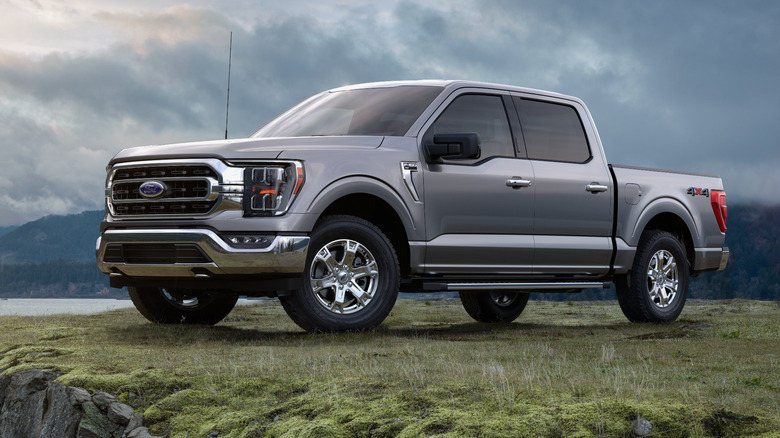
Due to greater emphasis on fuel efficiency and evolving emissions regulations, downsizing and turbocharging became particular areas of interest for automakers as they sought to improve both power and economy. Ford hopped on this bandwagon in 2009 with the release of the 3.5-liter EcoBoost V6, which was foreshadowed by the TwinForce engine with 415 horsepower and 400 pound-feet of torque in the 2007 Lincoln MKR concept vehicle. The production version that debuted in the Ford Taurus SHO had a slightly lower output of 365 horsepower and 350 pound-feet of torque, but it was good enough to earn plenty of attention. The engine would go on to feature on many Ford and Lincoln models, but 2010 was when it was stuffed in the F-150 ahead of the 2011 model year. The truck variant made the same power, but was up in torque by some 70 pound-feet of twist.
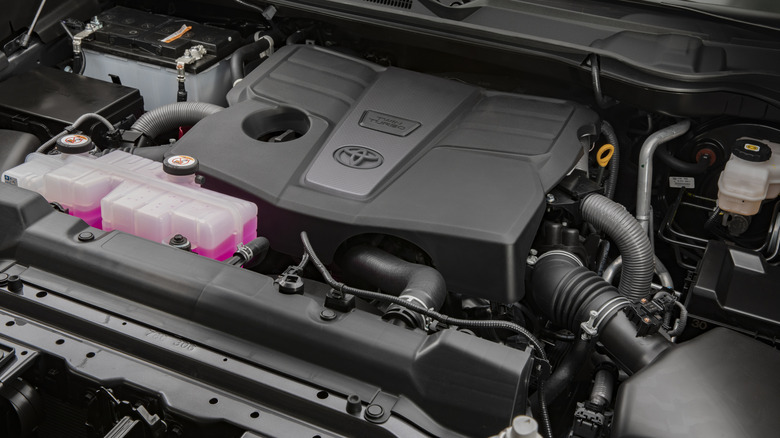
Meanwhile, at that point, the Toyota Tundra was all naturally aspirated, offering 4.0-liter V6, 4.6-liter V8, and 5.7-liter V8 options for 2011. It took almost a decade before Toyota dipped its toes more deeply with the burgeoning efficiency-focused market. Its answer came in the form of the 3.5-liter V35A-FTS V6, which was used in the Lexus LS 500 in 2017. Later, the V6 made its way into many Toyota body-on-frame vehicles, including the third-generation Toyota Tundra introduced in 2021. The Toyota engine works on nearly the same principle as the EcoBoost 3.5 V6, utilizing turbocharging, direct injection, and variable valve timing to boost both fuel economy and output.
The Ford 3.5 EcoBoost makes more power than the Toyota 3.5 engine
Ford's 3.5 EcoBoost V6 has evolved over several generations. The basic variant of the third-gen engine introduced in 2021 makes up to 400 horsepower and 500 pound-feet of torque, as seen in the F-150 light-duty pickup. That model also has a hefty towing capacity of 13,500 pounds and a maximum payload of 2,440 pounds. But beyond all that power and capability, the 3.5 EcoBoost is easy to appreciate for its smooth power delivery and decent fuel economy. It's able to return an estimated 20 miles per gallon, which is impressive for a truck engine with that much power.
There's also a high-performance version of this engine. Found in the likes of the dune-bashing Ford F-150 Raptor, it makes a staggering 450 horses (or 440 horsepower in the Lincoln Navigator) and 510 pound-feet of torque. Then there's the ultra high-performance version, which brings the 3.5 EcoBoost output even further to 660 horsepower in the Ford GT.
The Toyota 3.5 V6, meanwhile, makes 358 horsepower and 406 pound-feet of torque in its basic "i-Force" form — as found in the Tundra SR. The Tundra Limited, Platinum, and 1794 Edition models offer its own high-performance variant, boasting 389 horsepower and 479 pound-feet of torque. This engine is tow-rated at 12,000 pounds, which is the most towing capacity for the current-gen Tundra. It's also exceptionally efficient, delivering up to 22 combined mpg. A more powerful derivative of the Toyota 3.5 engine found in the Lexus LS makes 416 horsepower, but its torque rating is slightly lower at 442 pound-feet.
Both engines offer hybrid versions
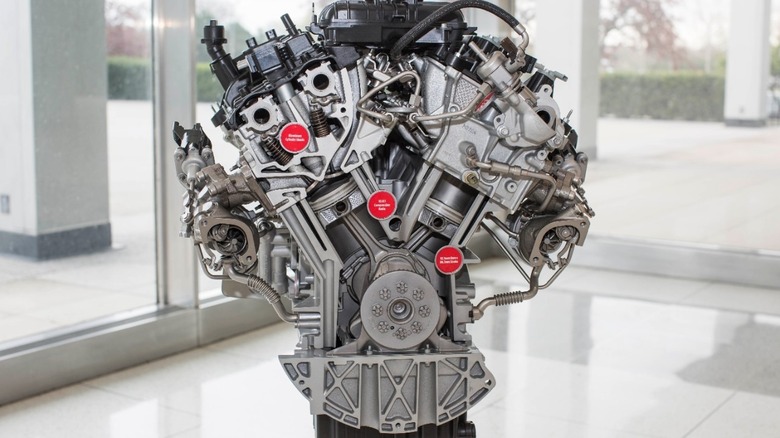
Ford and Toyota both offer hybrid power trains centered around the 3.5 EcoBoost and 3.5 i-Force engines. Under the PowerBoost name, Ford's offering generates 430 horsepower and 570 pound-feet of torque in the F-150 Hybrid, making it the most torque-rich version of the 3.5 EcoBoost V6. This engine can tow up to 11,200 pounds, and its maximum payload reaches 1,815 pounds.
Toyota's hybrid alternative is called the i-Force Max. It makes more power than Ford's unit at 437 horsepower and 583 pound-feet of torque. That also translates into slightly more towing capacity, reaching 11,450 pounds for the Tundra Hybrid. The Ford engine is more efficient, however, averaging up to 25 combined mpg according to EPA estimates.
As for their capacities, the Ford 3.5 EcoBoost is larger than the i-Force 3.5 liter V6. While Toyota markets its engine as a 3.5 liter, it is technically a 3.4 liter, as it has a displacement of 3,445 cc, which rounds down to 3.4 liters. The Ford 3.5-liter engine, by comparison, boasts a larger displacement of 3,496 cc, which instead rounds up to 3.5 liters.