

Why Pumping The Brakes During A Skid Is Outdated (And Dangerous) Advice

If you learned to drive a car before anti-lock brake systems (ABS) became common, or if you were taught to drive by someone that did, you've likely received driving advice such as, "pump your brakes to avoid locking them up and losing traction during a skid." While some cars were ahead of their time, ABS didn't become common in most vehicle trims until the 1990s. Without ABS, holding the brake pedal down once the tires lost traction kept them locked up with no chance of regaining control on a slippery surface. Gently pumping the brake allowed the tires an opportunity to regain traction between brake applications.
However, when performing an emergency stop in a vehicle equipped with ABS, you should apply firm pressure to the brake pedal continuously with your right foot until you've stopped or are ready to proceed. Contrary to the advice given for avoiding a skid in vehicles without ABS, pumping the brake pedal on an ABS-equipped vehicle can cause the system to disengage, increasing the stopping distance.
How ABS replaces the need to pump the brakes
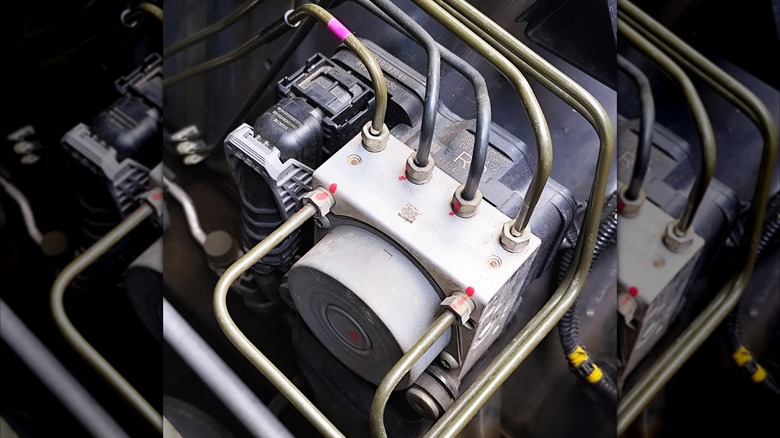
Modern cars combine ABS with traction control to make pumping the brake pedal an outdated and sometimes dangerous method of maintaining control during a skid. While traction control can be an annoying thing in some cars, when combined with ABS, it's proven to reduce the risk of accidents.
Anti-lock braking systems use sensors at each wheel to monitor tire speed. The vehicle's computer monitors the speed data supplied by the sensors, in addition to other inputs such as braking force and vehicle speed. The system activates when the brakes are applied and the wheel speed doesn't match the vehicle's speed. The rapid deceleration experienced just before the brakes lock up is counteracted by the system opening a valve to release brake line pressure to that wheel. If the brakes are still applied, the valve closes and a pump rapidly reapplies braking pressure. The process repeats until the danger of brake lockup has passed or the brake pedal is released.
In vehicles equipped with ABS, the system, in effect, pumps the brake pedal for you to prevent locking the brakes, but it does so much faster and more precisely than any human is capable of doing. You may feel the system vibrate through the brake pedal, and you may even hear it. However, it's important to recognize the sensation as a normal indication of the system working properly.