

Crash Data Reveals How Dangerous Riding A Motorcycle Can Be Compared To Driving A Car
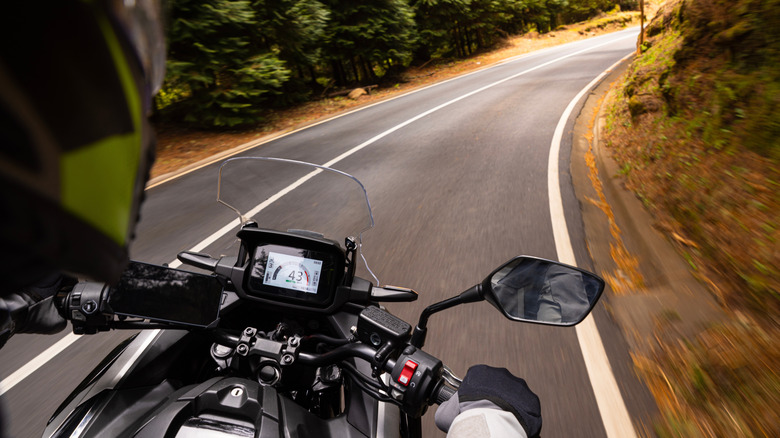
In 2023, we lost 6,335 people to motorcycle crashes. Though just a fraction of the vehicle population, motorcyclists represent an outsized number of traffic deaths on our roads. According to data published in October, 2025 by the National Highway Traffic Safety Administration (NHTSA), motorcycles in 2023 accounted for just 3.1% of all registered vehicles, and motorcyclists made up a whopping 15% of all traffic fatalities. Passenger vehicles and light trucks, in contrast, represented 92% of registrations and their occupants 59% of traffic fatalities.
The NHTSA in its motorcycle-specific report also breaks things down by vehicle miles traveled (VMT) for additional perspective: "Per 100 million VMT in 2023, the fatality rate for motorcyclists (31.39) was almost 28 times the passenger car occupant fatality rate (1.13) and nearly 48 times the fatality rate for light-truck occupants (0.66). The motorcyclist injury rate (409) was almost 5 times the injury rate of passenger car occupants (88) and 7 times the injury rate of light-truck occupants (56)."
We know cars are relative safety cages, and sitting on a bike leaves you exposed. But what factors and situations contribute most to the danger, and what can this data tell us about how drivers and motorcyclists alike can make the roads safer?
Comparative outcomes from common hazards
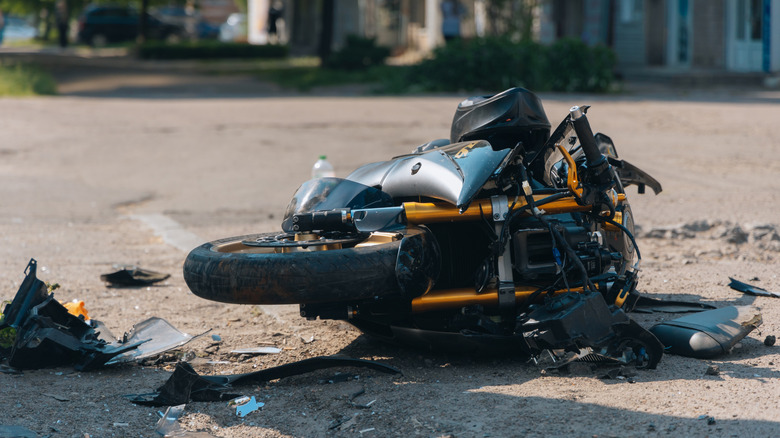
Without airbags and sheet metal that's designed to crumple around you, what happens when you crash your motorcycle is obviously different from crashing a car. Even if you're wearing an airbag system while riding, your body is prone to absorbing more direct impact, because you are subject to flying off the bike.
For perspective, the closest corollaries in passenger vehicle crashes are ejections and rollovers — two of the most statistically fatal crash outcomes. Being completely ejected from the vehicle resulted in 3,892 lives lost, or 13% of passenger car deaths and 20% of light truck fatalities. Rollovers accounted for 28% of passenger vehicle fatalities — a sadly similar number (6,596) as motorcycle deaths.
When you're doing something like speeding, the danger on a bike is amplified, as the NHTSA highlights in its report: 36% of the motorcyclists who died in a crash in 2023 were speeding, versus 22% of passenger car drivers who fatally wrecked while exceeding the speed limit.
That doesn't mean all riders speed, nor does it attribute fault. It also doesn't indicate if riders or drivers were behaving recklessly beyond speeding. However, for the sake of comparison, if speeding was the prime factor in a deadly crash, nearly 900 motorcyclists might have lived, had the collective speeding percentage dropped from 36% to passenger car levels.
In addition to slowing down, things like learning the 12-second rule could help make riding a motorcycle less dangerous, so riders can anticipate trouble further down the road — moving, or fixed. Hitting a non-vehicle fixed object — like a tree or barrier — led to nearly 25% of motorcycle fatalities, versus 16% for passenger cars.
When cars and motorcycles collide
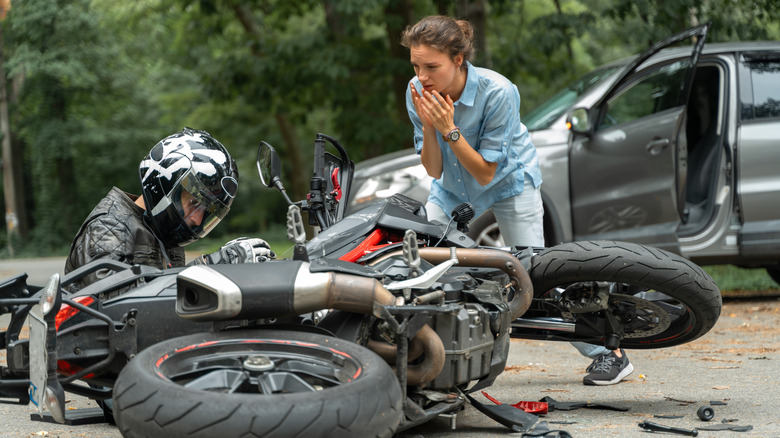
Collisions with other vehicles registered 60% of motorcycle fatalities. While car doors and oncoming traffic are everyday obstacles for riders, in nearly 50% of fatal two-vehicle crashes, motorcycles hit a car making a left turn. Left turns are a traffic menace in general, but that many deaths, resulting from a single type of traffic crash, is staggering.
Again, the data doesn't indicate whether the drivers or riders were at fault — nor does it get into things like lane splitting, or blind-spot lane-change wrecks. However, it suggests that perhaps, as drivers and riders, we can significantly improve these statistics by paying closer attention in just one type of everyday situation.
These NHTSA statistics don't exist in a vacuum. Even if every motorist became an ace rider or driver, motorcycles themselves would remain at a disadvantage, because, despite a number of available advances, current safety legislation doesn't seem to prioritize motorcycles as it does cars.
For example, all cars produced after September 1, 2011, have come with mandatory electronic stability control (ESC) and related anti-lock braking systems (ABS) to help avoid crashes. That's not the case for motorcycles in the United States as of this writing — despite the fact that the Insurance Institute for Highway Safety (IIHS) revealed that ABS-equipped motorcycles reduced fatal crashes by 22% over otherwise identical models.
Anyone interested in learning to ride, or better understand the relationship between cars and motorcycles on the road, may want to look into the Motorcycle Safety Foundation's training Basic Rider Course. Meanwhile, the NHTSA report is worth a look. It details statistics on everything from alcohol-related crashes and safety tips to state, weather, age group, time of week, helmet usage, and rural/urban data.