

How Reliable Is The 2nd Gen Nissan Leaf? Here's What Consumer Reports Says
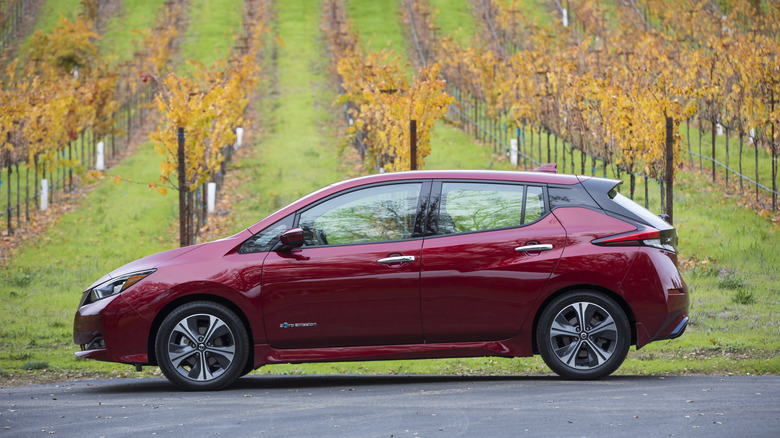
When we first saw the new third-generation Nissan Leaf, one thing immediately became clear: Despite its faults, it's light years better than before. On top of offering a full complement of high-tech safety features, it also gains a much more usable driving range. While the 2025 Leaf topped out with an anxiety-inducing range of 212 miles, the 2026 model can go up to 303 miles without charging.
What we don't know, however, is whether the 2026 Leaf — which was still being tested by Consumer Reports (CR) when this article was written — will be able to outdo its predecessor for reliability. It's certainly not a given, since the second-generation of the Leaf once had the highest reliability in its class. That was in 2022, when the Leaf significantly lowered its number of owner-reported trouble spots.
The second-gen Leaf found itself with excellent reliability scores for important parts of its power train, including the battery and electric motor. Moreover, CR considered both the Tesla Model 3 and Model S to be part of the Leaf's competitive set, and those models ended up with significantly lower rankings. On the other hand, the '22 Leaf was recalled four times, and owners did share complaints about leaks, exterior paint, and overall body hardware. Plus, the impressive reliability scores only account for one single year. The rest of the second-gen Leaf's production run tells a different story.
Second-gen Leaf reliability: The early years
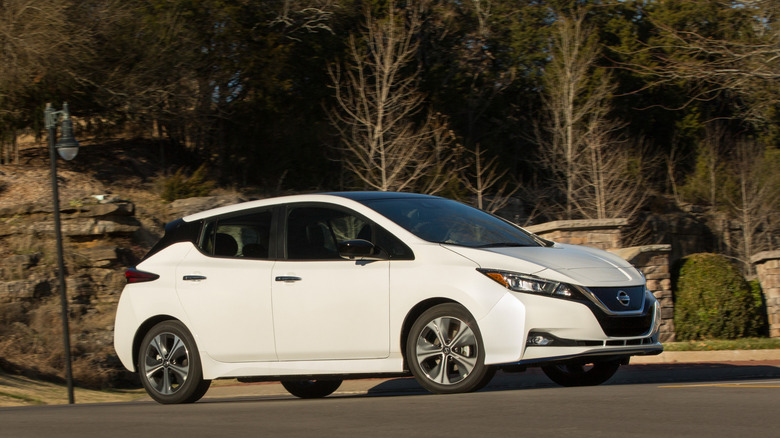
The second-generation Nissan Leaf was launched in 2018. Perhaps the most notable thing about it was its massive increase in range that more than doubled the EPA maximum of the original. True, that only got you 151 miles, but it's still more range than what you'd get from the current Fiat 500e, which showed why city cars are best as EVs. Unfortunately, this comprehensive redesign did come with some growing pains in the reliability department, at least as measured by Consumer Reports. The '18 Leaf had a slightly lower reliability score than the '17 model, driven at least partly by owner-reported issues with its EV battery. And both cars were rated as being less reliable than their rivals from the same model year.
Nissan added a larger optional battery pack for even more range in the 2019 Leaf Plus, which was reported to travel 226 miles before needing to recharge. It didn't help reliability much, however, as the battery was still causing plenty of problems for owners, leading to the car's overall CR reliability score slipping once again. The lowest point for reliability for the second-generation Leaf came in 2020. At that stage, its power train was facing the greatest number of overall issues, particularly with both the battery and the motor. By this stage, Consumer Reports said that even the long-range Leaf was "outclassed by other 'affordable' EVs, such as the Hyundai Kona Electric and Kia Niro EV."
Second-gen Leaf reliability makes a rebound
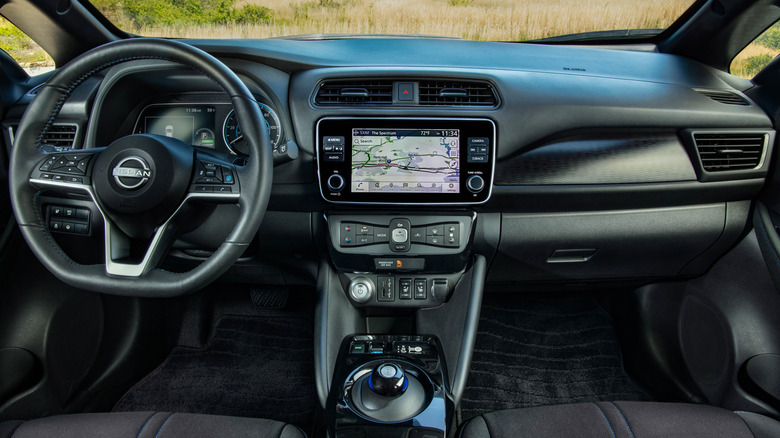
Despite entering the 2021 model year essentially unchanged, the Leaf enjoyed a huge jump with its CR reliability score. The result left it with average reliability compared to the industry at large, but that put the Leaf behind only the Hyundai Kona Electric and ahead of the aforementioned Kia Niro EV. By 2022, though, the Leaf's inability to compete with newer rivals was noticed even by Nissan itself, and the company resorted to cutting the car's price and boosting its content to keep it on customers' shopping lists.
But this was also the year of peak Leaf reliability. In fact, Nissan's compact EV was the only one in its class to receive an above-average rating. Additionally, every part of the Leaf's power train suddenly had perfect scores in terms of fewest owner-reported trouble spots. The second-generation models fell from that high mark for the 2023, 2024, and 2025 model years, but its reliability still remained about average during this time. For what it's worth, that third-gen Leaf — which is finally ready for the real world – is predicted to have average reliability as well.