

Why Mazda Built The Three-Rotor 20B Engine (And Used It Just Once)

Mazda made a splash in the market in 1990, launching the Eunos Cosmo with the three-rotor 20B engine. Compared with contemporary Wankel rotary engines, the 20B's extra rotor beefed the compact powerplant up and provided even more output. Specifically, this engine generated 276 horsepower (although some theorize it was much higher), and 296 pound-feet of torque, with the help of sequential twin-turbochargers. Sadly, it would be the only mass-production iteration of this interesting engine, as the Cosmo was discontinued in 1995, along with any future plans for the three-rotor 20B.
While the 20B engine was certainly a standout in the industry, the design also included some downsides that led Mazda to stop production. However, the Wankel engine did continue in two-rotor form up until 2012. Officially, Mazda CEO Masahiro Moro explained to Road & Track, the decision to end rotary production in 2012, "was to comply with stringent emissions regulations like LEV IV in the U.S., and Euro 7." This sheds some light on the reasons the 20B was scrapped, but there were a few other hiccups in its design. The first batch suffered failures that Mazda had to rebuild under warranty, while rotary engines generally guzzle fuel, rotary apex seals fail, and the engines require a careful maintenance, which makes them less ideal for a daily driver.
Why a rotary engine, and how do they work?
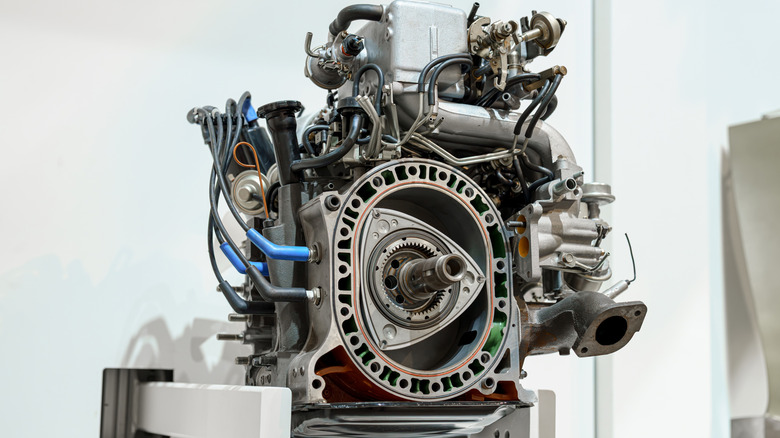
In an effort to differentiate itself from the competition, Japanese automaker Mazda decided to launch the unique three-rotor 20B motor. Wankel rotary engines weren't a new concept at the time, with inventor Felix Wankel conceptualizing the idea back in the 1920s, and eventually building the first iteration of his design in the late 1950s.
This type of powerplant doesn't use pistons, but instead utilizes three-pointed rotors with convex edges, which spin to perform all four strokes of a cycle within the voids of the oval housing during each revolution. Perhaps it's best to see this design in action to truly understand how it works, and fortunately, you can watch a Wankel rotary engine at work through a transparent housing in an eye-opening video.
The 20B was hardly the automaker's first foray into this kind of rotary engine, releasing its first back in 1967, and developing many other notable examples until the early 2010s. The 20B wasn't even Mazda's first three-rotor engine, with the 13G found under the hood of its race car, the Mazda 757, in the mid-to-late 1980s. Due to its success, engineers at the automaker wanted to develop a mass-production version, which is how the production 20B came to exist.
The 20B is still highly coveted for engine swaps
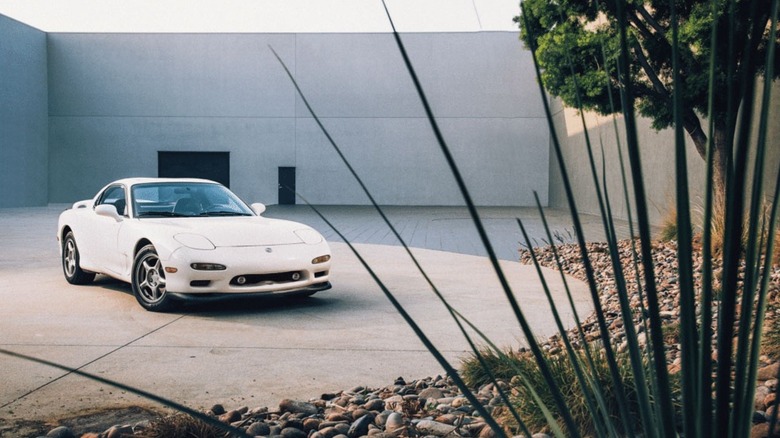
While Mazda's hugely popular RX-7 sports car did feature a rotary engine, it was only ever offered with two rotors. Naturally, to enthusiasts keen on correcting what some consider a massive missed opportunity, the idea of swapping in a three-rotor 20B was irresistible. After all, making that change along with some other upgrades could net you over 900 horsepower (770 whp), in an RX-7. Although, a rotary powered Mazda RX-7 successor is definitely 100% for sure coming this time, which is great news for fans continually disappointed by rumors that have failed to materialize.
Nevertheless, the issue with a 20B swap is that these engines are a challenge to find, especially for those in the U.S. The Eunos Cosmo was released in Japan only, so unless you can find one that's already made the journey state-side, you'll need to import it. You'll also need deep pockets, as age hasn't made these '90s cars any more affordable. Depending on mileage and other factors, you can expect to pay upwards of $50,000 for a Eunos Cosmo. For some, however, the money and hard work required for an RX-7 20B engine swap is all worth it. You can find owner's recounting their 20B swap stories online, some of which took more than a decade to complete.